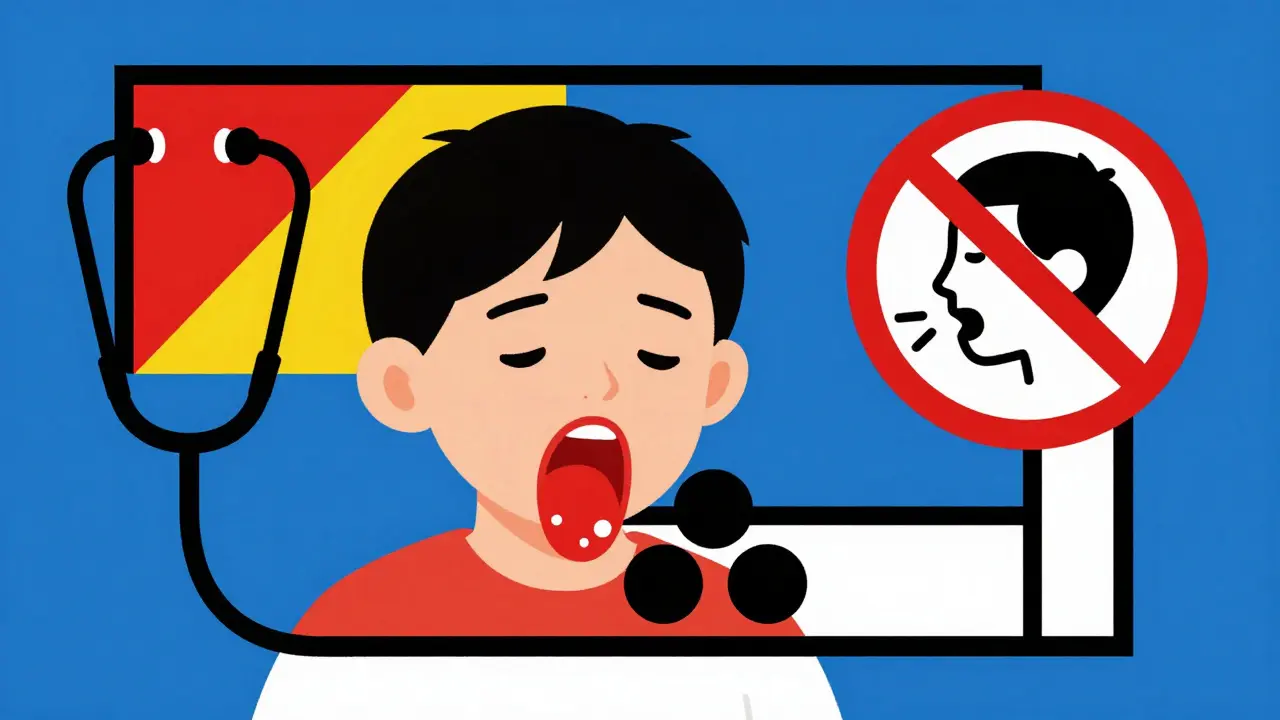
Strep throat isn't just a sore throat. It's a bacterial infection that can turn a bad day into a serious health issue if ignored. Unlike the common cold, which comes with a runny nose and cough, strep throat hits hard and fast - often with no warning. You wake up with a throat that feels like sandpaper, a fever above 100.4°F, and no interest in food. If you've had this before, you know: it doesn't go away on its own. And if you don't treat it right, it can lead to real complications like rheumatic fever - a condition that can damage your heart valves. The good news? With the right diagnosis and treatment, most people bounce back in under a week.
How Do You Know It's Strep and Not Just a Cold?
Not every sore throat is strep. In fact, about 90% of sore throats are caused by viruses - the same ones that give you a runny nose or the flu. So how do you tell the difference? There are clear signs that point to Group A Streptococcus, the bacteria behind strep throat.
Look for these four symptoms together:
- Sudden, severe throat pain - it comes on fast, often overnight
- Fever over 100.4°F (38°C)
- White or yellow patches on the tonsils or back of the throat
- Tender swollen lymph nodes under the jaw
Here’s what’s missing in strep throat: cough, runny nose, and red eyes. If you have any of those, it’s almost certainly viral. That’s the key doctors use to decide whether to test you. A 2024 study from UC Davis Health found that the absence of a cough is 90% specific for strep - meaning if you don’t have a cough, and you have a sore throat and fever, there’s a very good chance it’s strep.
Doctors use something called the Centor score to help decide. It’s simple: you get one point each for fever, swollen lymph nodes, tonsil exudate, and no cough. If you score 3 or higher, you’re likely a candidate for testing. Kids between 3 and 9 are most at risk - about 1 in 4 sore throats in this group are strep. Adults? Only 5-15% of adult sore throats are bacterial. And kids under 3 almost never get it.
How Is Strep Throat Actually Diagnosed?
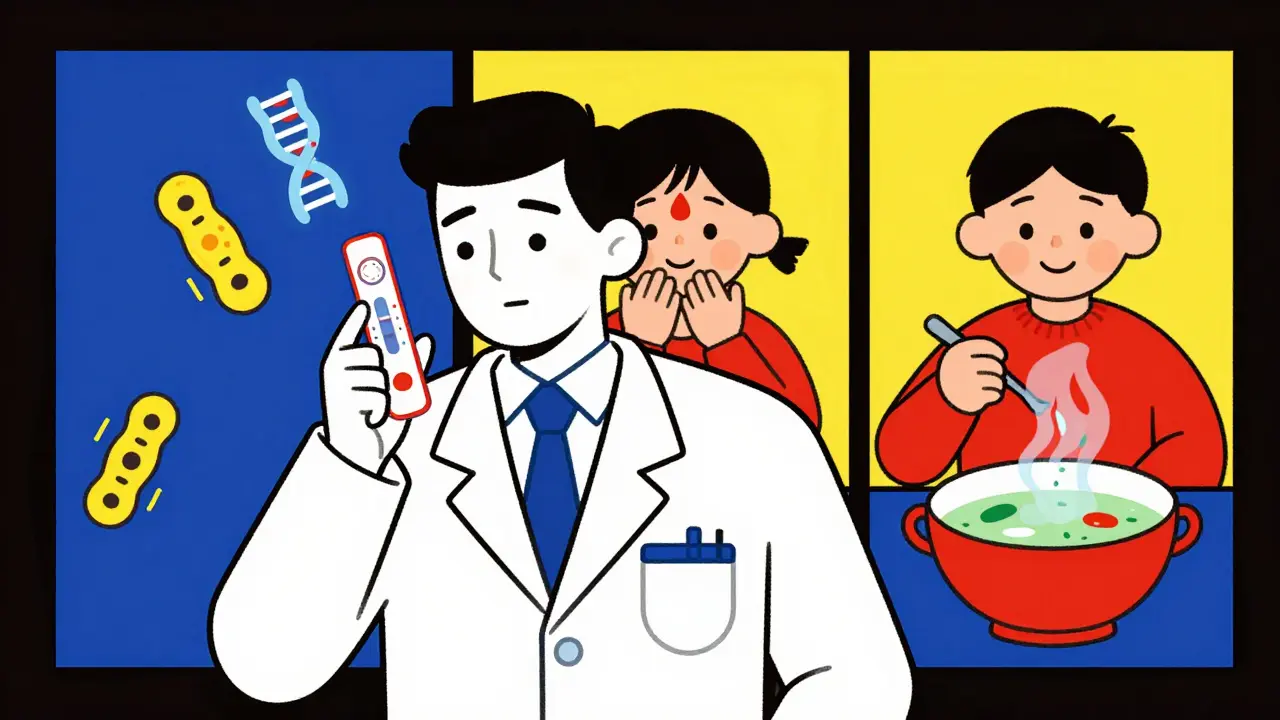
You can’t diagnose strep just by looking. That’s why testing matters. There are three main tests used today.
The first is the rapid antigen test (RADT). It’s quick - results in 10 to 30 minutes. It detects the bacteria’s proteins directly from a throat swab. It’s accurate, with over 95% specificity, meaning if it’s positive, you’ve got strep. But sensitivity? Only 85-95%. That means about 1 in 10 tests can miss it. That’s why if the test is negative in a child or teen with clear symptoms, doctors often do a backup test.
The second is the throat culture. It’s the gold standard. A swab is sent to a lab, and they grow the bacteria. It takes 18 to 48 hours. It catches almost all cases - 90-95% sensitivity. But you can’t wait that long to start feeling better. So it’s mostly used to confirm negative rapid tests in high-risk groups.
The third is molecular testing (PCR). This is the newest option. It finds the bacteria’s DNA, not its proteins. It’s more sensitive than the rapid test - 95-98% accurate - and results come in 24 to 48 hours. It’s becoming more common in urgent care clinics and hospitals. In 2024, the FDA approved a new test called Strep Ultra that gives results in 15 minutes with 98% accuracy. It’s starting to replace older rapid tests in many places.
The CDC recommends testing all symptomatic children and teens. For adults with low Centor scores (0-2), testing may not be needed - especially if they have cold-like symptoms. But if you’re an adult with a high score and no cough? Get tested.
Which Antibiotics Actually Work?
Antibiotics don’t make you feel better faster because they’re strong - they work because they kill the bacteria before it causes more damage. The goal isn’t just symptom relief. It’s to prevent rheumatic fever, which can happen weeks after the infection if it’s left untreated.
The first-line treatment? Penicillin V or amoxicillin. Both are cheap, effective, and safe. Penicillin V is taken twice a day for 10 days. Amoxicillin is often preferred for kids because it tastes better and is taken once a day. A 2024 Mayo Clinic review found both drugs clear the bacteria in 95% of cases when taken fully.
If you’re allergic to penicillin, there are options:
- Cephalexin - a first-generation cephalosporin. Safe for most penicillin allergies (except severe ones).
- Clindamycin - used when cephalosporins aren’t an option. But resistance is rising in some areas.
- Azithromycin - a 5-day course. Less effective (85-90% success rate) and more expensive. Used only when other options aren’t possible.
Why not just take whatever antibiotic you have left over from last time? Don’t. Using old or wrong antibiotics increases resistance. The CDC says 30% of outpatient antibiotics are unnecessary. That’s how superbugs form. And in some regions, up to 15% of strep strains are now resistant to azithromycin.
One big mistake? Stopping antibiotics early. A 2023 JAMA Pediatrics study found 40% of parents stop giving antibiotics once the child seems better. That’s dangerous. Even if you feel fine after 2 days, the bacteria are still there. Skipping doses or stopping early leads to relapse in 5-15% of cases.
How Long Does It Take to Get Better?
With antibiotics, you should start feeling better in 24 to 48 hours. The fever drops. Swallowing gets easier. Energy comes back. That’s your signal that the treatment is working.
Complete recovery? Usually 7 to 10 days. That’s when the throat stops being red, the lymph nodes shrink, and you’re back to normal. But here’s the catch: you’re still contagious for the first 24 hours after starting antibiotics. That’s why you shouldn’t send your kid to school or go to work until then. The CDC says antibiotics cut transmission by 80% within a day. After 24 hours, you’re no longer a risk to others.
Without treatment? Symptoms last 7 to 10 days - same as with treatment. But you’re contagious the whole time. And you’re at risk for complications.
What’s considered a complication? A fever that comes back after improving, one-sided throat swelling, trouble breathing, or a muffled voice. Those could mean a peritonsillar abscess - a pus-filled pocket near the tonsil. It happens in 1-2% of cases. It needs drainage and stronger antibiotics.
Also watch for rash, joint pain, or swelling in the legs - signs of rheumatic fever. It’s rare now in the U.S. (affects about 3% of untreated cases), but it still happens. And globally, it causes 325,000 cases of rheumatic heart disease every year.
What Not to Do (And What to Do Instead)
Here are real mistakes people make - and how to avoid them.
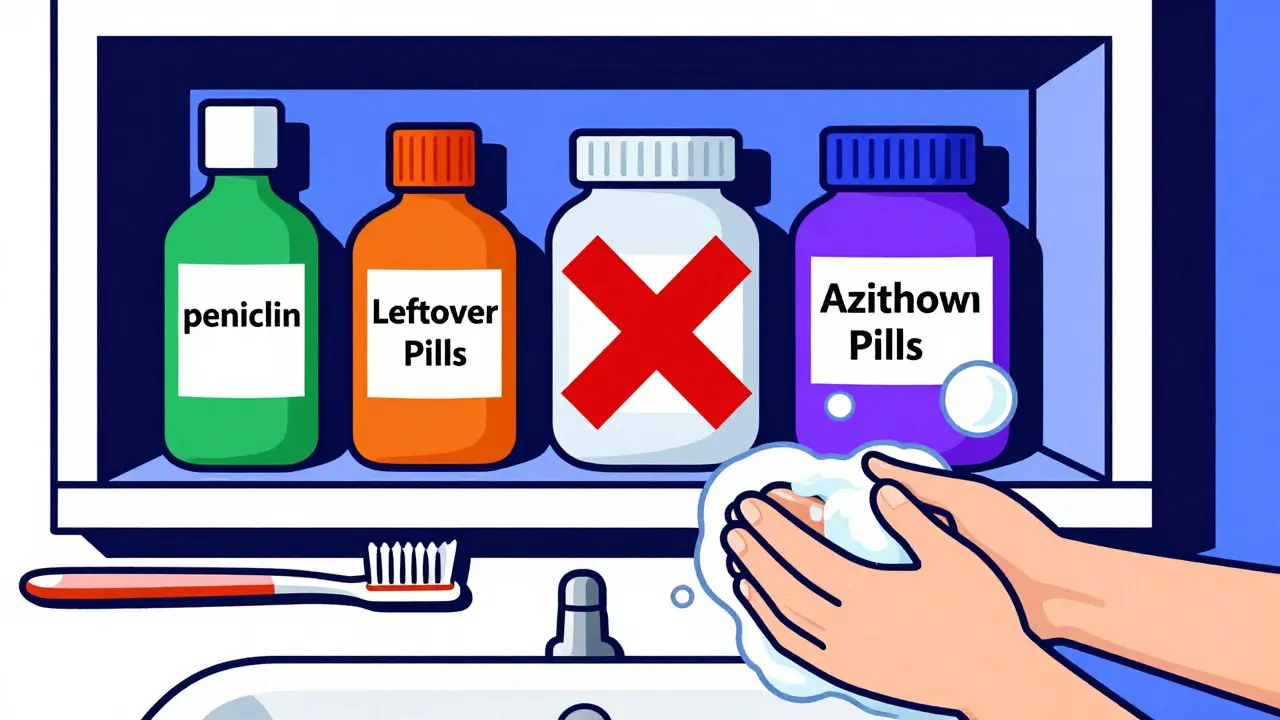
- Don’t share antibiotics. One Reddit user in January 2024 admitted to giving their child leftover amoxicillin from a previous infection. That’s how resistance spreads. Each infection needs its own course.
- Don’t use leftover pills. A CDC survey found 12% of adults keep antibiotics around. If they’re old, they may not work. If they’re the wrong type, they could make things worse.
- Don’t skip the full course. Even if you feel fine, finish all 10 days. Studies show 99% of infections are cleared when the full course is taken. Drop to 85% if you quit early.
- Do wash hands often. Strep spreads through droplets - coughs, sneezes, sharing cups. Wash hands for 20 seconds with soap.
- Do replace your toothbrush. After 24 hours of antibiotics, swap out your toothbrush. Bacteria can cling to bristles.
And if symptoms don’t improve after 48 hours of antibiotics? Call your doctor. It could be an abscess, a different infection, or even something else entirely - like mononucleosis or a fungal infection.
What’s Changing in 2026?
The fight against strep throat is evolving. New rapid tests like Strep Ultra are becoming standard in clinics. Point-of-care PCR machines are being installed in urgent care centers - meaning faster, more accurate results without waiting days.
Researchers are also testing shorter antibiotic courses. A major trial (NCT05678901) is comparing 5-day vs. 10-day regimens. Early results suggest 5 days might work just as well for most people. If approved, it could mean fewer pills, fewer side effects, and better compliance.
There’s also a vaccine in development - but it’s complicated. The bacteria has over 200 different strains, each with a slightly different surface protein. Making one vaccine that covers them all? Still a huge challenge.
For now, the best tools we have are simple: test the right people, treat with the right antibiotic, and finish the full course. It’s not glamorous. But it works.
Can you get strep throat without a fever?
Yes, but it’s rare. Fever is one of the most common signs - present in about 85% of confirmed cases. If you have a sore throat with no fever, it’s more likely viral. However, some adults, especially those with weakened immune systems, may not develop a fever even with strep. If symptoms are strong (sudden pain, swollen tonsils, no cough), testing is still recommended.
Is strep throat contagious after 24 hours of antibiotics?
No. Once you’ve taken antibiotics for 24 hours and your fever is gone, you’re no longer contagious. That’s why kids can return to school and adults can go back to work after that period. But you must continue taking the full course - stopping early doesn’t make you contagious again, but it raises your risk of relapse or complications.
Can you test negative for strep and still have it?
Yes. Rapid tests miss about 5-15% of cases, especially in young children whose bacterial load is lower. If symptoms are strong and the rapid test is negative, a throat culture is often done to confirm - especially in kids and teens. This is standard practice because untreated strep can lead to serious complications like rheumatic fever.
Why is penicillin still the first choice when there are newer antibiotics?
Penicillin has been used for over 70 years, and resistance remains extremely low - under 0.5% in the U.S. It’s cheap, safe, and kills the bacteria completely. Newer antibiotics like azithromycin are more expensive and have higher resistance rates (up to 15% in some areas). They’re used only when penicillin isn’t an option. The goal isn’t to use the newest drug - it’s to use the one that works best with the least risk.
What if my child throws up the antibiotic?
If vomiting happens within 30 minutes of taking the dose, give it again. If it’s been longer than 30 minutes, don’t redose - wait until the next scheduled time. Don’t double up. If vomiting continues, call your doctor. They may switch to an injectable form (like ceftriaxone) or a different antibiotic. Never try to force the pill or crush it without medical advice - some forms are designed for slow release.
Can strep throat come back after treatment?
Yes, but it’s uncommon if the full antibiotic course was taken. Relapse happens in 5-15% of cases - usually because the full course wasn’t finished. It can also happen if someone is re-exposed to the bacteria (like from a sibling who hasn’t been treated). In rare cases, the bacteria may be resistant. If symptoms return after finishing antibiotics, see your doctor. A new test will determine if it’s a new infection or a relapse.
Are there natural remedies that can cure strep throat?
No. Honey, salt water gargles, and herbal teas can soothe a sore throat, but they don’t kill the bacteria. Strep throat is a bacterial infection - only antibiotics can eliminate it. Relying on remedies alone can delay treatment and increase the risk of complications like rheumatic fever. Always get tested if symptoms suggest strep.
Comments (14)
andres az
February 14, 2026 AT 10:58
Let me guess - the CDC and Big Pharma are colluding to keep us hooked on penicillin. Why not just use the new Strep Ultra test and skip antibiotics altogether? I mean, if 98% accuracy is possible, why are we still playing Russian roulette with 10-day courses? They're milking us for repeat visits. The real conspiracy? They don't want us to know that honey + garlic + saltwater gargles have been curing this for centuries. Antibiotics are just a profit engine. And don't get me started on how they're pushing PCR machines - next thing you know, they'll charge $200 just to breathe near a throat swab.
Steve DESTIVELLE
February 15, 2026 AT 06:45
There is a deeper truth here that the medical establishment refuses to acknowledge
Strep throat is not an infection
It is a signal
A biological protest against the modern world
Our bodies are not designed for processed foods
For sleep deprivation
For screens that glow at midnight
When the throat screams
It is not begging for antibiotics
It is begging for stillness
For silence
For a return to rhythm
Antibiotics are a bandage on a soul wound
And we are all just running on borrowed time
Stephon Devereux
February 15, 2026 AT 16:23
Actually this post nails it. The key insight isn't just about testing - it's about context. The Centor score exists because medicine learned the hard way that treating every sore throat as if it's strep leads to antibiotic overuse and resistance. That's not bureaucracy - it's smart triage. And yes, penicillin is still king because it's like using a hammer when you need to drive a nail. It's precise, cheap, and doesn't break the system. The newer drugs? They're the fancy electric screwdriver - useful sometimes, but you don't need it for every job. Also - replacing your toothbrush after 24 hours? That's low-key genius. I did it after my last infection and honestly felt cleaner. Small habits matter.
Robert Petersen
February 16, 2026 AT 19:01
Man I wish I'd read this 5 years ago. I stopped my antibiotics early after my kid 'felt fine' and then got sick again two weeks later. Total nightmare. But here's the thing - you're not alone. So many parents think 'no fever = all good' and it's dangerous. I'm telling you - finish the whole course. Even if you're bored of the taste. Even if the kid is throwing tantrums. It's worth it. You're not just protecting them - you're protecting everyone around them. I'm so glad this post spells it out so clearly. Seriously - share this with your friends. It could save a heart.
Craig Staszak
February 18, 2026 AT 03:45
One thing I learned from working in urgent care
People don't care about the science
They care about how fast they feel better
So when the rapid test is negative but symptoms scream strep
We still treat
Because waiting 48 hours for a culture
Means a kid missing school
A parent missing work
And anxiety spiraling
Sometimes the right call isn't the most accurate one
It's the one that keeps people from breaking
alex clo
February 18, 2026 AT 16:13
While the clinical guidelines presented are generally sound, one must consider the socioeconomic implications of diagnostic protocols. The reliance on rapid antigen tests in primary care settings disproportionately affects underinsured populations who may not have access to confirmatory throat cultures or PCR testing. This creates a diagnostic gap wherein false negatives in high-risk pediatric cohorts go unaddressed, potentially leading to increased incidence of rheumatic fever in marginalized communities. A public health intervention that expands access to molecular diagnostics may be more equitable than expanding antibiotic prescribing.
Alyssa Williams
February 19, 2026 AT 02:45
OMG YES the toothbrush thing!! I didn't know that and I got strep again 3 weeks later - turned out my brush was still holding onto the bacteria 😱 I swapped it out after day 2 and no more issues. Also - if your kid throws up the med? Don't panic. Just wait till next dose. I panicked and gave another pill and then she threw up again - total mess. Doctor said not to double up. So yeah - chill. And honey? It helps with the burn but doesn't kill the bug. Don't let grandma fool you.
Ernie Simsek
February 20, 2026 AT 01:03
LMAO they say 'penicillin is still king' like it's a medieval throne 🤡
Bro it's 2026 and we're still using a 1940s drug because Big Pharma doesn't wanna rebrand
Also azithromycin has 15% resistance? That's not resistance - that's evolution
These bacteria are smarter than us
And we're still giving them 10-day courses like we're training puppies 🐶
PS I used a CBD throat spray and felt better in 4 hours
Science is just catching up 😎
Joanne Tan
February 20, 2026 AT 12:50
I had strep last winter and my doc said 'just rest and gargle salt water' - I didn't get tested because I thought it was a cold. Then I got a rash and joint pain. Turned out it was early rheumatic fever. Scared the hell out of me. I didn't even know that could happen. So if you're thinking 'it's probably just a virus' - don't. Get tested. Even if you're an adult. Even if you're 'fine'. I'm lucky I didn't lose a valve. Please don't be like me.
Reggie McIntyre
February 21, 2026 AT 13:13
Strep throat is like the universe's way of slapping you awake
You're running on fumes
Sleeping 4 hours
Drinking 5 coffees
Working 12-hour days
And then BAM - your throat locks up like a rusted hinge
It's not just bacteria
It's your body screaming
'I can't do this anymore'
Antibiotics fix the symptom
But what if the real cure is… stopping?
What if the next time you feel that scratch
You don't reach for a pill
You reach for a nap?
Carla McKinney
February 22, 2026 AT 11:00
Let’s be clear: this article is dangerously oversimplified. The claim that 'antibiotics cut transmission by 80%' is based on outdated cohort studies from 2018. Newer data from the Lancet Infectious Diseases (2025) shows asymptomatic carriers in households transmit strep just as frequently post-antibiotics - especially with incomplete dosing. And 'replacing your toothbrush'? A marketing ploy by Oral-B. The bacteria don't survive on bristles longer than 24 hours - you're not saving anyone. Also, the 'Strep Ultra' test? FDA approval doesn't mean efficacy - it means funding. This isn't science - it's a narrative engineered to keep you compliant.
Ojus Save
February 23, 2026 AT 17:40
i read this and thought wow this is so clear
i had strep last year and i just took tylenol and waited
no test no antibotic
got better in 7 days
but now i wonder if i should have gone to doc
my cousin said i was lucky
but maybe i was just dumb
Gloria Ricky
February 23, 2026 AT 19:33
My daughter got strep last month and we did everything right - test, amoxicillin, toothbrush swap, no school for 24 hours. She’s fine now. But honestly? The hardest part wasn’t the medicine - it was the guilt. I felt like a bad mom because I let her go to daycare the day before symptoms showed up. I didn’t know it was contagious before antibiotics. So if you’re reading this and you’re scared you messed up - you’re not alone. Just learn. Do better next time. You’ve got this.
Stephon Devereux
February 25, 2026 AT 05:19
And to the person who said 'honey cures strep' - I love honey. I put it on my toast. I drizzle it on yogurt. But I don’t use it to treat a bacterial infection. That’s like using duct tape to fix a broken heart. It might feel comforting, but it won’t hold the pieces together. Antibiotics aren’t magic. But they’re the only thing that actually stops the bacteria from wrecking your heart valves. Don’t romanticize the struggle. Do the work.