Antidepressant Sexual Side Effects Comparison Tool
Understanding Your Options
This tool helps you compare sexual side effect risks of common antidepressants and identify alternatives with fewer sexual side effects.
When you start taking an antidepressant, you’re hoping to feel better-less anxious, less numb, more like yourself. But for many people, the relief comes with an unexpected cost: sexual side effects. Loss of desire, trouble getting or keeping an erection, delayed or absent orgasm, dryness, or just plain disinterest in sex. These aren’t rare quirks. They’re common, often debilitating, and rarely discussed openly-even with doctors.
Studies show between 35% and 70% of people on antidepressants experience some form of sexual dysfunction. For some, it’s mild. For others, it’s enough to end relationships, stop taking medication, or feel like they’ve lost a core part of who they are. The truth? You’re not broken. You’re not alone. And there are real, science-backed ways to fix this without giving up your mental health progress.
Why Do Antidepressants Kill Your Sex Drive?
The answer lies in serotonin. Antidepressants like SSRIs (Prozac, Zoloft, Paxil) and SNRIs (Effexor) work by increasing serotonin in the brain. That helps stabilize mood. But serotonin doesn’t just affect emotions-it shuts down the pathways that control arousal, pleasure, and orgasm.
Think of it like turning down a volume knob. Dopamine and norepinephrine, the chemicals that drive sexual response, get drowned out. In men, this leads to lower libido, erectile issues, and delayed ejaculation. In women, it’s often reduced lubrication, anorgasmia, and lack of desire. The numbers don’t lie: 64% of men on SSRIs report low libido; 52% of women report reduced lubrication. These aren’t side effects you can just "get used to." They’re neurochemical roadblocks.
And here’s the catch: depression itself causes sexual problems. About 35-50% of people with untreated depression already have low libido or arousal issues. So when you start feeling better emotionally but your sex life stays broken, it’s hard to tell what’s the illness and what’s the medicine.
Not All Antidepressants Are Created Equal
Some antidepressants are far worse than others when it comes to sex. Paroxetine (Paxil) is the worst offender. Studies show it causes sexual dysfunction in nearly 1 in 2 people. Sertraline (Zoloft) and citalopram (Celexa) are close behind. Fluoxetine (Prozac) has a longer half-life, so side effects can linger longer after stopping.
But not all are the same. Bupropion (Wellbutrin) is the exception. Multiple trials show it causes significantly fewer sexual side effects-sometimes half as many as SSRIs. In one study, 68% of people who switched from an SSRI to bupropion saw improvement in their sex life. That’s not a coincidence. Bupropion works on dopamine and norepinephrine, not serotonin. It doesn’t turn down the volume-it keeps it on.
Other options include mirtazapine (Remeron), which has a neutral or even positive effect on libido in many users, and agomelatine (Valdoxan), used in Europe, which shows minimal sexual side effects. Nefazodone (Serzone) was also better than SSRIs-but it was pulled from the U.S. market due to rare liver damage risk. So it’s not an option anymore.
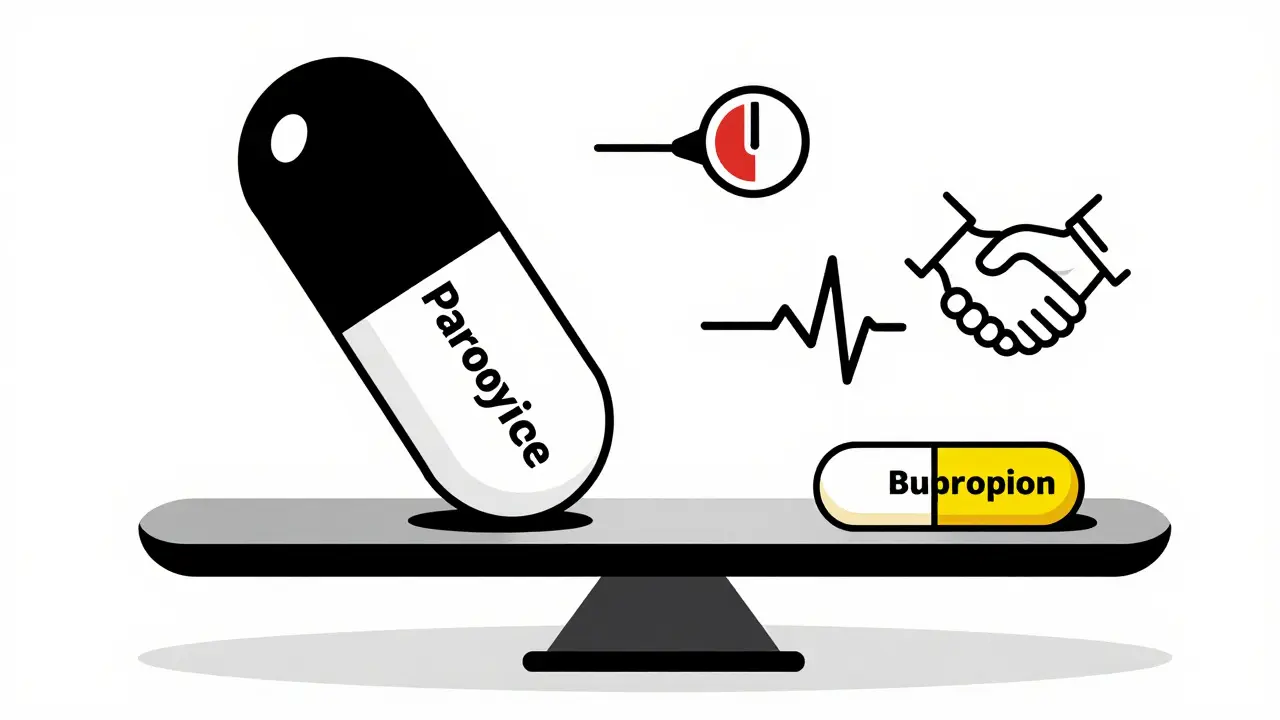
If you’re on paroxetine or sertraline and struggling with sex, switching isn’t a sign of failure. It’s a smart adjustment. The number needed to harm (NNH) for sexual dysfunction with paroxetine is just 2-4. That means for every 2-4 people taking it, one will experience sexual side effects. Switch to bupropion? The NNH drops to 17. That’s a massive difference.
What to Do If You’re Already on an SSRI
You don’t have to quit your antidepressant to fix your sex life. There are proven strategies that work-without throwing your mental health out the window.
1. Switch to a lower-risk antidepressant
This is the most effective solution. Bupropion is the gold standard here. A 2019 trial in the Journal of Clinical Psychiatry found that adding 150mg of bupropion to an SSRI improved sexual function in 58% of women. Some doctors prescribe it as a standalone. Others use it as an add-on. Either way, it’s one of the few treatments with solid evidence.
Switching isn’t instant. You need a cross-taper: slowly reduce the SSRI while adding the new drug. This takes 2-4 weeks. Don’t quit cold turkey-especially with paroxetine. Its short half-life can trigger withdrawal symptoms like dizziness, nausea, and brain zaps.
2. Add a medication to fix the side effect
For men with erectile problems, sildenafil (Viagra) works. In trials, 65-70% of men on SSRIs saw improvement with 50mg of sildenafil before sex. Placebo? Only 25%. Tadalafil (Cialis) works too. For women, flibanserin (Addyi) is approved for low libido-but it’s expensive, has side effects, and doesn’t work for everyone. A simpler option? Topical testosterone cream (off-label), which some doctors prescribe for women with low desire.
For anorgasmia (inability to climax), cyproheptadine (4mg at night) has shown promise. A 2021 study found 52% of people on SSRIs regained orgasm ability after taking it, compared to 18% on placebo. It’s an old antihistamine, cheap, and generally safe.
3. Try a drug holiday
This means skipping your pill on weekends or before planned intimacy. Works best with longer-acting SSRIs like fluoxetine. Not recommended for paroxetine or sertraline-their short half-lives make withdrawal symptoms likely. Always do this under your doctor’s supervision. Relapse risk is real.
4. Lower your dose
Some people find that cutting their SSRI dose in half reduces sexual side effects without losing mood benefits. This works in 20-30% of cases. But don’t do it on your own. Too low, and your depression comes back.

The Real Cost of Ignoring Sexual Side Effects
People don’t talk about this, but it’s one of the top reasons people quit antidepressants. GoodRx data shows 23% of people stop SSRIs within 90 days because of sexual side effects. Women are 1.7 times more likely to quit for this reason than men.
On Reddit’s r/antidepressants, 78% of people who posted about sexual side effects said it damaged their relationships. Some couples broke up. Others stopped being intimate altogether. One woman wrote: "I love my husband, but I haven’t felt like having sex in 18 months. I don’t know if I’m depressed or just medicated. Either way, I feel dead inside."
And here’s the scary part: side effects rarely go away on their own. Only 18% of users on Drugs.com reported improvement after six months. That’s far lower than the 30-40% seen in clinical trials. Why? Because trials use structured assessments. Real life? People just suffer in silence.
Then there’s PSSD-post-SSRI sexual dysfunction. It’s rare, but real. About 0.5-1.2% of people report persistent sexual problems-loss of arousal, numb genitals, lack of orgasm-even after stopping the drug for months or years. Over 28 case reports have been published since 2010. It’s not common, but it’s enough to make you think twice before starting an SSRI without a plan.
What’s New? Emerging Alternatives
There’s hope on the horizon. Esketamine (Spravato), the nasal spray approved for treatment-resistant depression in 2019, has only a 3.2% rate of sexual side effects in trials. That’s almost none. But it costs $880 per dose, requires clinic visits, and carries risks of dissociation and elevated blood pressure. It’s not a first-line fix-but for someone who’s tried everything else, it’s a lifeline.
Researchers are also testing new drugs like SEP-227162, a serotonin receptor modulator. In early trials, it caused 87% fewer sexual side effects than sertraline. It’s still in Phase II, but if it works, it could be the first antidepressant that doesn’t wreck your sex life.
Another emerging tool? Pharmacogenomic testing. Some people are poor metabolizers of certain drugs because of their genes. If you’re a CYP2D6 poor metabolizer, paroxetine builds up in your system. That means higher doses = worse side effects. A simple saliva test can tell you if you’re at risk. It’s not routine yet-but more clinics are starting to offer it.
What You Should Do Right Now
If you’re on an antidepressant and your sex life has changed:
- Don’t stop cold turkey. Talk to your doctor.
- Ask about switching to bupropion. It’s cheap, effective, and has the best track record for preserving sexual function.
- If you can’t switch, ask about adding bupropion (150mg daily) or sildenafil (for men) or cyproheptadine (for anorgasmia).
- Request a sexual function screening. The Arizona Sexual Experience Scale (ASEX) is quick, validated, and used by psychiatrists to track changes.
- Track your symptoms. Note when they started, how bad they are, and if they improve with time.
Cost isn’t a barrier. Generic bupropion XL 150mg costs $15.72 a month. Brand-name Zoloft? $57.84. Switching saves money and improves quality of life.
And if your doctor dismisses your concerns? Find a new one. Sexual health matters. Your mental health shouldn’t come at the cost of your intimacy, your relationships, or your sense of self.
It’s Not Just About Sex
Sexual side effects aren’t just about pleasure. They’re about connection. About feeling alive. About being whole. When you lose that, you lose part of your identity. And that can undo the progress you made fighting depression.
You deserve to feel better-not just emotionally, but physically, intimately, fully. There are options. They’re not perfect. But they’re real. And they work.
Ask the right questions. Push for better answers. You’re not asking for too much. You’re asking for what you need to truly heal.
Do all antidepressants cause sexual side effects?
No. While SSRIs and SNRIs like sertraline, paroxetine, and venlafaxine have high rates of sexual side effects, others like bupropion (Wellbutrin), mirtazapine (Remeron), and agomelatine (Valdoxan) have much lower or even neutral effects. Bupropion is especially known for causing fewer sexual problems and is often used as a switch option.
How long do sexual side effects last after stopping antidepressants?
For most people, sexual function returns within weeks to months after stopping. But a small percentage-about 0.5-1.2%-experience Post-SSRI Sexual Dysfunction (PSSD), where symptoms persist for months or even years after discontinuation. This is rare but well-documented in medical literature. If symptoms don’t improve after 3-6 months, consult a specialist.
Can I take Viagra with my SSRI?
Yes, sildenafil (Viagra) is safe and effective for men experiencing erectile dysfunction from SSRIs. Clinical trials show 65-70% of men improve with 50mg taken 30-60 minutes before sex. No dangerous interactions have been found. Always start with the lowest dose and monitor for side effects like headaches or dizziness.
Is bupropion as effective as SSRIs for depression?
Bupropion is just as effective as SSRIs for treating depression in most cases, especially for symptoms like low energy and lack of motivation. It’s less effective for severe anxiety or obsessive thoughts, where SSRIs may have an edge. But for many, the trade-off-better mood without sexual side effects-is worth it.
Why don’t doctors talk about this more?
Many doctors assume patients won’t bring it up, or they think it’s a minor issue compared to depression. But research shows sexual side effects are a leading cause of medication non-adherence. The American Psychiatric Association now recommends routine sexual function screening at the start of treatment and during follow-ups. If your doctor doesn’t ask, bring it up yourself.
Comments (11)
Michael Burgess
January 2, 2026 AT 10:31
Man, I was on Zoloft for two years and thought my sex life was just... gone. Like, permanently. Switched to Wellbutrin and it was like waking up from a coma. Not just the sex - I felt alive again. Like I could laugh without forcing it. Seriously, if you're on an SSRI and your libido's MIA, don't wait. Talk to your doc. Bupropion is cheaper than your monthly coffee habit.
Kerry Howarth
January 4, 2026 AT 02:31
Good post. Bupropion is the go-to for a reason. Evidence-based, low side effect profile, and it doesn't turn your brain to mush. Also, don't skip the ASEX scale - it's the only way to track progress objectively.
Brittany Wallace
January 4, 2026 AT 23:16
It’s wild how we’ve normalized suffering in silence just because it’s "mental health." 🤔 We’ll take a pill to fix sadness but act like losing your ability to feel pleasure is just "part of the deal." We’re not machines. We’re not supposed to feel numb - even if it’s "for a good reason." Love that you included PSSD. It’s rare, but it’s real. And if we keep pretending it doesn’t exist, people will keep getting hurt. 💙
Haley Parizo
January 4, 2026 AT 23:49
Of course the system ignores this. Pharma doesn’t make money off bupropion - it’s generic. And Viagra? That’s a cash cow. They’ll push you to stay on the SSRI, then sell you a $50 pill to fix what the SSRI broke. Capitalism in a pill bottle. 🤬
Philip Leth
January 5, 2026 AT 13:14
Been there. Took Celexa for anxiety. Lost all interest in sex. Girlfriend left. Didn’t even blame her. I was a ghost. Switched to Wellbutrin. Three weeks later, I kissed someone for the first time in 14 months. Didn’t feel like a robot anymore. This post? Lifesaver.
Angela Goree
January 7, 2026 AT 00:04
STOP. Just STOP. You're telling people to just "switch meds" like it's changing a Netflix subscription? What about the withdrawal? The brain zaps? The relapse? And then you say "find a new doctor" like they're all incompetent? I’ve seen people quit cold turkey and end up in the ER. This is dangerous advice wrapped in a pretty bow.
Shanahan Crowell
January 7, 2026 AT 18:54
Don’t let fear silence you. If your doctor shrugs, find someone who cares. Your sex life isn’t a bonus feature - it’s part of being human. And you deserve to feel whole. I’ve seen people come back from this. Not just surviving - thriving. You got this. 💪
Shruti Badhwar
January 8, 2026 AT 08:05
The data presented here is methodologically sound, particularly the NNH comparisons and the inclusion of pharmacogenomic considerations. However, the omission of cultural variables - such as stigma in collectivist societies like India, where sexual health is rarely discussed - limits generalizability. In many non-Western contexts, even acknowledging sexual dysfunction is taboo, making medical intervention less likely regardless of efficacy. Further research should integrate cross-cultural psychopharmacology.
Joy F
January 8, 2026 AT 15:22
Okay but let’s be real - this whole thing is a symptom of the medical-industrial complex. They sell you a serotonin hammer because it’s patentable. Then they sell you Viagra because the hammer broke your libido. Then they sell you Addyi because you’re a woman and they need another revenue stream. And meanwhile, the real solution - therapy, lifestyle, trauma work - is buried under 17 pages of drug names and clinical trials. We’ve turned intimacy into a pharmacological problem. 🤡
JUNE OHM
January 9, 2026 AT 14:35
They’re lying. SSRIs are just a government mind-control tool. The FDA knows this. They don’t want you to have a sex drive because then you’ll be too busy living to vote. That’s why they push Paxil - it makes you docile. And now they’re pushing esketamine because it’s even more expensive and keeps you hooked. Wake up. This isn’t medicine. It’s control.
Tiffany Channell
January 11, 2026 AT 09:53
Wow. So you’re telling me the solution to depression is just... having more sex? That’s it? You’re basically saying if you just take a pill to get hard or wet, your mental health will magically fix itself? This is the most shallow take I’ve ever read. You’re reducing trauma, grief, and anxiety to a libido problem. Pathetic.