Akathisia vs RLS Symptom Checker
Symptom Assessment Tool
Answer the questions below to determine if your symptoms are more likely akathisia or restless legs syndrome. This tool is for informational purposes only and should not replace professional medical advice.
What This Means
Important: This tool helps identify symptoms, but only a healthcare professional can diagnose akathisia or restless legs syndrome. If you experience these symptoms, contact your doctor immediately.
Understanding the difference is crucial because misdiagnosing akathisia as anxiety often leads to increased medication doses, which worsens symptoms. Akathisia can cause severe distress and increase suicide risk if not properly addressed.
Key Differences
| Feature | Akathisia | RLS |
|---|---|---|
| When symptoms occur | Daytime | Night |
| Sensation | Inner restlessness | Physical discomfort |
| Movement effect | No relief (movement delays agony) | Relief (movement provides comfort) |
| Medication trigger | Dopamine-blocking drugs | Iron deficiency, genetics |
| Treatment approach | Reduce medication, beta-blockers | Dopamine-boosting drugs |
Medication Risk
High-risk medications for akathisia:
- Haloperidol
- Risperidone
- Olanzapine
- Quetiapine
- Metoclopramide
Tip: If you're taking these medications and experiencing restlessness, consider discussing lower-risk alternatives with your doctor.
Results
Answer the questions above to see your results
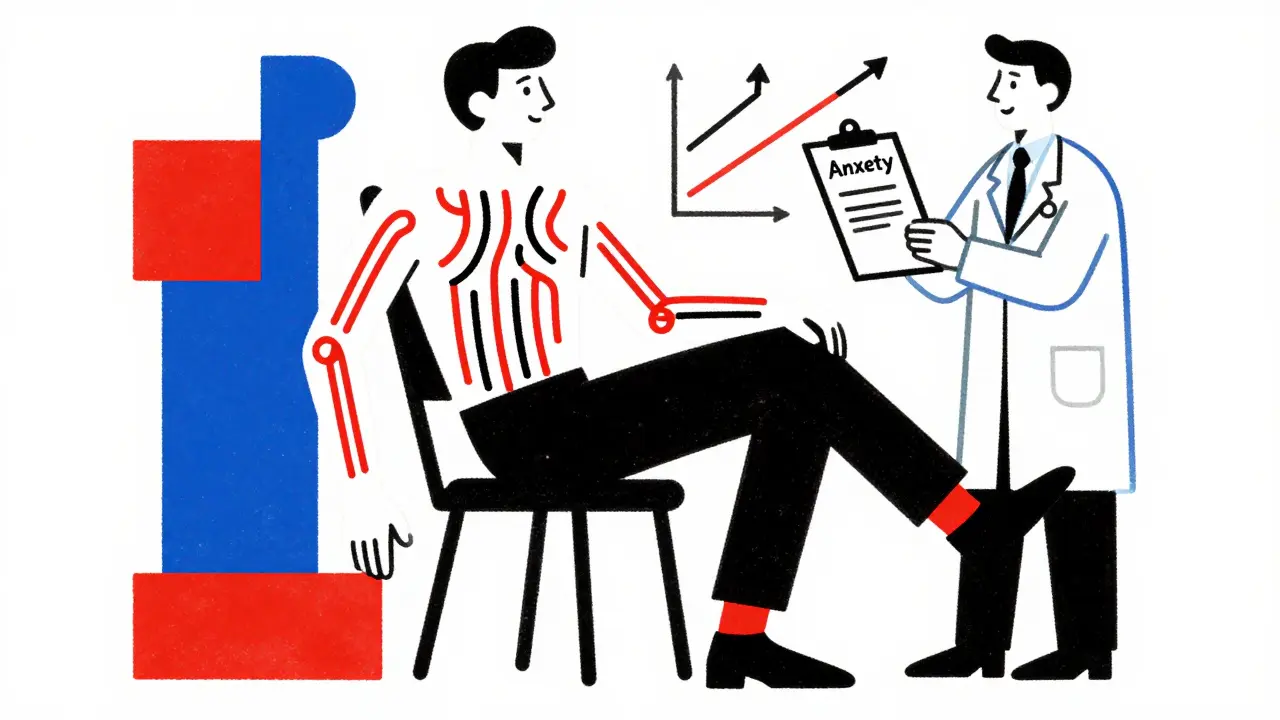
When you start a new medication-especially an antipsychotic-you might notice something strange: an unbearable urge to move your legs. You can’t sit still. You pace. You cross and uncross your legs. You shift your weight constantly. Your doctor says it’s anxiety. So they increase your dose. And it gets worse.
This isn’t anxiety. It’s akathisia.
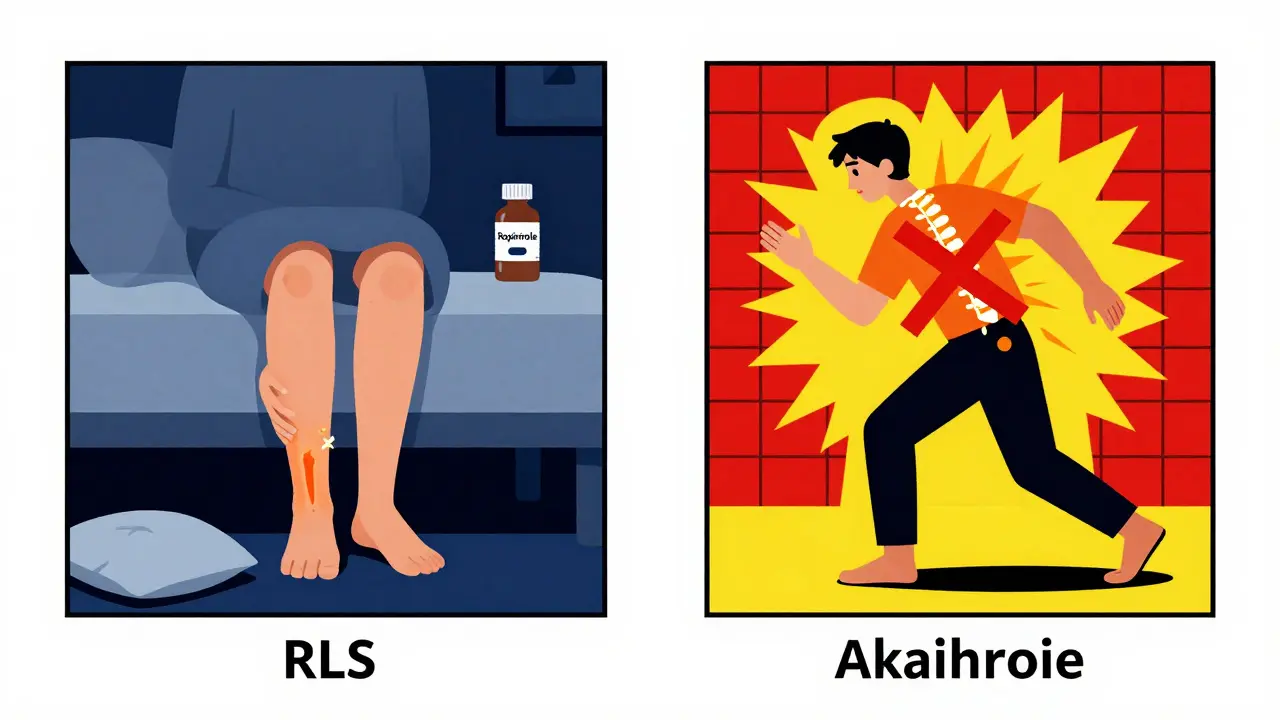
And if you’re feeling restless legs at night, you might think it’s restless legs syndrome (RLS). But the two aren’t the same. Mixing them up can lead to dangerous mistakes-like making your symptoms worse with more medication.
Here’s what you need to know: how to spot the difference, why it matters, and what actually works to fix it.
What Is Akathisia? It’s Not Just Being Nervous
Akathisia isn’t a mood. It’s a physical movement disorder caused by certain medications. It started showing up in medical records in the late 1950s, right after antipsychotics became common. Back then, doctors didn’t know what they were seeing. They called it ‘nervousness’ or ‘agitation.’
Today, we know better. Akathisia is a direct side effect of drugs that block dopamine in the brain-especially older antipsychotics like haloperidol, but also newer ones like risperidone and even some anti-nausea meds like metoclopramide.
The key signs? An intense, uncomfortable feeling inside your body-like your nerves are buzzing, your skin is crawling, or you’re about to jump out of your own skin. You don’t just feel restless. You need to move. Constantly. When you sit, you fidget. When you stand, you pace. You can’t relax. And the more medication you take, the worse it gets.
Here’s what patients describe:
- ‘I feel like I’m being eaten alive from the inside.’
- ‘I have to walk until my legs give out, then I collapse-but I still can’t sit still.’
- ‘It’s worse than the psychosis I was being treated for.’
And here’s the scary part: if your doctor mistakes akathisia for anxiety or agitation, they’ll often increase your antipsychotic dose. That makes the problem worse. Studies show this misdiagnosis leads to suicidal thoughts, aggression, and violent outbursts in up to 15% of cases.
Restless Legs Syndrome: The Nighttime Mimic
Now, let’s talk about restless legs syndrome. It’s different. RLS happens mostly at night or when you’re resting. You get a creepy-crawly, aching feeling in your legs. Moving helps-walking, stretching, shaking your legs. But the relief is temporary.
RLS isn’t caused by antipsychotics. It’s linked to low iron, genetics, or kidney disease. People with RLS often have family members with it too. And unlike akathisia, RLS responds to dopamine-boosting drugs like levodopa or ropinirole.
So here’s the big difference:
- Akathisia: Happens during the day, while sitting or standing. You feel an inner compulsion to move. It’s not about comfort-it’s about survival. Movement doesn’t bring relief; it just delays the agony.
- RLS: Happens at night or during inactivity. You feel a physical discomfort. Moving gives you relief. It’s not a compulsion-it’s a response to pain.
And here’s the trap: many patients with akathisia are told they have RLS. Why? Because both involve leg movement. But treating akathisia with RLS meds like gabapentin or iron supplements won’t help-and might make things worse.
How Doctors Miss It (And How You Can Help)
A 2022 survey by NAMI found that 68% of people on antipsychotics who had movement symptoms were misdiagnosed as having anxiety. Nearly half had their medication increased-making their akathisia 10 times worse.
Why does this keep happening?
- Doctors aren’t trained to look for it.
- Patients don’t know how to describe it.
- Electronic health records don’t have a checkbox for akathisia.
Here’s what you can do:
- Track your symptoms. When did they start? Right after a new med? After a dose increase?
- Describe the feeling. Don’t say ‘I’m anxious.’ Say: ‘I feel like I have to move or I’ll explode.’
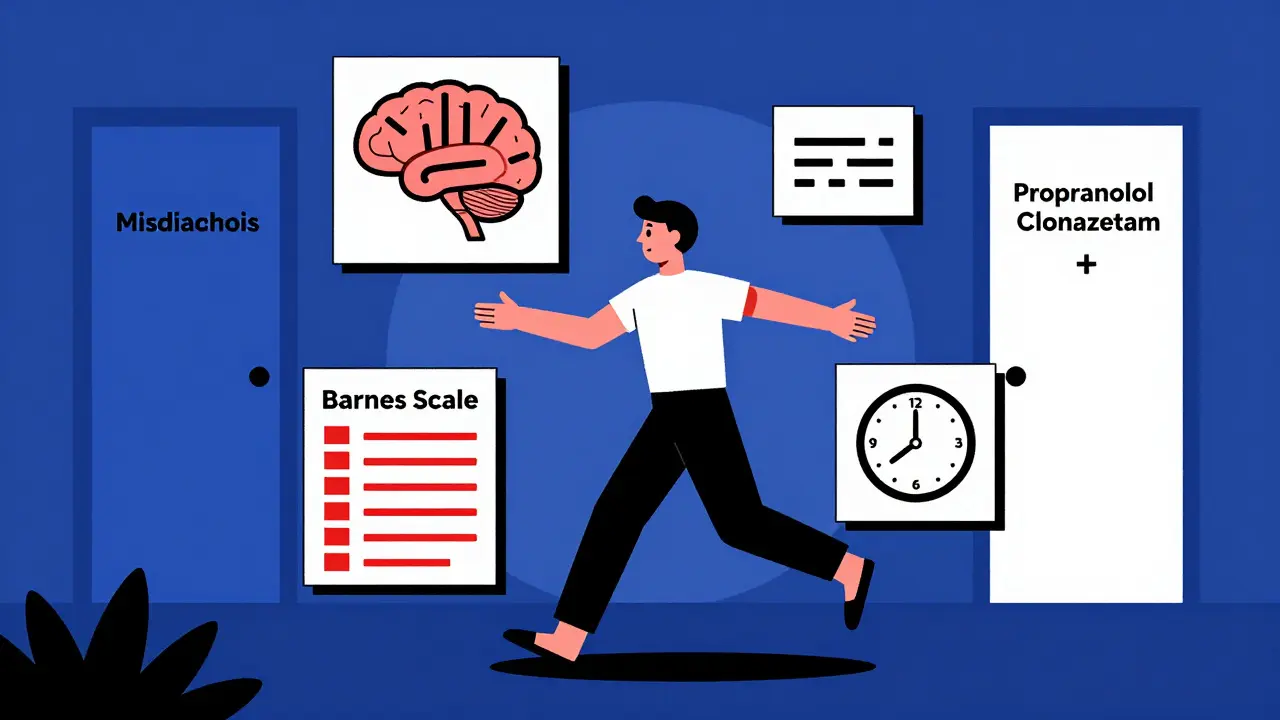
- Ask for the Barnes Scale. It’s a 10-minute test doctors can use to rate inner restlessness and visible movement. It’s simple, free, and reliable.
If your doctor says, ‘It’s just stress,’ ask: ‘Could this be akathisia? I read it’s common with antipsychotics.’
Many patients say the moment they named it-‘This is akathisia’-they finally got help.
What Actually Treats Akathisia?
The best treatment? Stop or reduce the drug causing it.
In the 2017 RACGP case study, a patient on haloperidol had severe akathisia. Her doctor doubled her dose. She became suicidal. Then, her psychiatrist stopped haloperidol and started clonazepam. Within three days, she was ‘back to herself.’
But sometimes you can’t just quit the antipsychotic. If you have severe psychosis, stopping could be dangerous. That’s where add-on treatments come in.
Here are the proven options:
- Propranolol (10-60 mg/day): A beta-blocker that calms the nervous system. Works for about 60% of patients.
- Clonazepam (0.5-2 mg/day): A benzodiazepine that reduces inner tension. Effective but can be sedating.
- Cyproheptadine (4-12 mg/day): An antihistamine that blocks serotonin. Less common but helpful in resistant cases.
Important: Avoid dopamine blockers like more antipsychotics. Don’t use RLS meds like ropinirole-they can make akathisia worse.
There’s new hope too. A 2023 trial showed pimavanserin (a drug used for Parkinson’s hallucinations) reduced akathisia by 62%. It’s not FDA-approved for this yet, but it’s being studied.
What to Do If You’re on Antipsychotics
If you’re taking any antipsychotic-whether it’s for schizophrenia, bipolar disorder, or even off-label for anxiety-do this now:
- Check your meds. Haloperidol, risperidone, olanzapine, quetiapine, and metoclopramide are the biggest culprits.
- Ask yourself: Do I feel an inner restlessness I can’t sit through? Do I move constantly even when I’m tired?
- Write it down. Track when symptoms start, how bad they are, and what makes them better or worse.
- Bring it to your doctor. Say: ‘I think I might have akathisia. Can we check?’
- Don’t wait. The longer it goes untreated, the more likely it becomes chronic-and harder to fix.
Some newer antipsychotics have lower risk. Lumateperone (Caplyta) caused akathisia in only 3.6% of users in trials, compared to 14.3% with risperidone. If you’re on a high-risk drug and struggling, ask about switching.
Why This Matters More Than You Think
Akathisia isn’t just annoying. It’s life-threatening.
One patient told a psychiatrist: ‘I’d rather be psychotic than feel this.’
Another described it as ‘the most torturous experience of my life.’
And yet, only 37% of U.S. psychiatric clinics routinely screen for it.
This isn’t a rare glitch. Up to 40% of people on older antipsychotics get it. Even newer ones affect 5-15%. That’s tens of thousands of people every year, suffering silently because no one asked the right question.
Recognizing akathisia isn’t just about fixing a side effect. It’s about saving lives.
Because when you stop treating the symptom as ‘anxiety’ and start treating it as akathisia-you don’t just reduce movement. You restore dignity. You reduce suicide risk. You give people back their peace.
What’s Next? New Tools, New Hope
In 2023, the International Parkinson and Movement Disorder Society launched a free app to help doctors diagnose akathisia on the spot. It uses video analysis and symptom checklists.
Researchers are now using AI to detect subtle movements during telehealth visits. One Stanford study got 89% accuracy just from video footage.
And in 2024, a JAMA Neurology study found specific brainwave patterns that appear before akathisia starts. That could lead to early warnings-before the suffering begins.
But none of this matters if doctors don’t know to look.
Education is the real treatment.
If you’re on antipsychotics, know your risk. If you’re a caregiver, watch for movement. If you’re a clinician, screen every patient.
Because restlessness isn’t anxiety.
It’s a warning.
Can akathisia go away on its own?
Sometimes, yes-but only if the triggering medication is stopped or reduced. Akathisia caused by antipsychotics rarely resolves without intervention. If you keep taking the drug, symptoms can become chronic, lasting months or even years. Waiting it out is risky. Early action leads to faster recovery.
Is akathisia the same as Parkinson’s tremors?
No. Parkinson’s causes slow, stiff movements, tremors at rest, and shuffling gait. Akathisia is about inner restlessness and constant movement-pacing, rocking, leg crossing. They’re both side effects of dopamine-blocking drugs, but they look and feel completely different. A doctor can tell them apart using the Barnes Scale or by observing movement patterns.
Can I take RLS medication for akathisia?
No. Medications like ropinirole or pramipexole, which treat restless legs syndrome, can actually make akathisia worse. They boost dopamine, and akathisia is linked to dopamine imbalance-but in a different way. Using RLS drugs can trigger more agitation or even worsen psychosis. Stick to proven akathisia treatments like propranolol or clonazepam.
How long does akathisia last after stopping the drug?
For most people, symptoms begin improving within 24-72 hours after stopping the medication. In the RACGP case study, patients saw major improvement in under three days. If symptoms last longer than six weeks, it may be chronic akathisia, which requires longer-term management with beta-blockers or benzodiazepines.
Are there any natural remedies for akathisia?
There’s no proven natural cure. Some patients report mild relief from magnesium, vitamin B6, or exercise-but these don’t replace medical treatment. The core fix is adjusting or stopping the causative drug. Natural remedies may help with general anxiety or sleep, but they won’t resolve the neurological root of akathisia. Always talk to your doctor before trying supplements, especially if you’re on other meds.
Can akathisia cause permanent damage?
The movement symptoms themselves usually don’t cause permanent physical damage. But the psychological toll can be lasting. Many patients develop PTSD, depression, or phobias around medication use after a severe episode. In rare cases, chronic akathisia can become persistent even after stopping the drug-called tardive akathisia. Early recognition and treatment prevent this.
Comments (14)
Corey Chrisinger
January 16, 2026 AT 02:09
I used to think I was just anxious until I read this. That feeling like my nerves are being eaten alive? That’s akathisia. I didn’t know it had a name. Now I know why I paced until my knees gave out. 🤯
Bianca Leonhardt
January 16, 2026 AT 09:40
Ugh. Another person who thinks doctors are idiots. Maybe if you stopped being dramatic and took your meds like a grown-up, you wouldn’t feel this way.
Travis Craw
January 17, 2026 AT 20:14
i had this for like 8 months and my doc kept saying 'just relax'... i finally found a psych who knew what it was. took me 2 years. dont wait like i did.
propranolol saved me. no joke.
Stephen Tulloch
January 18, 2026 AT 04:01
Honestly, it’s pathetic how little training psychiatrists get in movement disorders. I mean, we’re talking about a condition that’s been documented since the 50s and yet it’s still being misdiagnosed as 'anxiety' like it’s 1972. 🤦♂️
And don’t get me started on the fact that RLS meds make it worse-why is this even a debate? It’s neuropharmacology 101.
Corey Sawchuk
January 18, 2026 AT 22:03
I’ve been on risperidone for 3 years. Started pacing in the kitchen at 3am. Thought I was losing my mind. Then I found this post. Took me 3 days to tell my doctor. He checked the Barnes Scale. Said 'oh wow, yeah, that’s it.' We cut the dose. I slept for 12 hours straight.
Thank you.
Rob Deneke
January 20, 2026 AT 20:15
You’re not alone. I’ve been there. The moment you name it, you start healing. Keep pushing for help. Your voice matters. And if your doc doesn’t listen? Find another one. You deserve better.
evelyn wellding
January 22, 2026 AT 00:00
OMG YES THIS!! I’ve been telling my therapist for months that I feel like I’m going to explode if I sit still 😭 I finally got the name for it and now I’m not crazy! 🙌
Chelsea Harton
January 23, 2026 AT 16:07
antipsychotics = dopamine blockers = akathisia. simple.
Christina Bilotti
January 24, 2026 AT 06:42
Oh wow, a whole article about something that’s been in every psych textbook since the 80s. Did you write this for people who’ve never opened a medical journal? 🙄
brooke wright
January 25, 2026 AT 09:45
I had akathisia and my doctor prescribed gabapentin. It made me feel like a zombie. Then I found this post and switched to propranolol. I cried. Not from sadness-from relief. Why didn’t anyone tell me this before?
vivek kumar
January 26, 2026 AT 08:02
In India, this is almost never diagnosed. We have zero awareness. I had to read this in English to understand what was happening to me. My doctor said 'you’re overthinking.' I’m not. This is real. And it’s systemic.
Nick Cole
January 28, 2026 AT 01:32
I’ve been a nurse in psych for 12 years. I’ve seen patients get worse because we didn’t recognize akathisia. I’ve also seen them come back to life when we stopped the drug. This isn’t theoretical. It’s life or death. Thank you for putting this out there.
Riya Katyal
January 28, 2026 AT 03:21
So let me get this straight-you wrote a 2000-word essay on something that’s literally in the drug’s FDA label? And you’re surprised doctors don’t know? 🤡
Henry Ip
January 29, 2026 AT 10:53
This is the kind of post that saves lives. I’m sharing it with my entire support group. If you’re reading this and you feel like you’re going to burst-please, don’t wait. Print this. Show it to your doctor. You’re not crazy. You’re just medicated wrong.