Tolerance Risk Calculator
Opioid Tolerance Risk Assessment
This tool helps you understand the overdose risk associated with your current opioid dose. Based on CDC guidelines and clinical evidence, your tolerance level and usage pattern significantly impact safety.
Risk Assessment Results
Have you ever noticed that your pain medication doesn’t work like it used to? You’re taking the same dose, but the relief is weaker. So your doctor raises it. Then again. And again. It’s not that your pain got worse-it’s that your body changed. This is opioid tolerance, and it’s one of the most common, misunderstood, and dangerous side effects of long-term opioid use.
What Exactly Is Opioid Tolerance?
Opioid tolerance means your body has adapted to the drug. Over time, the same amount of medication doesn’t produce the same effect. What once eased your pain now feels like a whisper. To get back that same relief, you need more. It’s not addiction. It’s not dependence. It’s biology.
When you take an opioid-like oxycodone, hydrocodone, or morphine-it binds to special receptors in your brain and spinal cord, mainly the mu-opioid receptor (MOR). This blocks pain signals and triggers dopamine release, giving you comfort and sometimes a sense of calm. But with repeated use, your cells start to fight back. Receptors become less sensitive. Some even disappear from the cell surface. Your nervous system learns to function with the drug present, and when it’s there, it works less efficiently.
This isn’t a flaw in your body. It’s a survival mechanism. Your brain doesn’t want to be constantly flooded with artificial chemicals. So it adjusts. And that adjustment is what forces dose increases.
Why Do Some People Need Higher Doses Faster Than Others?
Not everyone develops tolerance at the same rate. Some people need more after a few weeks. Others stay stable for months or even years. Why?
- Genetics: The OPRM1 gene controls your mu-opioid receptors. Variations in this gene can make someone more or less likely to develop tolerance quickly.
- Metabolism: Liver enzymes break down opioids differently in each person. Faster metabolism means the drug leaves your system quicker, leading to earlier cravings and higher doses.
- Usage pattern: Taking opioids daily, even as prescribed, speeds up tolerance. Skipping doses or taking them only when pain flares can slow it down.
- Other health conditions: Inflammation in the body-caused by arthritis, nerve damage, or chronic illness-activates immune pathways like TLR4 and NLRP3 inflammasomes. These directly interfere with how opioids work, making tolerance develop faster.
Studies show about 30% of people on long-term opioids need a higher dose within the first year. For some, it happens in weeks. For others, it never happens. There’s no way to predict who will fall where-only to watch for signs.
Tolerance Isn’t the Same as Dependence or Addiction
People often confuse tolerance with dependence or opioid use disorder (OUD). But they’re different.
- Tolerance = You need more to get the same effect.
- Dependence = Your body relies on the drug to feel normal. Stop it, and you get withdrawal-sweating, nausea, anxiety, muscle aches.
- Opioid Use Disorder = A pattern of harmful use. You keep using even when it hurts your health, relationships, or job.
You can have tolerance without dependence. You can have dependence without OUD. But tolerance often leads to dependence, and dependence can lead to OUD-if not managed carefully.
The FDA warns that tolerance can develop at different rates for different effects. You might lose pain relief quickly but still feel the sedative or respiratory-depressing effects at the same dose. That’s dangerous. You might feel fine, but your breathing could be slowing down-without you knowing it.
The Dangerous Cycle: More Dose, More Risk
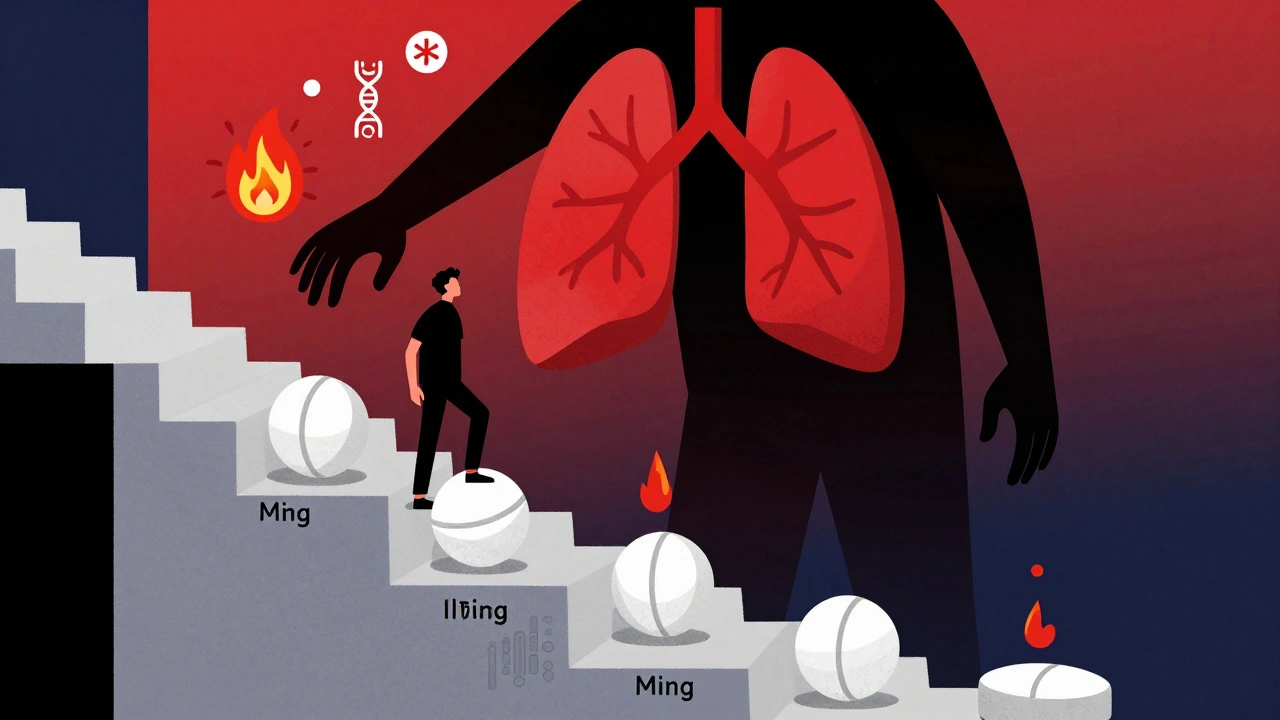
Every time you increase your dose, you’re climbing a steeper hill. Higher doses mean higher risk of overdose. And here’s the cruel twist: when you stop taking opioids-even for a short time-your tolerance drops.
That’s why people who go to rehab, get released from jail, or take a break after surgery are at extreme risk. Their bodies have forgotten how to handle the drug. If they go back to their old dose, their system can’t cope. The CDC found that 74% of fatal overdoses among people with opioid use disorder happen within the first few weeks after leaving incarceration.
And it’s not just prescription opioids. Street drugs like fentanyl are 50 to 100 times stronger than morphine. Someone with tolerance to oxycodone might think they can handle a small amount of fentanyl. They can’t. One pill can kill.
That’s why the CDC’s current public health message is so clear: “Your tolerance is lower now-start with a fraction of your previous dose.” It’s not advice. It’s a lifesaver.
How Doctors Check for Tolerance
There’s no blood test that directly measures tolerance. But doctors use clues:
- Are you asking for higher doses more often?
- Do you report less pain relief despite sticking to the schedule?
- Are you experiencing side effects like constipation, drowsiness, or nausea that didn’t happen before?
- Are your blood levels higher than expected for your dose?
Some clinics use urine or blood tests to check if you’re taking the right amount-but those only show presence, not tolerance. The real test is clinical: how are you feeling? Is the medication still working? Are you safer now than you were six months ago?
The CDC recommends that before increasing your daily dose beyond 50 morphine milligram equivalents (MME), your doctor should stop and ask: Is this still helping? Are there safer alternatives?
What Can Be Done About It?
There’s no magic pill to reverse tolerance. But there are smarter ways to manage it.
- Opioid rotation: Switching from one opioid to another-like going from oxycodone to methadone or buprenorphine-can reset your sensitivity. Your body hasn’t adapted to the new drug yet.
- Non-opioid options: Physical therapy, nerve blocks, antidepressants like duloxetine, and anti-seizure drugs like gabapentin can reduce pain without triggering tolerance.
- Low-dose naltrexone: This is an experimental approach. Naltrexone blocks opioid receptors. When given in tiny doses, it may prevent the body from adapting to opioids, helping maintain effectiveness without increasing the dose. Early trials show a 40-60% reduction in dose escalation.
- Abstinence breaks: Under medical supervision, taking a break from opioids can reset tolerance. But this must be planned. Going cold turkey is dangerous.
The FDA is now pushing drug makers to develop new pain medications that don’t cause tolerance. Researchers are testing drugs that block inflammatory pathways (TLR4 inhibitors) to keep opioids working at lower doses. These aren’t available yet-but they’re coming.
What You Should Do If You’re on Opioids
If you’re taking opioids for pain, here’s what matters:
- Track your pain levels and medication effectiveness. Keep a simple journal: “Day 1: 5mg oxycodone, pain 6/10. Day 7: 5mg oxycodone, pain 7/10.”
- Ask your doctor: “Is this dose still working? Are we trying anything else?”
- Never increase your dose on your own. Even a little extra can be deadly.
- If you’ve stopped opioids-even for a week-never go back to your old dose. Start low. Way low.
- Know the signs of overdose: slow or shallow breathing, blue lips, unresponsiveness. Keep naloxone on hand. It can save your life.
Tolerance isn’t a personal failure. It’s a normal biological response. But it’s also a warning sign. The goal isn’t to keep increasing doses forever. The goal is to manage pain safely-and get off opioids if you can.
Final Thought: Tolerance Is a Signal, Not a Sentence
Needing a higher dose doesn’t mean you’re weak. It doesn’t mean you’re addicted. It means your body is doing exactly what biology designed it to do: adapt.
The problem isn’t tolerance. The problem is not recognizing it for what it is: a signal that it’s time to rethink your plan. Whether that means switching medications, adding non-drug therapies, or planning a slow, supported taper-there’s always another path. You don’t have to keep climbing higher to feel better. Sometimes, the answer is stepping sideways.
Can opioid tolerance go away?
Yes. Tolerance can decrease if you stop taking opioids for a period of time-weeks or months. This is why people in recovery are at high risk of overdose if they return to their previous dose. Their body has lost its tolerance, but their brain still expects the same level of effect. That mismatch can be fatal.
Is it safe to take higher doses of opioids if my pain isn’t controlled?
Not without careful medical supervision. Increasing your dose raises your risk of overdose, respiratory depression, and addiction. Before raising your dose, your doctor should evaluate whether opioids are still the best option. Non-opioid treatments like physical therapy, nerve blocks, or medications like gabapentin may work better with fewer risks.
Does tolerance mean I’m addicted?
No. Tolerance is a physical change in your body’s response to the drug. Addiction, or opioid use disorder, is a behavioral condition where you continue using despite harm-like losing your job, relationships, or health. You can have tolerance without addiction. But untreated tolerance can lead to addiction if you start chasing higher doses for relief or euphoria.
Why do some people develop tolerance faster than others?
Genetics play a big role. Variations in the OPRM1 gene affect how your opioid receptors respond. Your metabolism, liver function, and whether you have chronic inflammation also matter. People with conditions like arthritis or nerve damage often develop tolerance faster because inflammation interferes with how opioids bind to receptors.
Can I avoid opioid tolerance altogether?
It’s hard to avoid completely if you’re taking opioids regularly. But you can slow it down. Use the lowest effective dose. Take breaks if possible. Combine opioids with non-drug therapies like exercise, acupuncture, or cognitive behavioral therapy. Avoid daily use unless absolutely necessary. And never use opioids for non-pain reasons-like sleep or anxiety-because that speeds up tolerance.
What Comes Next?
If you’re on opioids and noticing your dose keeps rising, don’t panic. But don’t ignore it either. Talk to your doctor. Ask about alternatives. Ask about naloxone. Ask about tapering. You’re not alone. Thousands of people face this exact situation. The goal isn’t to stay on opioids forever-it’s to find a way to live well without being controlled by them.
There are better options. They just require patience, support, and the courage to ask for help before things get worse.
Comments (13)
Michael Robinson
December 8, 2025 AT 17:10
It’s not about willpower. It’s about biology. Your body isn’t broken-it’s just trying to survive. Tolerance isn’t a moral failing. It’s a feature, not a bug.
Sarah Gray
December 9, 2025 AT 21:21
Let’s be clear: if you’re on opioids long-term and haven’t considered non-pharmacological interventions, you’re not managing pain-you’re delaying the inevitable. Physical therapy isn’t optional. It’s foundational. And if your doctor doesn’t mention it, find a new one.
There’s a reason the CDC recommends MME caps. It’s not bureaucracy. It’s survival.
People confuse tolerance with addiction because they don’t understand neuroplasticity. Your neurons adapt. That’s not weakness. It’s evolution.
And yes-some of you will say ‘but I need it to function.’ So do people with insulin dependence. That doesn’t mean we let them self-prescribe higher doses without oversight.
Stop romanticizing opioids. They’re not a lifestyle. They’re a last-resort tool. And like any tool, misuse turns them into hazards.
Low-dose naltrexone? Fascinating. Peer-reviewed studies show 40-60% dose reduction. Why isn’t this standard of care yet?
Because profit drives medicine, not science. And that’s the real crisis.
If you’re reading this and thinking ‘I’m not like those addicts’-you already are. Tolerance doesn’t discriminate. It just waits.
Track your pain. Track your dose. Track your mood. If you’re not documenting, you’re gambling.
And if you think naloxone is only for ‘them’-you’re wrong. It’s for you. Your family. Your neighbor. Your doctor.
This isn’t fearmongering. It’s pharmacology.
Kathy Haverly
December 10, 2025 AT 12:40
Of course they’re pushing ‘non-opioid alternatives’-because Big Pharma’s making less money on gabapentin than on oxycodone. Tolerance? That’s just a distraction. The real goal is to get you off opioids so they can sell you something else.
They told us cigarettes were safe too.
Andrea Petrov
December 10, 2025 AT 16:50
Did you know the FDA approved opioids based on studies funded by Purdue Pharma? And now they’re telling us tolerance is ‘biological’? Funny how that works.
They’re not trying to help you. They’re trying to control you. Naloxone? It’s not a lifeline-it’s damage control for a system that never should’ve existed.
They want you to think you’re safe if you ‘follow the rules.’ But the rules were written by people who profit when you keep taking pills.
Suzanne Johnston
December 10, 2025 AT 20:25
What struck me most is how we’ve turned a biological process into a moral one. Tolerance isn’t failure-it’s adaptation. And yet, people feel shame for needing more. That shame keeps them silent. And silence kills.
We need to talk about this without stigma. Not as addicts or patients, but as humans whose bodies are doing exactly what they’re wired to do.
The real tragedy isn’t tolerance. It’s that we don’t have better tools to manage chronic pain without triggering this cycle.
Maybe the answer isn’t more drugs. Maybe it’s more time. More access to therapists. More physical rehab. More community support.
We treat pain like a math problem: more pills = more relief. But pain isn’t math. It’s messy. It’s emotional. It’s human.
Let’s stop pretending there’s a quick fix.
Graham Abbas
December 11, 2025 AT 18:12
I used to think tolerance meant I was weak. Then I realized-I wasn’t failing my body. My body was fighting for me. Every time I needed more, it wasn’t because I wanted to feel high. It was because the pain was still there.
And then I met someone who’d lost their brother to an overdose after jail. He’d gone back to his old dose. He didn’t know his tolerance had dropped.
I cried for days.
Now I carry naloxone. Not because I think I’ll need it. But because I know someone else might.
Tolerance isn’t the enemy. Ignorance is.
Haley P Law
December 13, 2025 AT 03:59
ok but like… why is everyone so dramatic about this?? like i get it tolerance is a thing but also maybe just stop taking the meds if it’s not working?? 🤷♀️
Andrea DeWinter
December 13, 2025 AT 09:36
Track your pain. Write it down. Even if it’s just a note on your phone. You’d be surprised how much it helps your doctor see the pattern. I did this for six months and realized my dose hadn’t helped in four. We switched to gabapentin and my pain dropped. No extra pills. Just better management.
Also-ask for a referral to pain psychology. It’s not ‘in your head.’ It’s your brain learning to stop screaming.
You’re not alone. And you don’t have to suffer in silence.
Steve Sullivan
December 14, 2025 AT 07:51
bro i had a back injury and got prescribed oxycodone and yeah i needed more over time but i never felt high so i didnt think it was a problem
then my cousin died from an overdose after surgery and i realized… oh. i couldve been next
now i take half my dose and do yoga. still hurts but i’m alive
naloxone in my wallet now. no joke
George Taylor
December 15, 2025 AT 14:08
And yet, despite all the data, all the guidelines, all the warnings-doctors still increase doses without evaluating non-opioid alternatives. Why? Because it’s easier. Because insurance won’t cover PT. Because they’re overworked. Because they’re afraid of being accused of ‘not caring’ if they don’t prescribe.
So the cycle continues.
And then people die.
And then we all act shocked.
It’s not a tragedy. It’s negligence.
ian septian
December 17, 2025 AT 12:40
Lower dose. Try movement. Talk to a therapist. Keep naloxone. That’s it.
Chris Marel
December 18, 2025 AT 13:14
I’m from Nigeria. We don’t have easy access to opioids here. But I’ve seen people with chronic pain suffer silently because they’re afraid to ask for help. Your post reminded me that pain is universal-even if the medicine isn’t.
Thank you for writing this. It’s a quiet kind of courage.
Evelyn Pastrana
December 19, 2025 AT 08:09
soooo… if tolerance = biology, then why is everyone acting like it’s a personal failure? like wow, your body is a genius at adapting, congrats?? 🤦♀️
also, can we just admit that doctors are terrible at explaining this? i had to google it myself. they just say ‘we’re increasing your dose’ and move on.
also also-i tried gabapentin. it made me feel like a zombie with a headache. so yeah, not magic.
but i’m keeping naloxone. just in case. because i’m not dying because someone didn’t tell me tolerance drops.