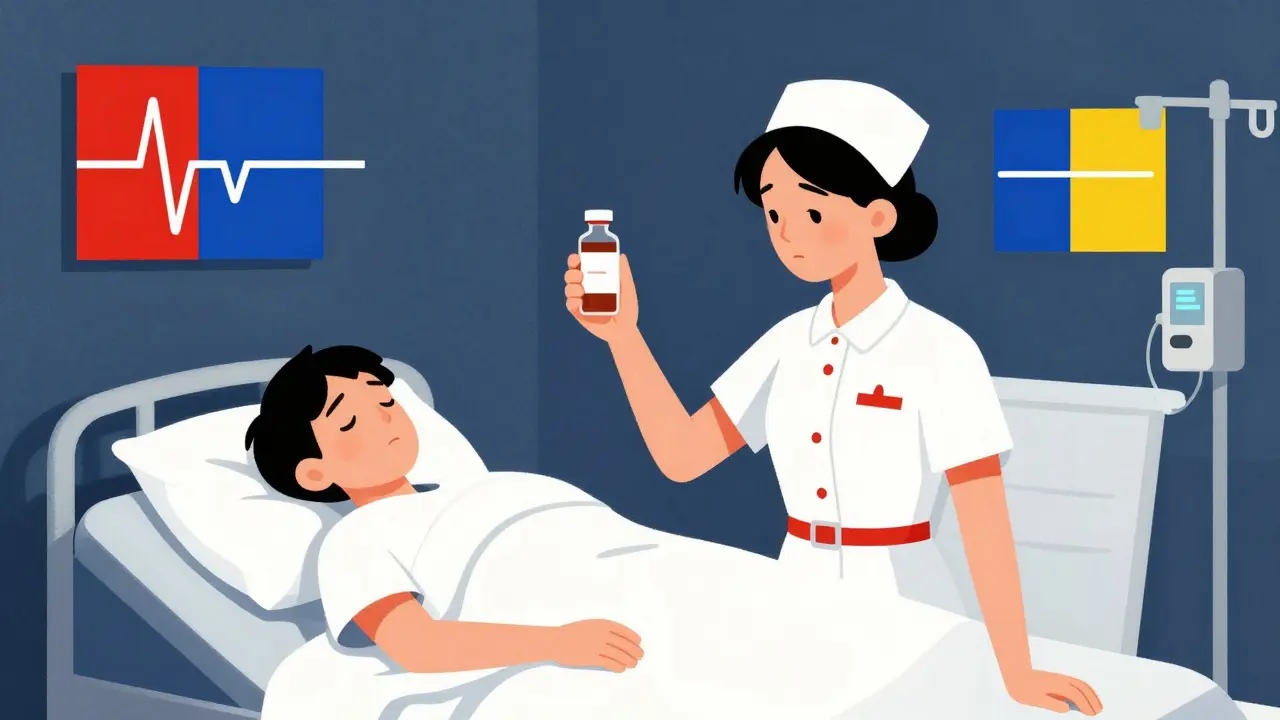
It’s 3 a.m. You’ve been on your feet for 14 hours. Your eyes feel heavy. The IV pump beeps. You reach for the wrong vial. The label blurs. You give the patient twice the dose. It’s not a nightmare-it’s a real mistake that happens more often than you think. Nighttime is when medication errors spike. Not because nurses or doctors are careless. But because fatigue rewires the brain.
Why Nighttime Is the Riskiest Time for Medication Errors
When you’re tired, your brain doesn’t just feel sluggish-it starts making mistakes you wouldn’t make sober. A 2023 review of 38 studies across 15 countries found that fatigue was linked to 82% of medication administration errors and near misses. That’s not a coincidence. It’s biology.
Your circadian rhythm, the internal clock that tells your body when to sleep and wake, gets scrambled during night shifts. This doesn’t just make you sleepy. It slows down your attention span, weakens your memory, and dulls your reaction time. One study showed that after a single night without sleep, healthcare workers’ ability to focus dropped by 23%. Their memory declined by 18%. That’s the difference between giving a patient 5 mg or 10 mg of a drug.
And it’s not just the obvious mistakes. Sometimes, you misread a name. You confuse two look-alike drugs. You skip a double-check because you’re too exhausted to think it through. These aren’t big, dramatic errors. They’re quiet, subtle ones-and they’re the most dangerous.
The Medications That Make Fatigue Worse
Here’s something no one talks about enough: some of the medications you or your coworkers take to get through the night might be making things worse.
Antihistamines like diphenhydramine (Benadryl) are common in night shift kits. But 50-60% of people who take them feel drowsy. That’s not a side effect-it’s the main effect. Same with sleep aids like zolpidem (Ambien). Even if you take it at 10 p.m., 15-20% of users still feel impaired the next day. Benzodiazepines like diazepam (Valium) cause residual sedation in 30% of users. Narcotics like oxycodone? 25% of people feel drowsy. Even some antidepressants like trazodone, often used for sleep, make you sluggish.
If you’re constantly tired on night shifts, ask yourself: Could one of your meds be the problem? The CDC’s NIOSH recommends switching from sedating drugs to non-sedating alternatives-like loratadine instead of diphenhydramine. It’s not about quitting sleep aids. It’s about choosing ones that don’t sabotage your job.
How Long Shifts Break Your Brain
Working 12-hour shifts isn’t just tiring. It’s dangerous. Nurses working overtime have a 15% higher rate of medication errors. Surgeons who get less than six hours of sleep have patients with 2.7 times more complications. When their shifts stretch past 12 hours, complications jump nearly 50%.
It’s not just about being tired. It’s about cumulative sleep loss. One night of missed sleep doesn’t just make you groggy-it takes up to three days to fully recover. That means if you work three nights in a row, you’re running on a brain that’s been slowly shutting down. And your brain doesn’t tell you when it’s failing. You think you’re fine. But your accuracy drops. Your speed slows. Your judgment gets fuzzy.
And it’s not just the patient who’s at risk. Fatigue increases your chance of a car crash by 37%. It raises your risk of depression by 28%, anxiety by 22%, and anger by 19%. This isn’t just a patient safety issue. It’s a provider safety issue.

What Actually Works to Prevent Mistakes
There are no magic bullets. But some strategies have real, measurable results.
Strategic napping helps-but not how most people think. A 20-minute nap before your shift can boost alertness by 12-15%. A 90-minute nap? Only 8% improvement. Why? Because long naps cause sleep inertia-the groggy, disoriented feeling right after waking. That can last up to 30 minutes and drop cognitive performance by 22%. Short naps work. Long ones don’t.
Alarms and checklists reduce errors by 18%. Why? Because they force your brain to pause. When you’re exhausted, you skip steps. A second person checking the drug, dose, and patient name cuts mistakes in half. That’s not bureaucracy. That’s a lifesaver.
Breaks matter. Walking for five minutes every two hours improves alertness more than caffeine. Movement wakes up your nervous system. Sitting at a desk won’t. Get up. Stretch. Walk to the break room. Even if it’s just for a minute.
Caffeine is useful-but timing is everything. Drink it early in your shift. Don’t wait until 4 a.m. to chug coffee. By then, your body’s already flooded with stress hormones. Caffeine won’t fix that. It’ll just make you jittery and anxious. And if you drink it too late, you won’t sleep when you get home. That’s a cycle that gets worse every night.
Why Policy Changes Haven’t Fixed This
Since 2003, the ACGME has limited resident work hours. But here’s the problem: even with those rules, doctors still don’t sleep. They come home exhausted. They try to nap. But their brains are still wired for wakefulness. They’re stressed. They’re worried about patients. They’re checking emails. They’re scrolling. They don’t get real rest.
Studies show that restricting hours doesn’t always lower error rates. Why? Because the system hasn’t changed. You can’t fix fatigue by changing schedules alone. You have to change the culture.
That means hospitals need to stop glorifying burnout. No one should be praised for working 36 hours straight. No one should be shamed for taking a 20-minute nap. Safety isn’t about toughness. It’s about smart systems.
What You Can Do Right Now
You don’t need a hospital-wide policy change to protect yourself and your patients. Here’s what works today:
- Check your meds. Are you taking anything that makes you drowsy? Talk to your doctor about switching to non-sedating options.
- Take a 20-minute nap before your shift. Even if you’re not tired yet. It’s preventative.
- Use the two-person check. Always. No exceptions. Even if you’ve given that drug a hundred times.
- Walk every two hours. Get blood flowing. Clear your head. Don’t sit.
- Drink caffeine early. First hour of your shift. Not last.
- Don’t rely on willpower. Your brain is failing. It’s not your fault. Use tools to protect you.
The Real Cost of Fatigue
Medication errors cost the U.S. healthcare system $20 billion a year. That’s not just money. It’s lives. It’s pain. It’s families who lose loved ones because a nurse, exhausted and overworked, gave the wrong drug.
But here’s the truth: you’re not the problem. The system is. And until we stop treating fatigue like a personal failure and start treating it like a public health crisis, these mistakes will keep happening.
You deserve to be safe. Your patients deserve to be safe. And fixing this isn’t about working harder. It’s about working smarter.
Comments (10)
brooke wright
January 16, 2026 AT 11:55
I gave a patient 10mg of morphine instead of 5 because I was so tired I thought the vial said 5. I didn’t even realize until the family started screaming. I cried in the supply closet for 20 minutes. No one asked if I was okay. Just told me to ‘do better next time.’
vivek kumar
January 17, 2026 AT 15:52
Let’s be precise: the 82% statistic is misleading without controlling for shift length, workload density, and institutional support. The real variable isn’t fatigue-it’s systemic under-resourcing. Studies from India show that even with 16-hour shifts, error rates drop when double-check protocols are enforced with accountability, not just checklists. Stop blaming biology. Fix the structure.
waneta rozwan
January 19, 2026 AT 07:28
OH MY GOD. I JUST REALIZED I’VE BEEN TAKING BENADRYL FOR YEARS TO SLEEP. I’M A NURSE. I GAVE A PATIENT A SEDATIVE BECAUSE I WAS TOO DROWSY TO THINK. I’M A MONSTER. I’M A MONSTER. I’M A MONSTER. I NEED TO TALK TO MY DOCTOR TOMORROW. I CAN’T DO THIS ANYMORE. I’M SO SORRY TO EVERY PATIENT I’VE EVER HURT.
Cheryl Griffith
January 20, 2026 AT 17:20
I’ve been doing nights for 12 years. The nap before shift? Game changer. Not because I’m tired-I do it because my brain needs a reset. And the two-person check? I started doing it even when I was the only one left on the floor. One time, my partner said, ‘You don’t have to do that.’ I said, ‘Yeah, I do.’ Because I don’t want to be the reason someone dies.
swarnima singh
January 21, 2026 AT 10:57
u r all so fake. like u care about patients but u still take ambien. u r just performative. the system is broken but u r just wanna feel like heroes. wake up. no one is saving anyone. we are just cogs. and the cogs are rusting.
kanchan tiwari
January 22, 2026 AT 00:09
EVERYTHING IS A LIE. THEY PUT SEDATIVES IN THE WATER. THEY WANT US TIRED. THEY WANT US TO MESS UP. LOOK AT THE PHARMA COMPANIES. BENADRYL IS OWNED BY A BIG PHARMA CORP THAT ALSO MAKES THE DRUGS WE GIVE. THEY WANT US TO GIVE WRONG DOSES SO THEY CAN SELL MORE MEDS. I SAW A VIDEO OF A MANAGER LAUGHING ABOUT ‘FATIGUE ERRORS.’ THEY KNOW. THEY LET IT HAPPEN.
Bobbi-Marie Nova
January 22, 2026 AT 06:02
So… we’re all just supposed to nap, walk, and drink coffee before 4am like it’s a yoga class? Meanwhile, admin is cutting staff and praising ‘resilience’? 😂 bless your hearts. I’ll take my 20-minute nap and my 12-hour shift. But I’m not gonna pretend this is ‘smart.’ It’s survival.
Ryan Hutchison
January 23, 2026 AT 04:51
Look, I get it. But you people act like we’re in some third-world hospital. In the US, we have protocols, tech, and oversight. If you’re taking Benadryl on shift, you’re the problem. Not the system. Get your act together. We don’t need more drama. We need discipline. And if you can’t handle nights, go work days. Simple.
Samyak Shertok
January 23, 2026 AT 10:01
Oh wow. So fatigue is a biological inevitability, but caffeine timing is the solution? That’s like saying ‘the Titanic sank because the passengers didn’t drink enough tea.’ You’re missing the point. The system doesn’t care if you nap. It cares about profit margins. They don’t want you rested-they want you cheap. Your ‘strategic naps’ are just Band-Aids on a hemorrhage.
Stephen Tulloch
January 24, 2026 AT 06:53
Bro. I’m a resident. I took a 20-min nap before my 14-hr shift. Used the checklist. Walked every 2 hrs. Still got flagged for a near-miss because ‘protocol wasn’t followed to the letter.’ 😭 The system doesn’t want you safe. It wants you compliant. And if you’re not compliant? You’re ‘unreliable.’ So yeah. I’m done pretending this is about patient care. It’s about liability. And we’re all just collateral.