Medication Timing Calculator
Safe Timing Calculator
Ensure you take your medications at the right times to avoid interference between thyroid medication, antibiotics, and magnesium supplements.
Taking magnesium supplements while on thyroid medication or antibiotics isn’t dangerous-but doing it at the wrong time can make both treatments useless. If you’re on levothyroxine for hypothyroidism and also take magnesium for muscle cramps, sleep, or constipation, you might be unknowingly sabotaging your treatment. The same goes if you’re on ciprofloxacin or doxycycline. These aren’t theoretical risks. They’re real, measurable, and preventable with simple timing changes.
Why Magnesium Interferes with Thyroid Medication
Levothyroxine, the most common thyroid hormone replacement, is absorbed in the upper part of your small intestine. Magnesium, especially in forms like hydroxide, carbonate, or sulfate, binds to it in your stomach and gut before it can be absorbed. This creates a chemical bond that traps the thyroid hormone, turning it into an insoluble compound your body can’t use. Studies show this can cut levothyroxine absorption by 25% to 35%. That’s not a small drop-it’s enough to push your TSH levels from normal into hypothyroid range.One 2021 study in the Journal of Clinical Endocrinology & Metabolism tracked patients who took magnesium supplements with their morning levothyroxine. Within weeks, their TSH levels jumped from an average of 2.1 to over 5.8. Symptoms returned: fatigue, weight gain, brain fog. Their doctors thought their dose was too low-until they asked about magnesium. When patients switched to taking magnesium at night, four hours after their thyroid pill, their TSH dropped back to normal in 6 to 8 weeks.
Not all magnesium is the same. Magnesium oxide, often used in cheap supplements for constipation, causes less interference than magnesium hydroxide (found in antacids like Mylanta). But even magnesium glycinate, marketed as "gentler" and better absorbed, still binds to levothyroxine. The American Association of Clinical Endocrinologists and the Endocrine Society both recommend spacing them by at least 4 hours. Some newer liquid formulations like Tirosint or Unithroid reduce the interaction to 8-12%, but they’re not a fix-all. Timing still matters.
How Magnesium Affects Antibiotics
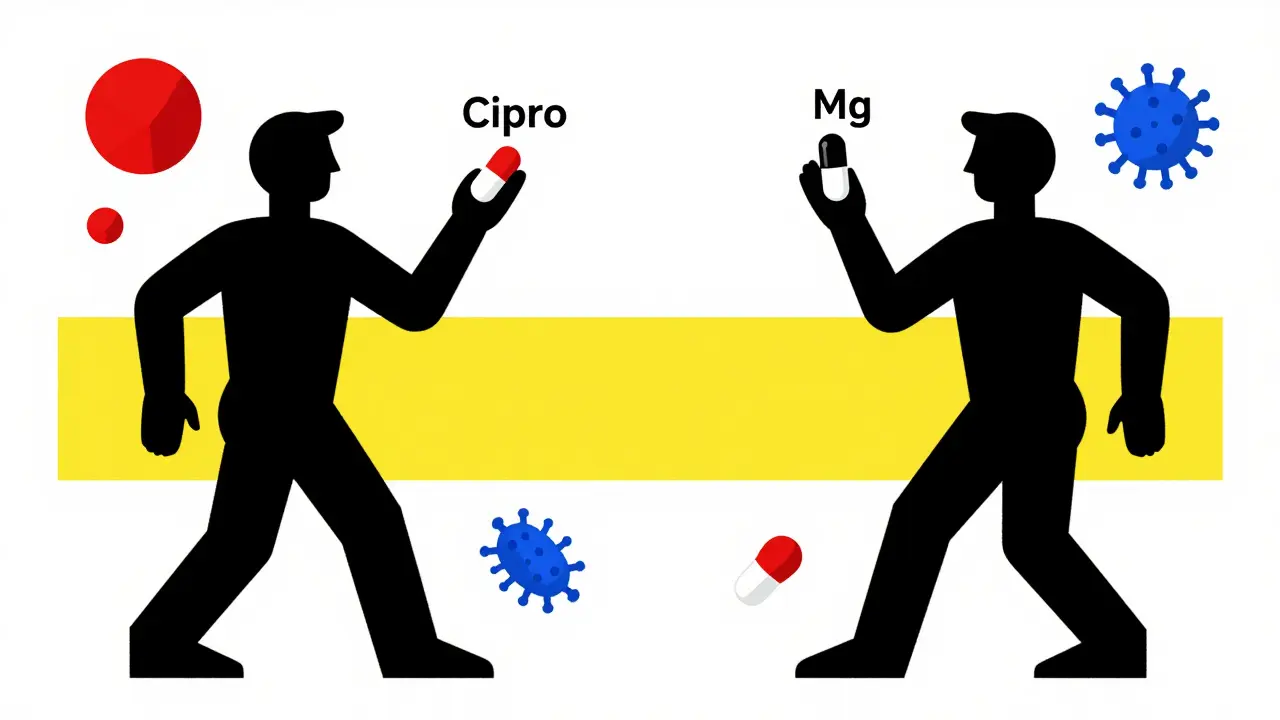
Magnesium doesn’t just mess with thyroid meds-it also knocks out certain antibiotics. Tetracyclines (doxycycline, minocycline) and fluoroquinolones (ciprofloxacin, levofloxacin) are especially vulnerable. These antibiotics work by binding to bacterial proteins, but magnesium ions do the same thing. When you take them together, the magnesium grabs the antibiotic before it can reach your bloodstream. The result? Less drug in your system, longer infection, possible treatment failure.The FDA’s labeling for ciprofloxacin says magnesium can reduce its absorption by up to 50%. A 2021 study in Antimicrobial Agents and Chemotherapy found that 500 mg of magnesium citrate taken with levofloxacin dropped peak blood levels by 37%. That’s not a minor inconvenience-it’s a risk of antibiotic resistance. If the drug doesn’t reach therapeutic levels, surviving bacteria can adapt and become stronger.
Penicillin, amoxicillin, azithromycin, and other common antibiotics don’t interact with magnesium. So if you’re on one of those, you don’t need to worry. But if your doctor prescribes doxycycline for acne or ciprofloxacin for a UTI, you need to plan ahead. The Infectious Diseases Society of America recommends taking magnesium at least 2 hours before or 4 to 6 hours after these antibiotics. That means if you take your antibiotic at 8 a.m., don’t take magnesium until after 2 p.m. or wait until bedtime.
When to Take Magnesium: The 4-Hour Rule
The simplest, most effective strategy is to take magnesium at least 4 hours after your thyroid medication. Most people take levothyroxine first thing in the morning on an empty stomach. Wait 45 to 60 minutes, then eat breakfast. Take your magnesium supplement with dinner or right before bed. That’s a natural 6- to 8-hour gap. No guesswork. No rushing.Here’s a real-world schedule that works for most people:
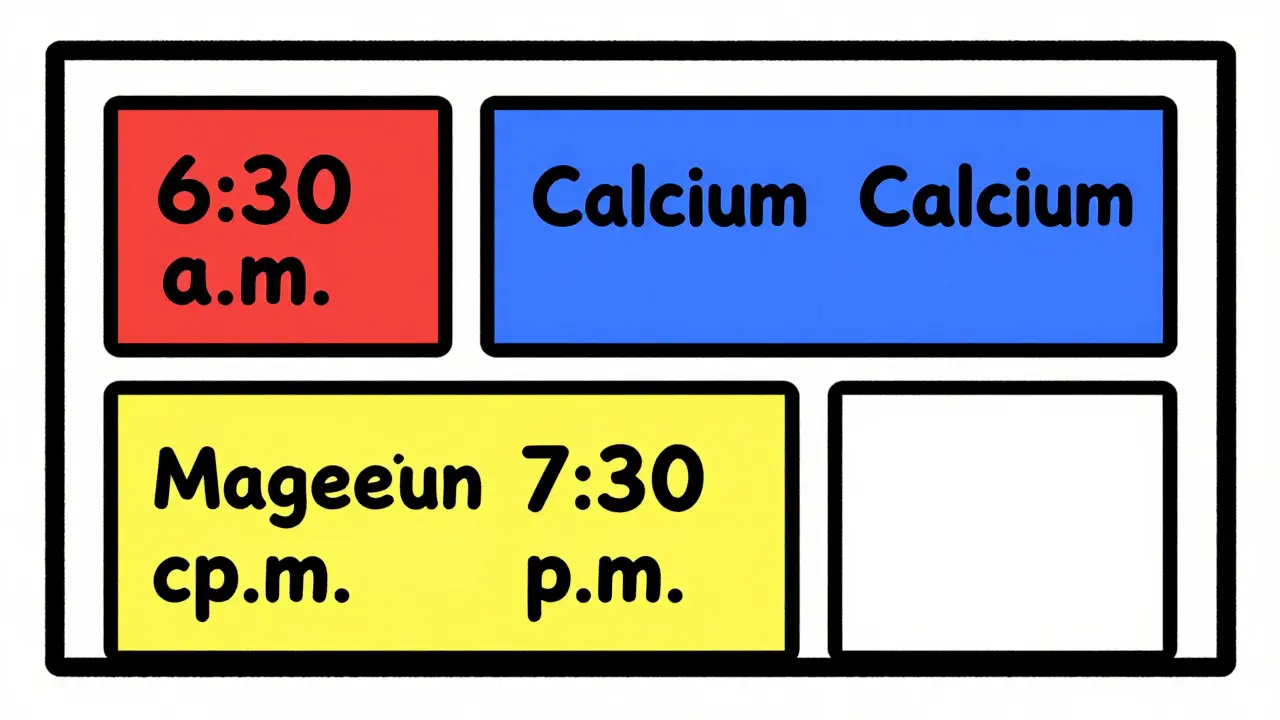
- 6:30 a.m.: Take levothyroxine with a full glass of water (no coffee, no food, no supplements)
- 7:30 a.m.: Eat breakfast
- 12:30 p.m.: Take calcium or iron supplements (if prescribed)
- 6:30 p.m.: Eat dinner
- 7:30 p.m.: Take magnesium supplement
This avoids overlap with both thyroid meds and antibiotics. If you’re on an antibiotic like doxycycline, take it at 8 a.m. and wait until 2 p.m. to take magnesium. If you’re on ciprofloxacin twice a day, take the first dose at 8 a.m., magnesium at 7 p.m., and the second dose at 8 p.m. (wait 1 hour after magnesium).
One patient on Reddit shared how she took 300 mg of magnesium glycinate with her Synthroid every morning for months. Her TSH climbed from 1.8 to 14.2. She felt awful-cold, tired, bloated. Her doctor kept increasing her Synthroid dose. She didn’t realize magnesium was the problem until a pharmacist asked about her supplements. After switching to nighttime magnesium, her TSH dropped back to 2.4 in 8 weeks.
What Magnesium Form to Choose
Not all magnesium supplements are created equal. If you’re trying to minimize interaction risk, avoid magnesium oxide unless you’re using it strictly for constipation. It’s poorly absorbed and can cause diarrhea. Magnesium glycinate and magnesium malate are better choices for daily use. They’re gentler on the stomach and more bioavailable.Here’s a quick breakdown:
- Magnesium hydroxide (Mylanta, Milk of Magnesia): Highest interaction risk. Avoid within 4 hours of thyroid meds.
- Magnesium carbonate (some antacids): Also high risk. Often paired with aluminum or calcium.
- Magnesium oxide: Lower interaction in some studies, but still not safe to take together. Best taken at night.
- Magnesium glycinate: Best for sleep and muscle relaxation. Low gastrointestinal side effects. Still needs spacing.
- Magnesium citrate: Good for constipation. Higher interaction risk than glycinate. Use with caution.
- Magnesium malate: Good for energy and fatigue. Lower binding potential. Still requires spacing.
Check the label. Look for "elemental magnesium"-that’s the actual amount your body gets. A 500 mg pill might only contain 120 mg of elemental magnesium. Don’t assume more is better. Most adults need 310-420 mg per day. Splitting doses (200 mg at dinner, 200 mg at bedtime) can help with absorption and reduce digestive upset.
What Your Doctor Might Not Tell You
A 2023 survey by the American Medical Association found that 62% of patients who had thyroid issues due to supplement interactions said their doctor never warned them. Many doctors focus on the thyroid dose, not the supplement list. Pharmacists are more likely to catch it. If you get your prescriptions filled at CVS or Walgreens, ask for their thyroid timing card. Most now offer free printed guides showing exact spacing schedules.Another common mistake: taking magnesium with other minerals. Calcium and iron also bind to levothyroxine. If you’re taking all three, space them out. Take levothyroxine first, then wait an hour. Take iron at lunch, calcium at dinner, magnesium at bedtime. Use a pill organizer with labeled compartments. It’s not glamorous, but it’s the difference between feeling fine and feeling exhausted.
Some people report vivid dreams or disrupted sleep when taking magnesium at night. That’s usually because they’re taking the wrong form. Magnesium citrate and oxide can be stimulating. Switch to magnesium glycinate or L-threonate-they’re calming and less likely to cause restless nights.
What’s New and What’s Coming
New formulations are making this easier. Tirosint, a liquid softgel levothyroxine, reduces the interaction by more than half. Chronocell’s new time-release version, LevoThyrin, is in Phase 3 trials and shows almost no interference with magnesium. It’s not available yet, but it’s a sign of where things are headed.Pharmacogenomics is also emerging. Researchers at Mayo Clinic found genetic variants that affect how your gut absorbs drugs. Some people naturally absorb levothyroxine poorly, even with perfect timing. Others absorb magnesium slowly, reducing interaction risk. In the next few years, blood tests might tell you whether you need 2 hours or 6 hours of spacing.
For now, stick with the basics. Take your thyroid med on an empty stomach. Wait an hour. Eat. Take magnesium at night. Don’t mix it with antibiotics unless you know the timing. If you’re unsure, call your pharmacist. They’re trained to catch these interactions-and they’re usually happy to help.
Real Results, Real Stories
One woman in Seattle took 400 mg of magnesium oxide daily with her Synthroid. She gained 15 pounds, felt constantly cold, and had brain fog. Her doctor increased her Synthroid from 75 mcg to 125 mcg. Nothing changed. She finally stopped taking magnesium with her pill. She moved it to bedtime. Within 10 weeks, her TSH dropped from 8.1 to 2.7. She lost the weight. Her energy came back. She didn’t change her diet. She didn’t start exercising. She just spaced her pills.Another man took ciprofloxacin for a bladder infection. He took it at 8 a.m. and his magnesium at 10 a.m. The infection didn’t clear. His doctor prescribed a second round. He switched to taking magnesium at 9 p.m. The infection cleared in 3 days.
These aren’t rare cases. They’re common. And they’re fixable.
Can I take magnesium and levothyroxine at the same time if I take them with food?
No. Food doesn’t stop the interaction. Levothyroxine needs to be taken on an empty stomach for optimal absorption, and magnesium still binds to it in the gut regardless of whether you’ve eaten. Even if you take both with a meal, you’ll still get significantly less thyroid hormone into your bloodstream. Stick to the 4-hour gap.
Is magnesium oxide safe to take with thyroid medication?
It’s less likely to interfere than magnesium hydroxide or carbonate, but it’s not risk-free. A 2022 study showed no interaction in 65% of patients, but 35% still had elevated TSH levels. Since we can’t predict who will be affected, the safest approach is to space it by at least 4 hours. Don’t rely on luck.
What if I forget and take magnesium with my thyroid pill?
Don’t panic. One mistake won’t ruin your treatment. But don’t double up on your thyroid dose the next day-that can cause side effects like palpitations or anxiety. Just go back to your regular schedule. If this happens often, set a phone reminder or use a pill organizer with AM/PM slots.
Can I take magnesium with other supplements like zinc or vitamin D?
Yes. Zinc and vitamin D don’t interfere with levothyroxine or antibiotics. You can take them together with magnesium. Just avoid calcium, iron, and aluminum-containing antacids. Those need spacing too.
How long does it take to see improvement after spacing magnesium?
Most people see TSH levels drop within 4 to 6 weeks. Symptoms like fatigue and brain fog often improve faster-in 2 to 3 weeks. But don’t stop taking your thyroid med or assume you’re cured. Your body needs time to rebalance. Get a blood test after 6 to 8 weeks to confirm.
Do all antibiotics interact with magnesium?
No. Only tetracyclines (doxycycline, minocycline) and fluoroquinolones (ciprofloxacin, levofloxacin) are affected. Penicillin, amoxicillin, azithromycin, and cephalosporins are safe. Always check the label or ask your pharmacist when a new antibiotic is prescribed.
Comments (15)
Kiranjit Kaur
December 23, 2025 AT 11:26
OMG I literally just figured this out last month 😭 I was taking my magnesium with my levothyroxine for YEARS and thought I was just 'getting older'... fatigue, brain fog, weight gain - all of it. Switched to bedtime magnesium and my energy came back like a reboot. Also, glycinate is a GAME CHANGER for sleep. No more 3 a.m. wake-ups. 🙌
Jim Brown
December 24, 2025 AT 16:35
One is compelled to observe, with a certain degree of intellectual gravity, that the biochemical antagonism between divalent cations and thyroxine absorption represents not merely a pharmacological nuance, but a profound epistemological rupture in the patient-provider relationship. The systemic failure to communicate this interaction speaks volumes about the fragmentation of contemporary medical epistemes.
Sam Black
December 25, 2025 AT 00:13
Thanks for this. I’ve been on doxycycline for acne and was taking my magnesium at lunch - no wonder my skin wasn’t improving. Switched to bedtime glycinate and my breakouts cleared up in 10 days. Also, I used to think magnesium made me jittery - turns out it was the citrate. Glycinate is pure calm. 🙏
Jamison Kissh
December 25, 2025 AT 10:47
Interesting. But if magnesium binds to levothyroxine, why doesn’t it bind to T3? And why do some people not show any TSH changes even when taking them together? Is this interaction universal, or is it dependent on gut pH, transit time, or microbiome composition? I’ve seen studies where the effect was negligible in 30% of participants. Maybe it’s not the supplement - maybe it’s the individual.
Nader Bsyouni
December 25, 2025 AT 19:20
so you're telling me the pharma industry doesn't want us to know this because they make more money selling us higher doses of synthroid?? lol classic. also magnesium oxide is fine i've been taking it with my pill for 8 years and my tsh is 1.2 so who are you to judge my life choices
Julie Chavassieux
December 26, 2025 AT 05:02
I took magnesium with my thyroid med for 3 years. I lost my job. My dog left me. My ex came back. Then I realized. I switched to night. I cried. I healed. I got a cat. I’m alive again. 🌙💔
Tarun Sharma
December 27, 2025 AT 11:11
Thank you for the detailed explanation. This is critical information that should be standard in all thyroid patient education materials. Timing is everything.
Cara Hritz
December 29, 2025 AT 03:25
wait so if i take my levothyroxine at 7am and magnesium at 8pm thats 13 hours so its fine right? also i think i read somewhere that vitamin d makes it worse but i cant find the study again so maybe its fake news? lol
Candy Cotton
December 30, 2025 AT 13:19
As an American, I find it offensive that people from other countries think they know better than our FDA-approved guidelines. This is why we can't have nice things. Magnesium is just a supplement. Take your pills like a grown-up and stop blaming everything on supplements. Also, your pharmacist is not your doctor.
Jeremy Hendriks
January 1, 2026 AT 02:25
Look, I get it. But if you’re taking levothyroxine and you’re still tired, maybe you’re just lazy. Maybe you’re not even hypothyroid. Maybe you just need to drink more water and stop eating gluten. I’ve been on 200mcg for 12 years and I take magnesium with it. I run marathons. Your problem isn’t the magnesium. It’s your mindset.
Ajay Brahmandam
January 2, 2026 AT 03:56
bro this is gold. i was taking mag oxide with my synthroid every morning and wondering why i felt like a zombie. switched to glycinate at night. slept 8 hours straight for the first time in 5 years. no more midnight bathroom runs. also, dont get the cheap stuff - check the label for elemental mg. 120mg is enough. no need to go nuts.
jenny guachamboza
January 2, 2026 AT 17:29
this is all a big lie by the government to make us buy more meds. magnesium is actually a detox agent and it helps your thyroid work better. they made up the binding thing so you'd keep buying synthroid. also i think 5g of vitamin c fixes everything. and the FDA is controlled by big pharma. i saw it on a youtube video. my cousin's friend's neighbor is a pharmacist and he says the same thing. 🤫
Aliyu Sani
January 3, 2026 AT 07:59
yo this is lit. i been takin mag citrate wit my doxy for my UTI and i thought i was just weak. turns out my body was just chokin on the ions. switched to bed time mag and boom - infection gone in 3 days. also, i use the powder form now - easier to split dose. 200mg at dinner, 150mg at bedtime. my gut loves it. no more bloating. respect.
Tony Du bled
January 4, 2026 AT 13:46
Just moved from Nigeria to the States and this is the first time I’ve heard anyone talk about supplement timing like this. Back home, people just pop pills with tea or food and call it a day. This level of detail? Mind blown. I’m printing this out for my mom. She’s been on Synthroid since 2018 and takes magnesium with breakfast. She’s gonna be shocked.
Art Van Gelder
January 5, 2026 AT 17:41
Let me tell you something that changed my life. I didn’t just space my magnesium - I restructured my entire circadian rhythm around it. I woke up at 5:30 a.m., took my levothyroxine with 16 oz of water, waited exactly 68 minutes (yes, I timed it with a stopwatch), ate a protein-rich breakfast, then spent 20 minutes in sunlight. At 7:00 p.m., I took my magnesium glycinate with a cup of chamomile tea, dimmed the lights, and did 10 minutes of breathwork. I didn’t just fix my TSH - I unlocked a new version of myself. I’m not just healing. I’m evolving. The body is a symphony. You have to conduct it with precision. This isn’t medicine. It’s alchemy.