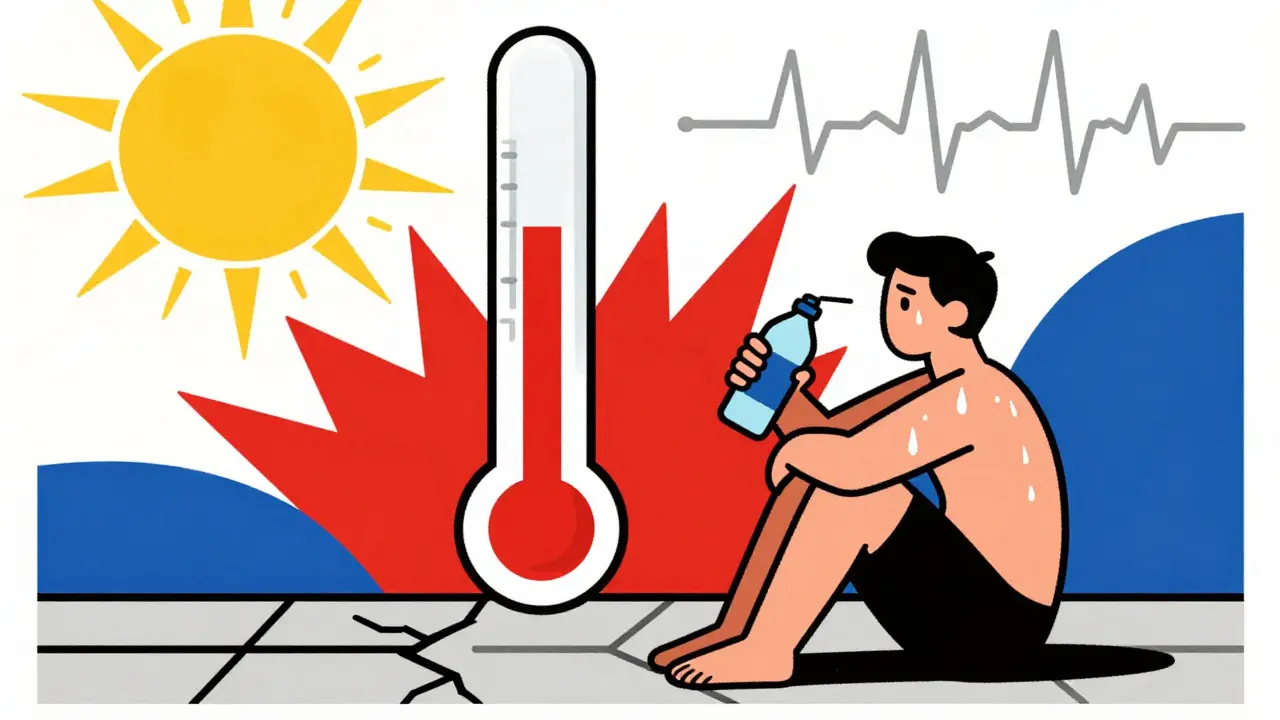
When the temperature hits 90°F and the air feels thick, most people think about staying cool, drinking water, and avoiding the sun. But for people who use drugs, extreme heat isn’t just uncomfortable-it’s deadly. Heatwaves don’t just raise body temperature; they raise the risk of overdose. And it’s not just about being outside. Even indoors without AC, the body struggles to process drugs the same way it does in cooler weather. This isn’t theoretical. In cities like Seattle, where summer heat used to be rare, overdose deaths spiked by 37% during the 2021 heat dome. People didn’t use more drugs-they just couldn’t handle what they already had.
Why Heat Makes Overdose More Likely
Your body works hard to stay at 98.6°F. When it’s hot outside, your heart pumps faster to move blood to the skin and cool you down. That’s normal. But if you’ve taken stimulants like cocaine or meth, your heart is already racing. Heat adds extra strain-up to 25 more beats per minute on top of a 40% increase from the drug. That’s a recipe for heart attack or stroke. Dehydration makes it worse. When you sweat, you lose fluids. Even a 2% drop in body water can concentrate drugs in your bloodstream by 15-20%. That means a dose you’ve taken safely before now hits like a stronger dose. It’s like drinking the same amount of alcohol on an empty stomach after a long hike. Your body can’t adjust fast enough. Opioids are just as dangerous. Heat slows down your body’s ability to breathe deeply and regularly. Opioids already suppress breathing. When you’re overheated, that suppression gets stronger. A 2022 study found that core body temperature rises of just 1.5°C can reduce respiratory compensation by up to 18%. That’s the difference between breathing okay and stopping altogether. And it’s not just the drugs. Many people take medications for mental health-antidepressants, antipsychotics, or blood pressure pills. About 70% of antipsychotics and 45% of antidepressants become less effective or more toxic in heat. That means someone managing depression or schizophrenia might feel worse, use more drugs to cope, and not realize their body is breaking down.Who’s Most at Risk
You don’t have to be homeless to be in danger. But homelessness increases risk dramatically. About 38% of people experiencing homelessness have a substance use disorder. They’re more likely to be outside, without water, without shade, and without access to cool spaces. In 2020, over half a million people in the U.S. were homeless on any given night. During heatwaves, many shelters turn people away if they’re actively using drugs. Some police departments even confiscate cooling supplies-misting towels, electrolyte packets-because they don’t understand they’re life-saving tools, not drug paraphernalia. People with chronic conditions-heart disease, kidney problems, diabetes-are also at higher risk. Heat stresses the body. If your organs are already working hard, adding drugs into the mix can push them over the edge. And here’s something many don’t realize: places that rarely see heat, like the Pacific Northwest, see the biggest spikes in overdose risk. Why? Because people there aren’t acclimated. Their bodies haven’t learned how to cope. In Arizona, where it’s hot every summer, the overdose increase during heatwaves is about 2.1 times normal. In Seattle or Portland, it’s up to 3.7 times higher.What You Can Do: Practical Harm Reduction Steps
If you or someone you know uses drugs, here’s what works-based on real programs that saved lives.- Reduce your dose by 25-30% during heatwaves. Your body processes drugs differently when it’s hot. What felt safe last week might kill you now.
- Drink water-on a schedule. Don’t wait until you’re thirsty. Drink one cup (8 oz) every 20 minutes. Cool water, between 50-60°F, is best. Avoid alcohol, caffeine, or sugary drinks-they make dehydration worse.
- Use a buddy system. Never use alone. If you feel dizzy, nauseous, or confused, stop. Your friend can call 911 or give naloxone if needed. Naloxone doesn’t reverse stimulant overdoses, but it can save lives in mixed-drug situations.
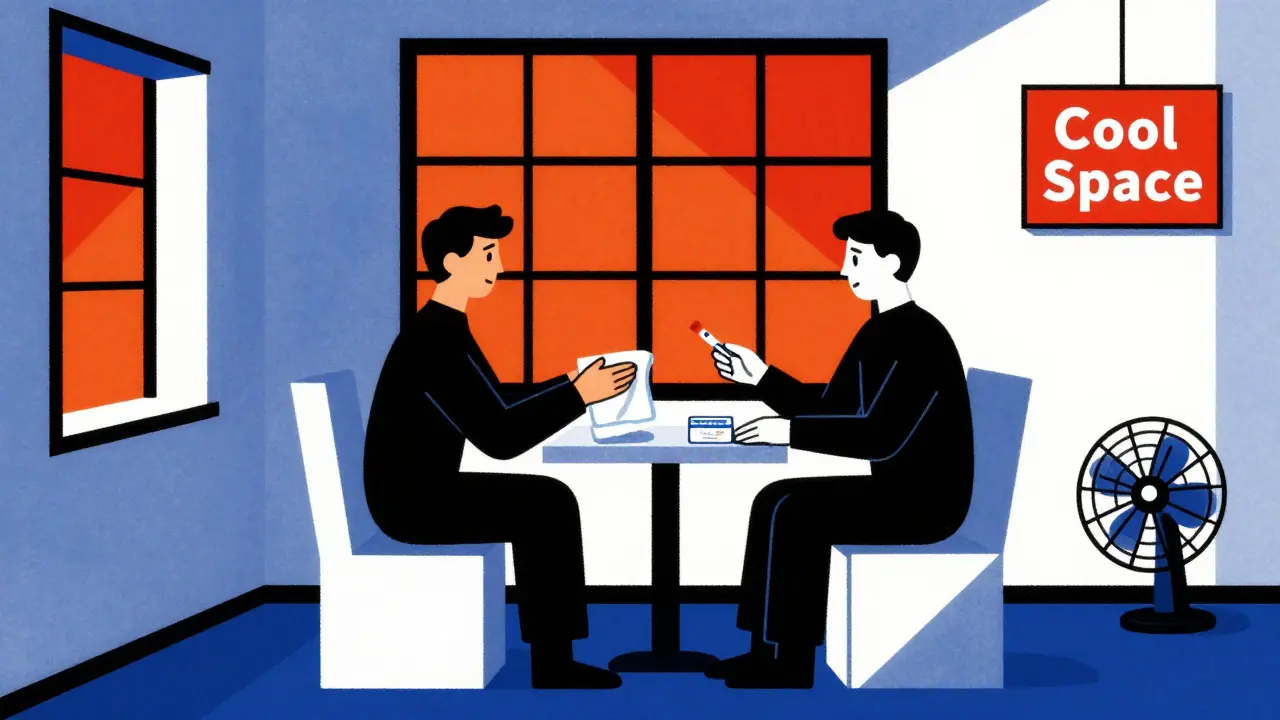
- Find a cool space. Libraries, community centers, malls, and public transit stations often have AC. Some cities now offer free cooling centers with trained staff who won’t call the police. Ask local harm reduction groups where they are.
- Use cooling tools. Wet a towel, put it on your neck or wrists. Use a fan. If you have ice packs, wrap them in cloth and press them to your armpits or groin. These spots have major blood vessels-cooling them lowers core temperature fast.
What Service Providers Should Do
Harm reduction organizations, clinics, and outreach workers are on the front lines. They need to act before people die.- Distribute cooling kits. These should include electrolyte packets, small misting bottles, cooling towels, and clear printed instructions. Philadelphia gives out 2,500+ kits every summer. They’ve seen a 17% drop in heat-related overdose calls.
- Train staff on heat risk screening. Use tools like the CHILL’D-Out questionnaire. It asks about housing, meds, heart conditions, and drug use. If someone checks three or more boxes, they need extra support.
- Partner with cooling centers. Vancouver’s program co-located air-conditioned respite centers with supervised consumption sites. During the 2021 heat dome, heat-related overdose deaths dropped by 34%.
- Advocate for policy change. Only 12 out of 50 U.S. states include drug users in their official heat emergency plans. That has to change. If your city doesn’t have a plan, push for one. Use data: people who use drugs make up 18-22% of heat-related ER visits.
What’s Changing-and What’s Coming
Climate change isn’t slowing down. By 2050, the U.S. could see 20-30 more days each year above the 24°C (75°F) threshold where overdose risk spikes. The CDC and WHO now recognize this as a public health emergency. The Biden administration allocated $50 million in 2023 to force states to include overdose risk in heat response plans by December 2025. New research is emerging too. Scientists are finding that heat changes the gut microbiome-which affects how drugs are broken down. That could mean future harm reduction advice will need to include dietary tips, not just hydration. For now, the tools we have work. Hydration. Lower doses. Cool spaces. Buddy systems. Naloxone. These aren’t new ideas. But in heatwaves, they’re life-or-death.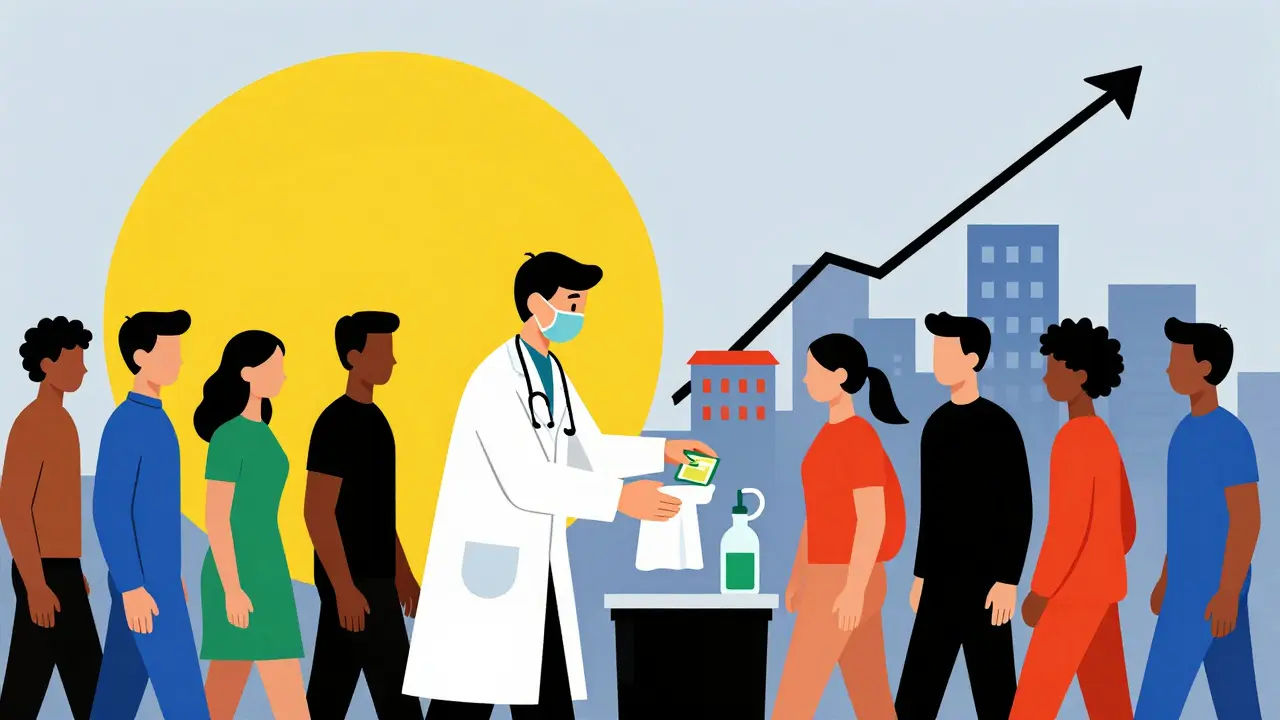
What to Do If Someone Overdoses in the Heat
If someone collapses, isn’t breathing, or is unresponsive:- Call 911 immediately. Say: “I think this is an overdose, and it’s hot-this person may be overheated.”
- Start CPR if they’re not breathing. Push hard and fast on the center of the chest.
- If you have naloxone, give it. Even if the drug isn’t an opioid, it won’t hurt-and it might help if the person used mixed drugs.
- Move them to a cooler place. Take off excess clothes. Wet their skin with water. Fan them.
- Stay with them until help arrives. Heat and overdose together make recovery slower. They need monitoring.
Don’t wait for symptoms to get worse. Heat makes things move fast. A person who seemed fine 10 minutes ago can stop breathing in under a minute.
Can drinking water really prevent an overdose during a heatwave?
Yes-when combined with other steps. Dehydration makes drugs more concentrated in your blood, so even your usual dose can become too strong. Drinking one cup of water every 20 minutes helps your body flush toxins and keeps your blood volume stable. But water alone won’t stop an overdose if someone uses too much. It’s part of a bigger strategy: lower doses, cool spaces, and having naloxone nearby.
Do I need to stop using drugs during a heatwave?
You don’t have to quit, but you do need to change how you use. Reducing your dose by 25-30% and avoiding using alone or in hot places can cut your risk significantly. Many people think they have to be sober to stay safe-but harm reduction is about reducing risk, not eliminating use. If you’re not ready to stop, make your use safer.
Are cooling centers safe for people who use drugs?
Some are, some aren’t. Look for centers run by public health departments or harm reduction organizations. Avoid shelters that have policies against drug use-many will turn you away or call police. In cities like Vancouver and Philadelphia, cooling centers are co-located with needle exchanges or overdose prevention sites. They’re designed to be nonjudgmental. Ask local groups: “Which cooling centers won’t call the cops?”
Why don’t more cities have heat plans that include drug users?
Because stigma still shapes policy. Many officials don’t see people who use drugs as “deserving” of protection. But data doesn’t lie: this group has the highest risk of dying during heatwaves. The CDC found that only 28% of city heat plans mention substance use. That’s changing, slowly. Federal funding now requires states to include overdose risk in their plans by 2025. Change is coming-but it’s not here yet.
Can I get naloxone for free?
Yes. In most U.S. states, you can get naloxone for free at pharmacies without a prescription, or from local harm reduction groups. Some cities mail it out for free. Call your local health department or search “naloxone near me” with your city name. Keep it in your bag, your car, your pocket. It’s small, it’s simple, and it can save a life.
Next Steps: What to Do Today
If you use drugs:- Check your local health department’s website for heat advisories.
- Call a harm reduction hotline or drop-in center. Ask: “Where are the cool places?”
- Get naloxone if you don’t have it.
- Text a friend: “If I don’t respond in an hour, check on me.”
- Reduce your dose-even a little-until the heat passes.
If you’re a friend, family member, or provider:
- Don’t assume someone’s fine because they’re not overdosing.
- Ask: “Are you staying cool? Are you drinking water?”
- Carry naloxone. Know how to use it.
- Push your city to include drug users in heat emergency plans.
Heat doesn’t care who you are. But your choices can still save your life-or someone else’s.
Comments (12)
christian ebongue
December 25, 2025 AT 16:08
Water ain't magic. But mixing it with lower doses and not being a dumbass in 100-degree heat? That's the bare minimum.
david jackson
December 25, 2025 AT 22:48
Let me tell you something nobody's saying loud enough - heat doesn't just make your body work harder, it rewires your brain's perception of risk. That dose you've done a hundred times? Your prefrontal cortex thinks it's still safe. But your amygdala? It's screaming. Your body's in survival mode, and drugs are the enemy now. I saw a guy in Portland last summer - used the same amount he always did, thought he was fine. He wasn't. His core temp hit 104.7°F. They found him curled up next to a broken AC unit, still holding the pipe. No one knew he was OD'ing because he wasn't blue - he was *red*. Like a lobster boiled alive. And that's the horror: heat overdoses don't look like overdoses. They look like heatstroke. They look like laziness. They look like 'he should've known better.' But the truth? He didn't have a chance. Not without a buddy. Not without water on a schedule. Not without someone who knew the difference between 'he's just hot' and 'he's dying.' We need to stop pretending this is about willpower. It's physiology. And we're failing it.
Jody Kennedy
December 27, 2025 AT 16:39
Y’all need to stop waiting for the system to save you. Get your naloxone. Find a cooling center. Text your friend. Drink water like it’s your job. You’re not weak for using - you’re weak if you don’t protect yourself. I’ve seen too many people die because they thought ‘it won’t happen to me.’ Spoiler: it will. But you can stop it. Start today. Not tomorrow. Today.
Alex Ragen
December 29, 2025 AT 07:34
Stupid question: why do cities still confiscate misting towels? Are they afraid people will get too comfortable? Like, if you’re not suffering, are you even worthy of living? #CapitalismIsAHellhole
Jeanette Jeffrey
December 29, 2025 AT 20:07
Oh look, another article telling people who use drugs how to survive. Meanwhile, the same people who wrote this are probably sipping iced matcha in their climate-controlled lofts. Real talk: if you're using drugs in a heatwave, you made bad life choices. No amount of hydration fixes a broken trajectory. Stop pretending this is about public health - it's about personal responsibility. Or lack thereof.
carissa projo
December 29, 2025 AT 21:40
There’s a quiet kind of courage in showing up for yourself when the world has already written you off. You don’t need to be perfect. You don’t need to quit. You just need to be a little kinder to your body today. Reduce the dose. Find the shade. Call your person. That’s not failure - that’s rebellion. And rebellion? It saves lives. I’ve held someone’s hand while they waited for EMS in a library bathroom during a heat dome. They didn’t die. Because they had water. Because they had a friend. Because they dared to ask for help. You’re not broken. You’re becoming. And that’s beautiful.
Zina Constantin
December 30, 2025 AT 14:12
Just got back from a harm reduction summit in Philly - they handed out 500 cooling kits today alone. Each one had a little note: 'You matter. Stay cool.' I cried. Not because it was fancy. But because someone finally said it out loud. And you know what? People showed up. Not to get judged. Not to get arrested. Just to survive. That’s the real story. Not the headlines. Not the stigma. The quiet, sweaty, determined act of choosing to live - one cup of water at a time.
Kuldipsinh Rathod
December 30, 2025 AT 20:34
I'm from India, we know heat. But I never thought about how it hits drug users differently. This is so real. My cousin used to take pills when he was stressed. In summer, he'd get dizzy, but we thought it was just the heat. Now I get it. He almost died once. This post saved me from being blind. Thank you.
Lori Anne Franklin
December 31, 2025 AT 11:46
Just got my free naloxone from the library! So easy. No ID, no shame. I keep it in my fanny pack next to my gum and phone charger. If someone needs it, they need it. No questions. I’ve got your back, stranger. 💙
Dan Alatepe
January 2, 2026 AT 01:05
bro… i just saw a dude pass out on the bus with a fan taped to his chest… i thought he was just vibin’… then i saw the empty baggie… i ran to the stop and grabbed a water bottle and wet his neck… 911 called… he woke up… i didn’t know what to do… but i did something… that’s all that matters 🫂
josue robert figueroa salazar
January 3, 2026 AT 14:58
They’ll give you a cooling towel but take your weed. Classic.
wendy parrales fong
January 4, 2026 AT 19:28
I used to think harm reduction was giving up. Now I know it’s the bravest thing you can do. Not quitting. Not pretending. Just trying to stay alive another day. That’s enough. More than enough. You’re not a statistic. You’re a person. And you deserve to breathe.