Medication Risk Estimator
Your medical history significantly impacts how your body responds to medications. This tool estimates your risk of side effects based on key factors from the article.
When you take a new medication, your doctor doesn’t just look at your current symptoms. They’re also reading your past - every illness you’ve had, every drug you’ve taken, every hospital stay, every allergy, every change in your body over time. That’s because your medical history isn’t just background information. It’s a roadmap to how your body will react to drugs - and where things could go wrong.
Your Body Remembers Every Drug You’ve Taken
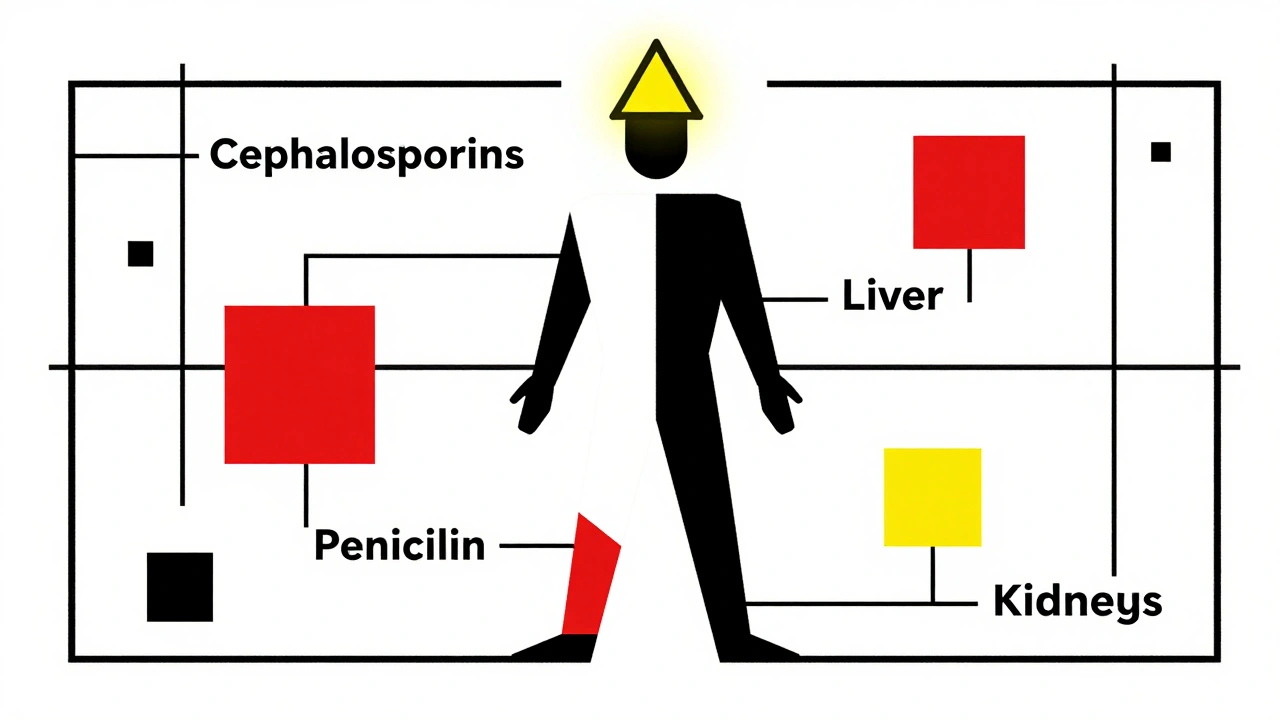
If you’ve had a bad reaction to one medication, your chances of reacting badly to another one go up - sometimes dramatically. A 2009 study found that people who had a previous adverse reaction to one drug class were 30-40% more likely to react to another drug in the same family. That’s why a penicillin allergy isn’t just about penicillin. It raises your risk of reacting to cephalosporins by up to eight times. Why? Because your immune system remembers. And sometimes, your liver and kidneys do too.
It’s not just allergies. If you’ve had liver damage from an old medication, your body may not break down new drugs the same way. If you’ve had kidney problems, your body can’t flush out drugs as quickly. That means even a normal dose can become toxic. The Merck Manual says patients with chronic kidney disease need dosage adjustments for 40% of common medications. For those with liver disease, it’s 25%. Yet, a Johns Hopkins study found that only 35% of electronic prescriptions even flag these known risks.
Polypharmacy: The Hidden Danger of Too Many Pills
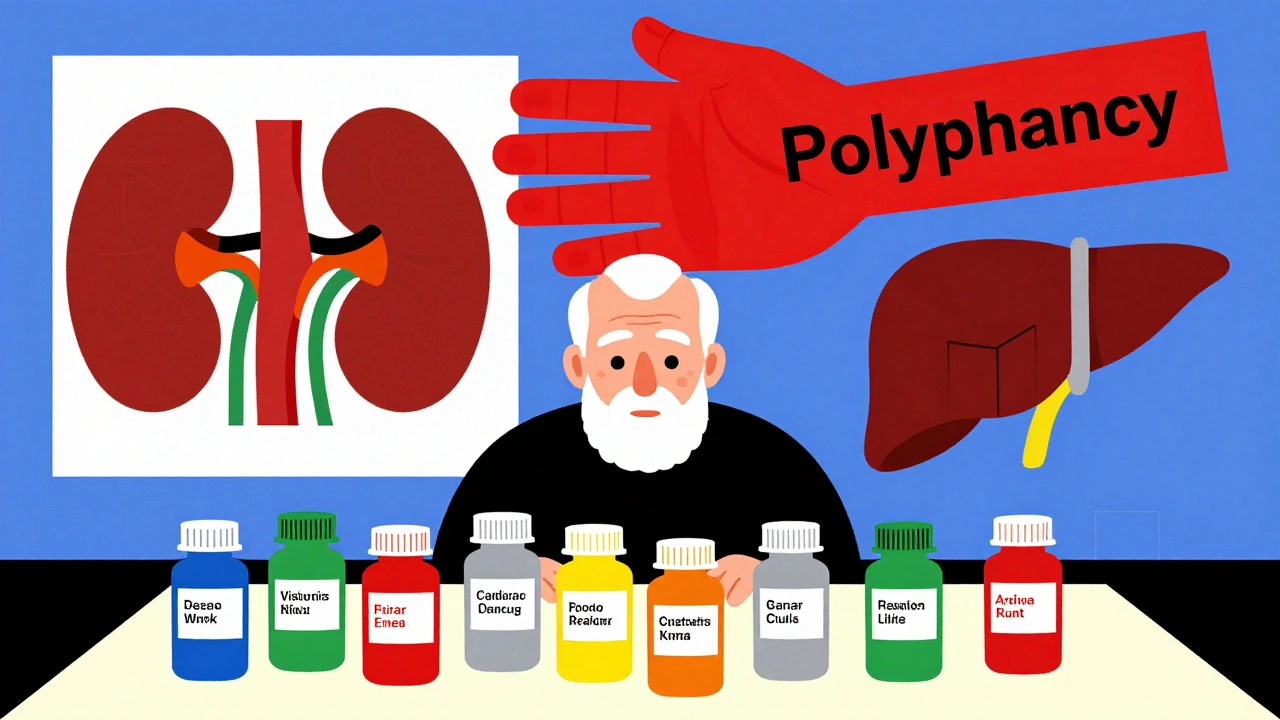
Taking five or more medications at once? You’re not alone - but you’re at serious risk. According to the British Heart Foundation, people on five to nine drugs are twice as likely to have an adverse reaction compared to those on fewer. If you’re on ten or more, your risk jumps over threefold. Each extra pill adds about 7-10% more chance of a dangerous interaction.
It’s not just about how many drugs you take - it’s how they interact. Warfarin, a blood thinner, mixed with common NSAIDs like ibuprofen? That combo causes over 34,000 emergency room visits in the U.S. every year. Why? Because both affect blood clotting. Your body can’t handle the double punch. And if you’ve been on these drugs for years, your system may have adapted in ways your doctor doesn’t even know about.
Age and Physiology: Why Older Adults Are at Higher Risk
As you get older, your body changes - and those changes affect how drugs work. After age 65, people experience 3 to 5 times more adverse drug reactions than younger adults. Why? Kidneys slow down. Liver enzymes become less efficient. Body fat increases, water decreases. All of this changes how drugs are absorbed, distributed, and cleared.
One major issue? Renal function. About 15% of U.S. adults over 60 have declining kidney function, measured by eGFR. That means 30% of commonly prescribed medications need lower doses. But a 2021 audit found that 45% of the time, doctors still prescribe the standard dose. That’s not just a mistake - it’s a safety gap.
And it’s not just physical changes. Cognitive decline increases risk too. A 2008 study found that patients with impaired cognition had a 13-times higher chance of a preventable medication error. Forgetting to take a pill? That’s one thing. Taking two doses by accident? That’s dangerous.
Gender Matters - Even If Your Doctor Doesn’t Talk About It
Women, especially older women, have a 50% higher rate of adverse drug reactions than men. Why? Because for decades, most drug trials were done on men. Between 2010 and 2020, women made up only 22% of participants in cardiovascular drug studies. That means dosing guidelines were built on male physiology - not female.
Women tend to have slower metabolism, higher body fat, and different hormone levels. These differences change how drugs move through the body. A dose that’s safe for a man might be too strong for a woman. Yet, most prescriptions still use the same numbers. That’s not just outdated - it’s risky.
Chronic Conditions Multiply the Risk
Having one chronic disease? You’re already at higher risk. Having three or more? Your risk skyrockets. The 2020 study from South Punjab found that patients with multiple comorbidities had 2.6 times higher odds of a medication error. The Charlson Comorbidity Index - a tool doctors use to measure how many long-term conditions you have - shows that each additional condition raises your risk by 31%.
Why? Because each disease affects how your body handles drugs. Diabetes? That changes how your liver processes insulin and other meds. Heart failure? That slows how drugs are cleared from your blood. COPD? That alters how your lungs absorb inhaled drugs. And if you’re taking meds for all of these at once? The interactions multiply.
And here’s something most people don’t realize: medications can mimic disease symptoms. Beta-blockers can hide signs of a heart attack. Steroids can mask the pain of a ruptured ulcer. If your doctor doesn’t know your full history, they might think you’re getting sicker - when you’re just reacting to a drug.
Cost and Nonadherence: The Silent Killer
One in four patients skip doses because they can’t afford their meds. That’s not just bad for your health - it’s dangerous. When you stop and start medications without guidance, your body gets confused. A 2022 study of over 12,000 Medicare patients found that this pattern leads to 37% more treatment failures and 28% more side effects when they restart.
Why? Because your body adjusts to having a drug in your system - then it adjusts again when you stop. Restarting at the old dose can overload you. It’s like revving a cold engine. The body doesn’t know what to expect. That’s why doctors need to know if you’ve missed doses - not just what’s on your prescription list.
What You Can Do: Protect Yourself
You can’t control every risk - but you can control how much your doctor knows. Here’s how:
- Keep a written list of every medication you take - including supplements, vitamins, and over-the-counter drugs. Update it every time something changes.
- Bring your list to every appointment - even if you think your doctor already knows. Most EHRs are incomplete.
- Ask: “Could this be a side effect?” If you feel weird after starting a new drug, don’t assume it’s your condition worsening. Ask if it could be the medication.
- Request a medication review - especially if you’re on five or more drugs. A 2023 Cochrane Review found that structured reviews reduce side effects by 22%.
- Know your genetic risks - if you’ve had unexplained reactions before, ask about pharmacogenomic testing. Platforms like YouScript analyze 27 gene-drug interactions and can cut your risk by 34% if you have relevant variants.
Still, adoption is low. Only 5.7% of U.S. healthcare systems use genetic testing for meds. And only 18% of eligible patients get formal medication reviews. That means the burden is often on you.
The Bottom Line
Your medical history isn’t just a record. It’s a warning system. Every past illness, every drug reaction, every missed dose, every change in your body - it all matters. And if your doctor doesn’t know it, they can’t protect you.
Adverse drug reactions are one of the leading causes of hospital admissions in the U.S. - and most of them are preventable. The fix isn’t a new drug. It’s better communication. Better records. Better questions.
Know your history. Share it. Demand that it’s used. Because when it comes to your meds, your past isn’t just relevant - it’s life-saving.
Comments (10)
Sam Mathew Cheriyan
December 6, 2025 AT 17:37
lol so u mean my grandpa’s 17 pills ain’t just ‘old person stuff’? 😅 i thought he was just forgettin’ which one was for his ‘magic beans’... turns out his liver’s been cryin’ since 2012. 🤦♂️
Nancy Carlsen
December 8, 2025 AT 07:41
This is so important 💖 I’ve seen so many elderly patients get prescribed the same dose as a 30-year-old man and wonder why they’re dizzy all day. Your body isn’t a one-size-fits-all machine. Advocate for yourself - you deserve to be heard. 🌸
Helen Maples
December 9, 2025 AT 09:42
The data is clear. Doctors are not adequately trained in pharmacokinetics across comorbid populations. Electronic health records fail to flag critical interactions because they’re designed for billing, not safety. This isn’t negligence - it’s systemic failure. Stop accepting half-measures.
Oliver Damon
December 10, 2025 AT 16:54
The pharmacogenomic gap is staggering. CYP2D6 and CYP2C19 polymorphisms account for up to 30% of variable drug response in the general population, yet testing remains underutilized due to reimbursement barriers and clinician unawareness. We’re treating physiology like it’s static when it’s dynamically encoded in our DNA.
Kyle Oksten
December 11, 2025 AT 03:52
I’ve spent years in the medical system. What I’ve learned is this: your history isn’t just data - it’s your body’s autobiography. If your doctor doesn’t read it like a novel, you’re not a patient. You’re a risk factor with a pulse.
Stacy here
December 12, 2025 AT 09:34
They don’t want you to know this… but pharmaceutical companies profit from side effects. More ER visits = more prescriptions = more profit. They fund the studies that downplay gender differences. They lobby against mandatory genetic testing. This isn’t medicine - it’s a money machine. Wake up.
Jennifer Anderson
December 12, 2025 AT 19:21
i used to think my anxiety was just stress… then i realized it was the ibuprofen i took daily for years. now i only take it when i absolutely have to. my body thanked me. 🙏
Kyle Flores
December 13, 2025 AT 14:16
my mom skipped her blood pressure med for 3 months because it cost $80 a bottle. when she restarted, she got so dizzy she fell. the doc blamed her ‘noncompliance’ - but never asked why she couldn’t afford it. we need real solutions, not guilt.
Sadie Nastor
December 14, 2025 AT 07:34
i just started a med list in my phone notes. added my turmeric, magnesium, and that gummy vitamin i thought didn’t count… turns out it does. 🤯 so glad i read this. thank you for writing it. i feel less alone now 🌻
Ernie Blevins
December 15, 2025 AT 10:21
you people are overcomplicating this. if you take too many pills, you get sick. duh. stop blaming doctors. blame the people who take 12 pills a day and still think they’re healthy. fix yourself first.