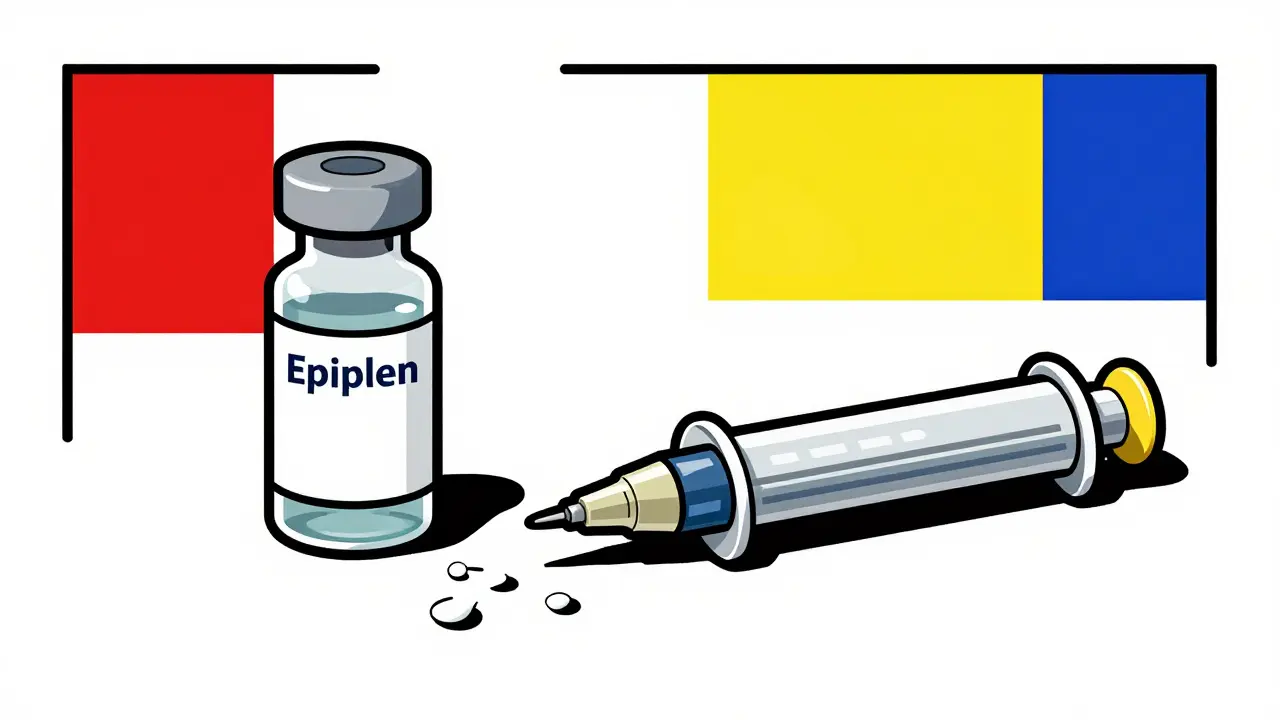
When you take a pill for high blood pressure, you probably don’t think about whether it’s a brand or a generic. Most of the time, it doesn’t matter - the generic works just as well, costs less, and your pharmacy swaps it without asking. But what happens when your medicine isn’t just a pill? What if it’s a pill and a device - like an inhaler, an injector, or a patch that only works with a specific holder? That’s where things get messy. This is the reality of generic combination products: when you need two or more generic parts to replace one branded product, and the system isn’t built to handle it.
What exactly is a combination product?
A combination product isn’t just two medicines mixed together. It’s a product that combines a drug, a device, or a biological component - and they’re designed to work as one unit. Think of an EpiPen. It’s not just epinephrine. It’s the drug plus the auto-injector that delivers it correctly. Or an inhaler like Advair: the drug is inside, but the inhaler device controls how much you get, when you get it, and how deep it goes into your lungs. The FDA calls this a combination product is a therapeutic product that combines a drug, device, or biological component in a single unit or system, where the components are intended for use together.
The key is interaction. If the device fails - if the needle jams, the dose is wrong, or the spray doesn’t reach the right spot - the drug doesn’t work. That’s why regulators treat these differently. The FDA doesn’t just look at the drug. They look at how the whole system performs. This is called the Primary Mode of Action (PMOA) is the single most important therapeutic effect in a combination product, which determines which FDA center reviews it. If the drug does the main job, the Center for Drug Evaluation and Research (CDER) handles it. If the device does the main job - like in an insulin pump - then it’s reviewed by the Center for Devices and Radiological Health (CDRH). This split makes approval harder, and it’s one reason why generic versions lag behind.
Why can’t you just swap the drug part?
Here’s the problem: current pharmacy laws assume substitution is simple. If a brand-name drug like Lipitor has a generic, you get the generic pill - no questions asked. But with combination products, swapping just the drug isn’t enough. You need the matching device too. And often, that device doesn’t have a generic version.
Take the case of generic epinephrine auto-injectors. In 2023, the FDA approved the first generic version of epinephrine - the drug itself. But the auto-injector device? No generic version was approved yet. So pharmacists couldn’t substitute it. Patients still had to pay full price for the branded EpiPen, even though the drug inside was now cheaper. A Reddit user summed it up: “I got the generic epinephrine, but my pharmacy said I still need the branded injector. Why? Because the injector is part of the product.”
This isn’t rare. In 2023, only 38% of complex combination products had more than one generic approved. Compare that to 72% for regular pills. That gap exists because developing a generic version of a device is expensive and complicated. The FDA requires human factors engineering (HFE) is a six-phase process to test how safely and effectively a device is used by patients, especially for generic versions of combination products testing. That means real people - with real hands, real vision, real stress - have to use the generic device to prove it works just like the brand. It’s not enough to say the drug is the same. You have to prove the whole system behaves the same.
The hidden costs of complexity
It’s not just regulatory hurdles. It’s money. Developing a generic combination product can cost between $2.1 million and $3.7 million more than a regular generic. It adds 9 to 15 months to development time. That’s why only 17 companies are responsible for 83% of all approved generic combination products. Most manufacturers can’t afford to try.
Patients feel the pinch. Data from patient forums shows people pay 37% more out-of-pocket for these products than for regular generics. Pharmacists report that 68% have faced confusion from patients asking why their insurance won’t cover the generic. One survey found 42% of pharmacists get at least one patient complaint per month about substitution issues.
Doctors aren’t immune either. A 2024 AMA survey found 57% of providers had treatment delays because they couldn’t switch a patient to a generic combination product. The average delay? 3.2 business days. That’s time lost. Pain prolonged. Risk increased.
Why don’t states fix this?
State laws still treat substitution like it’s 2005. Most allow pharmacists to swap generics automatically - as long as the drug is the same. But they don’t account for devices. That’s changing. In 2024, 14 states introduced new bills to update substitution rules. California’s AB-1847 and Massachusetts’ H.3982 now require pharmacists to consider both the drug and the device when substituting. If the generic device exists and is approved, they can switch. If not? They have to tell the patient.
This is progress. But it’s slow. Only 12% of generic manufacturers say FDA guidance on these products is clear. The FDA itself admits that 43% of rejected applications between 2020 and 2023 failed because of incomplete device comparisons. That’s not a lack of trying - it’s a lack of clear rules.
What’s changing in 2025 and beyond?
The FDA isn’t ignoring this. In June 2024, Commissioner Dr. Robert Califf launched Complex Generic Initiative 2.0 is a federal program aimed at accelerating approval timelines for complex generic combination products by reducing review times and increasing staff expertise. The goal? Cut approval time by 30% by 2026. The FDA has hired 32 new reviewers specializing in combination products - a 45% increase since 2022.
Industry analysts now predict generic penetration in this space could rise from 12% to 35% by 2027. That’s still far below the 90% seen in regular generics - but it’s a jump. The global market for these products is growing fast, projected to hit $214 billion by 2028. And with more companies entering the space, competition is starting to build.
Some of the most promising areas are respiratory inhalers and insulin delivery systems. Inhalers have seen 38% generic penetration. That’s because the devices are simpler, and manufacturers have figured out how to replicate them. Auto-injectors? Only 19%. The needle, the spring, the click - every part has to match perfectly. That’s hard. But it’s not impossible.
What does this mean for you?
If you’re on a combination product - whether it’s an inhaler, injector, or patch - here’s what you need to know:
- Ask your pharmacist: “Is there a generic version of the whole product - drug and device?” Don’t settle for just the drug.
- Check the FDA’s database. The agency publishes approved generic combination products. Don’t assume your pharmacy knows.
- If your insurance denies a generic, appeal. You’re not asking for a luxury - you’re asking for the same medicine at a fair price.
- Speak up. If you’ve been overcharged or delayed because of substitution rules, tell your doctor, your pharmacy, and your state representative.
Generic drugs saved the U.S. healthcare system hundreds of billions. But combination products are the next frontier. The rules were written for pills. They weren’t written for systems. And until they are, patients will keep paying more - and waiting longer - for medicines they should be able to access easily.
Can I substitute a generic drug for a branded combination product if I keep the original device?
No. Even if the drug is generic and identical, the device is part of the approved product. Using a branded device with a generic drug creates an unapproved combination. This can affect safety, dosing, and insurance coverage. The FDA requires the entire system - drug and device - to be approved together as a single unit.
Why are generic combination products so expensive?
They’re expensive because development is complex and costly. Manufacturers must replicate both the drug and the device, prove they work together, and pass rigorous human factors testing. The process can cost $2-4 million more than a regular generic and take 1-2 extra years. Few companies can afford this, so competition stays low - and prices stay high.
Do insurance companies cover generic combination products?
Sometimes - but not always. Many insurers still treat combination products as brand-only, even if a generic version exists. This is because their systems aren’t updated to recognize the product as a whole. Always check with your pharmacy and insurer. If denied, file an appeal with the FDA-approved generic product name and approval number.
How do I find out if a generic combination product is approved?
Visit the FDA’s Drugs@FDA database and search for the brand name. Look for approved Abbreviated New Drug Applications (ANDAs) with matching device components. You can also ask your pharmacist to check the FDA’s list of approved generic combination products, which is updated monthly.
Are there any combination products where generics are already common?
Yes. Respiratory inhalers like those for asthma (e.g., fluticasone/salmeterol) have seen the highest generic adoption, with 38% market share. This is because the inhaler devices are simpler to replicate. Insulin pens and some patch systems are also seeing growth. Auto-injectors and complex implantable devices remain the hardest to genericize.
What’s next?
The future of generic combination products depends on three things: clearer rules, more funding, and patient pressure. The FDA is moving in the right direction. States are starting to catch up. But until patients demand change - until they ask for their rights to affordable, interchangeable medicines - the system will keep favoring brands over generics. The goal isn’t just to copy a pill. It’s to copy a system. And that’s harder. But it’s necessary.
Comments (12)
Jimmy V
March 14, 2026 AT 20:48
Let’s cut through the BS: this isn’t about innovation. It’s about profit. Pharma companies lock in device patents like they’re guarding the Holy Grail. The FDA? They’re stuck in 2008 paperwork mode. Generic drug makers? They’d rather make 100 million pills than risk $3M on a spring-loaded injector that might fail a human factors test. Meanwhile, diabetics are paying $500 for an insulin pen because the needle’s ‘too complex’ to copy. It’s not science. It’s corporate greed dressed up as regulation.
Sally Lloyd
March 16, 2026 AT 20:37
Y’know what they don’t tell you? The same companies that make the branded devices also own the patents on the generic ones. They approve the generic… then charge the same price. I’ve seen the filings. The FDA’s ‘approval’ is just a rubber stamp for the same monopoly. They call it ‘safety.’ I call it legal collusion.
Tim Schulz
March 18, 2026 AT 10:37
Oh wow, a 38% generic penetration rate in inhalers? That’s practically socialism. 🤡 Next you’ll tell me people can just swap their EpiPens like they’re trading baseball cards. I mean, come on - if the device doesn’t match, the whole thing’s a liability lawsuit waiting to happen. 🤦♂️
Elsa Rodriguez
March 20, 2026 AT 09:04
I can’t believe people are still arguing about this. My cousin got denied coverage for a generic inhaler because ‘the cap didn’t click the same way.’ She had to wait 11 days just to get her medicine. Eleven days. She had a panic attack. And now she’s on disability. This isn’t a policy issue - it’s a human tragedy wrapped in bureaucratic red tape. 😭
tamilan Nadar
March 20, 2026 AT 10:38
In India, we don’t have this problem. Why? Because generics are the rule, not the exception. We make inhalers, injectors, even patches - all with local manufacturing. The FDA’s human factors testing sounds noble, but it’s also a wall to keep out global competition. If you want affordable medicine, stop pretending American innovation is the only valid path.
Rosemary Chude-Sokei
March 21, 2026 AT 16:29
As someone who works in pharmacy compliance, I can confirm: pharmacists are caught in the middle. We’re trained to substitute - but when the device isn’t approved as a generic, we’re legally prohibited from switching. Patients get angry. We get blamed. Insurance systems don’t even have codes for ‘partial generic.’ It’s a mess. And no one in Congress is fixing it.
Kathy Leslie
March 22, 2026 AT 18:30
I just got my generic epinephrine refill yesterday. Pharmacy handed me the branded injector. Asked why. They said, ‘We don’t have the generic device yet.’ I said, ‘So I’m paying $400 for a $20 drug?’ They shrugged. I’m not mad. Just… tired. This isn’t healthcare. It’s a vending machine with a medical license.
Amisha Patel
March 23, 2026 AT 01:37
Can someone explain how human factors testing works? Like, do they give the device to elderly people with shaky hands? Kids? People with arthritis? I’m curious because my grandma uses an insulin pen and she can barely hold it. If the generic device doesn’t work for her, does that mean it’s unsafe? Or just not ‘perfect’?
Emma Deasy
March 24, 2026 AT 11:18
Let me be perfectly clear: this system is a catastrophe. A full-blown, systemic, catastrophic failure of public health infrastructure. The FDA, the pharmaceutical industry, the state legislatures - they are all complicit. Patients are being systematically exploited under the guise of ‘safety.’ We are not talking about minor inconveniences. We are talking about lives. Delayed treatment. Increased hospitalizations. Preventable deaths. And yet, here we are, still debating whether a spring-loaded injector is ‘too complex’ to replicate. This is not a policy debate. This is a moral emergency.
Kandace Bennett
March 24, 2026 AT 16:06
OMG I’m so sick of this. 🇺🇸 We have the BEST healthcare system in the world - why are we even talking about generics? 🤦♀️ If you can’t afford your medicine, maybe you shouldn’t be on it. Or move to Canada. Or India. Or wherever. We pay taxes for innovation. We don’t pay for ‘equivalent.’ This is why America leads. 🇺🇸👏🔥
Dylan Patrick
March 25, 2026 AT 22:55
Just got my asthma refill. Generic drug, branded injector. Paid $380. Called my doc. He said: ‘Ask your pharmacist to order the combo generic - it exists. It’s called Fluticasone/Salmeterol MDI AND it’s approved.’ Turns out, my pharmacy’s database hadn’t been updated since 2021. I’m not mad. Just disappointed. This isn’t hard. Update the system. Train the staff. Stop treating patients like tech support tickets.
Leah Dobbin
March 26, 2026 AT 18:36
As someone who works in medical device design, I can say this: replicating a generic auto-injector isn’t about copying a spring. It’s about reproducing the exact torque, resistance, acoustic feedback, and tactile response that a user expects. A 5% variance in activation force can mean the difference between a life saved and a life lost. This isn’t laziness. It’s precision engineering. And yes - it costs millions. But if you think this is a simple ‘swap the drug’ problem, you’ve never held a real injector in your hand.