
When you're pregnant, taking folic acid isn't just a suggestion-it's a medical necessity. The neural tube, which becomes your baby's brain and spine, closes by day 28 after conception. Most women don't even know they're pregnant that early. That's why doctors tell you to start folic acid before you conceive. But here's the part no one talks about enough: folic acid doesn't play nice with every medication you might be taking. And if you're on anything for seizures, autoimmune issues, or even infections, your prenatal vitamin could be doing more harm than good.
Why Folic Acid Matters More Than You Think
Folic acid is the synthetic form of folate, a B vitamin your body uses to build DNA and make new cells. During pregnancy, your baby's nervous system is forming at lightning speed. Without enough folate, the neural tube can fail to close properly, leading to serious birth defects like spina bifida or anencephaly. The CDC says taking 400 mcg daily cuts that risk by 50 to 70%. That’s why every prenatal vitamin you buy has it-usually between 600 and 1,000 mcg.
The government made sure most bread, pasta, and cereal are fortified with folic acid since 1998. That’s why NTD rates dropped by nearly half. But fortified foods alone aren’t enough. You still need the supplement. Why? Because absorption from food is only about 50%. Supplements? Up to 100% if taken on an empty stomach.
When Folic Acid Clashes With Your Medications
Here’s where things get dangerous. Folic acid doesn’t just help your baby-it can interfere with how your other drugs work.
If you’re taking phenytoin (Dilantin), carbamazepine (Tegretol), or valproic acid for epilepsy, your folic acid dose needs to be way higher-up to 4,000-5,000 mcg daily. Why? These drugs lower folate levels in your blood. But here’s the twist: too much folic acid can reduce how well these seizure meds work. One Reddit user, u/AnxiousMom2022, had breakthrough seizures after starting a standard prenatal vitamin while on phenytoin. Her neurologist had to increase her seizure meds and adjust her folic acid carefully.
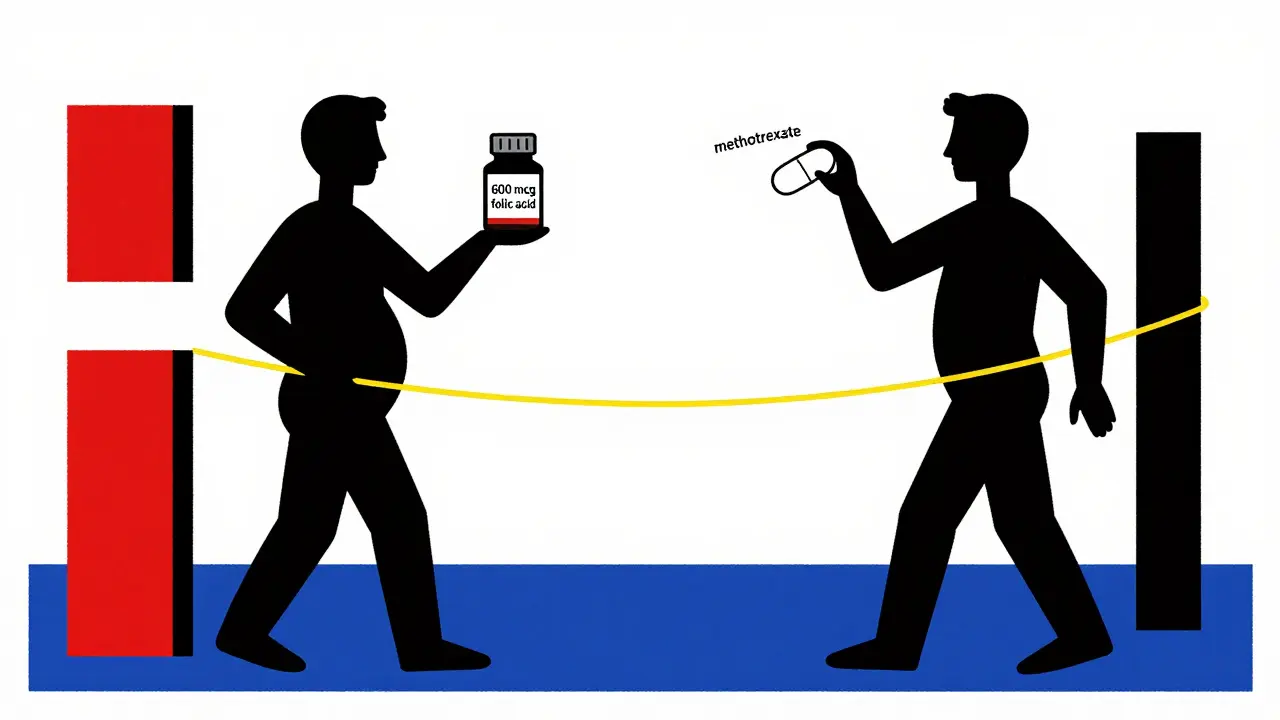
Same problem with methotrexate, used for rheumatoid arthritis or ectopic pregnancy. Methotrexate works by blocking folate. So giving folic acid alongside it sounds backwards-but it’s not. Doctors use low-dose folic acid (5-10 mg weekly) to reduce methotrexate’s side effects without killing its effectiveness. It’s a tightrope walk. Do it wrong, and you risk the drug failing. Do it right, and you protect your liver and gut.
Then there’s pyrimethamine, used to treat toxoplasmosis during pregnancy. Folic acid can make this drug less effective. Pharmacists at CVS report that 32% of pregnant women on pyrimethamine need their doses adjusted when they start prenatal vitamins. That’s not something you should guess at.
And don’t forget sulfasalazine, used for Crohn’s or ulcerative colitis. The UK’s NICE guidelines say folic acid can block its absorption. If you’re on this drug and pregnant, your doctor needs to know-and you need to be on a higher dose of folic acid, under supervision.
Iron and Calcium: The Silent Folic Acid Killers
You probably know prenatal vitamins have iron. What you might not know is that iron can cut folic acid absorption by 20-30% if you take them together. A 2017 study in the American Journal of Clinical Nutrition showed this clearly. So if you’re taking your prenatal with breakfast and it’s got both iron and folic acid, you’re not getting the full benefit.
Same goes for calcium. Milk, yogurt, antacids like Tums-all of them reduce folic acid absorption by 25-50%. The FDA updated labeling in 2021 to warn about this. So if you’re popping a prenatal with your morning latte and a Tums, you’re wasting money.
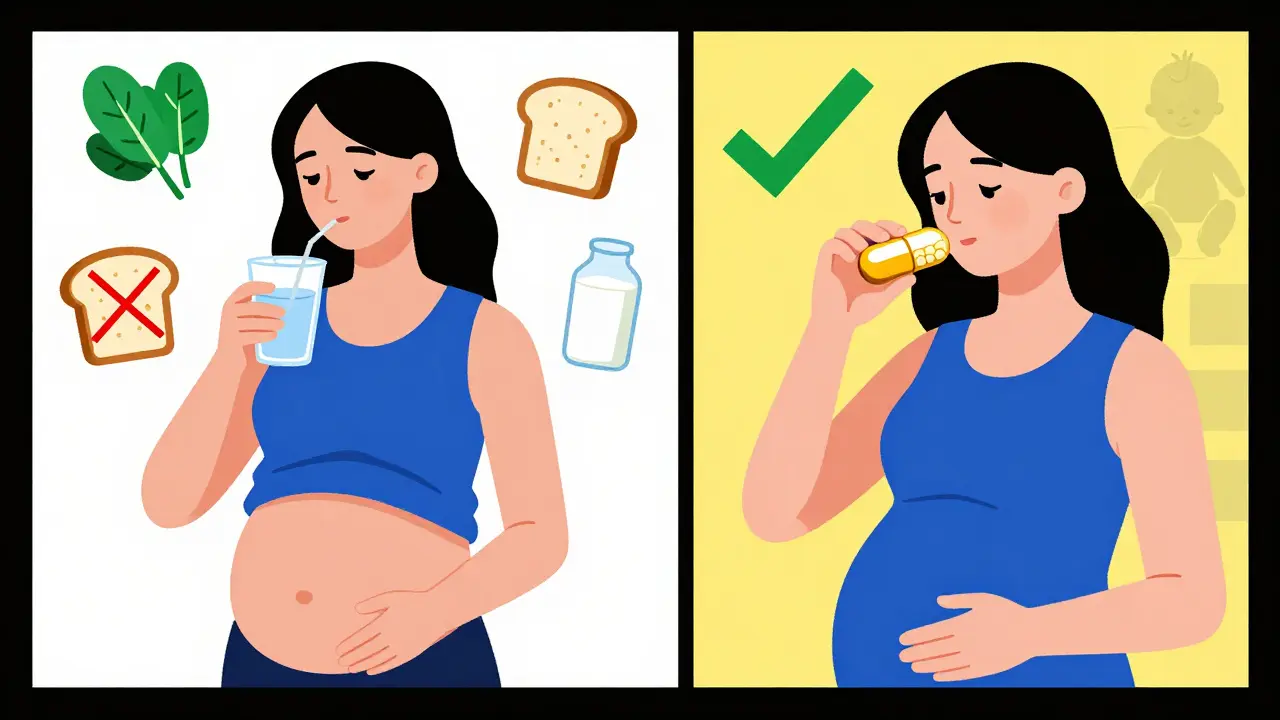
The fix? Take your prenatal on an empty stomach, with water, at least an hour before or after meals. If you get nauseous, take it at bedtime. Or split it: take folic acid alone in the morning, iron later in the day. Many women on Reddit say this cuts their nausea in half.
What About MTHFR? Should You Switch to L-Methylfolate?
One in five Hispanic women and one in ten Caucasians have a genetic variant called MTHFR 677C>T. This means their body can’t convert folic acid into the active form your baby needs. That’s why some women feel fine on regular prenatal vitamins, while others get headaches, fatigue, or even miscarriages.
For them, L-methylfolate (also called 5-MTHF or Quatrefolic®) is the answer. It’s the active form-no conversion needed. The FDA approved the first prenatal with Quatrefolic® in 2023. It costs about $46 a month, more than double the price of CVS Health’s version. But if you’ve had unexplained pregnancy loss, a baby with an NTD, or you know you have MTHFR, this isn’t a luxury-it’s essential.
Don’t self-diagnose. Get tested if you’ve got a family history of neural tube defects, recurrent miscarriages, or if you’ve been told you have high homocysteine levels. Your OB can order the test.
How Much Is Too Much?
The upper limit for folic acid is 1,000 mcg per day for adults. That’s what most prenatal vitamins hit. But some prescription versions go higher-up to 5,000 mcg-for high-risk cases. Taking more than that daily without a doctor’s order? Not worth the risk.
Some experts worry about unmetabolized folic acid building up in your blood. Dr. Joseph Selhub from Tufts University says it might mask B12 deficiency or even affect immune function over time. The CDC says there’s no confirmed harm-but they also say we don’t know everything yet. So stick to the guidelines. More isn’t better unless your doctor says so.
What to Look for in a Prenatal Vitamin
Not all prenatal vitamins are created equal. In a 2020 ConsumerLab test, 12 out of 15 met heavy metal safety standards. Some had dangerous levels of lead or arsenic. Always pick one with USP verification-look for the seal on the bottle.
Here’s what to check:
- Folic acid: At least 600 mcg. If you’re on anticonvulsants, you’ll need more-ask your doctor.
- Iron: 27 mg is standard. If you’re anemic, you may need more, but take it separately from folic acid.
- Form: If you have MTHFR, look for L-methylfolate. Otherwise, folic acid is fine and cheaper.
- Price: CVS Health Prenatal is $9/month. Thorne Basic Prenatal is $39/month. Both have the same folic acid dose. You don’t need to spend more unless you need special ingredients.
When to Start-and When to Stop
Start folic acid at least one month before you try to get pregnant. If you’re not planning, take it anyway. Half of all pregnancies are unplanned. By the time you miss your period, it’s already too late to prevent the most critical defects.
Keep taking it through the first trimester. After that, your baby’s neural tube is done. But many doctors recommend continuing through pregnancy and breastfeeding. Folate supports your own red blood cell production, and your baby still needs it through breast milk.
Don’t stop just because you feel fine. Symptoms don’t tell you if your baby’s getting enough. Blood tests aren’t routine, so trust the dose, not how you feel.
What Most Women Don’t Know
A 2023 survey by What to Expect found 43% of pregnant women didn’t know about medication interactions. 18% were taking anticonvulsants or autoimmune drugs without telling their OB. That’s terrifying. You wouldn’t skip a prenatal vitamin. But you might skip telling your doctor you’re on seizure meds. Don’t.
And don’t assume your pharmacist knows everything. They’ll see the folic acid and think, "More is better." But they won’t know you’re on sulfasalazine unless you tell them. Always list every medication you take-prescription, OTC, herbs, even supplements.
Also, forget the myth that folic acid causes autism. A 2022 JAMA Pediatrics study of 45,300 kids showed a 40% lower risk of autism when moms took folic acid before and during early pregnancy. But a 2021 Danish study found no link. The science isn’t settled, but the benefit is clear: taking the right dose reduces birth defects. That’s worth it.
Bottom Line: Do This Now
If you’re trying to get pregnant, or you’re already pregnant:
- Check your prenatal vitamin. Does it have at least 600 mcg folic acid?
- Are you on any of these? Seizure meds, methotrexate, sulfasalazine, pyrimethamine? Tell your OB and pharmacist.
- If you’ve had a previous pregnancy with an NTD, or you have MTHFR, ask for L-methylfolate.
- Take your vitamin on an empty stomach, or at least an hour before or after food.
- Don’t take calcium or antacids with it.
- Don’t take iron and folic acid at the same time-split them.
- Don’t take more than 1,000 mcg unless your doctor says so.
Folic acid isn’t magic. But it’s one of the few things in pregnancy that’s proven to prevent devastating birth defects. Get the dose right. Avoid the interactions. And don’t let confusion cost your baby their health.
Can I take folic acid with my prenatal vitamin if I’m on seizure medication?
No-not without medical supervision. If you’re on phenytoin, carbamazepine, or valproic acid, standard prenatal folic acid doses can reduce how well your seizure meds work. You’ll likely need a much higher dose-4,000 to 5,000 mcg daily-and your neurologist must coordinate with your OB. Never adjust this on your own.
Is L-methylfolate better than folic acid during pregnancy?
For most women, folic acid works fine. But if you have the MTHFR gene variant-which affects 10-25% of people-your body can’t convert folic acid efficiently. In those cases, L-methylfolate (like Quatrefolic®) is the better choice. It’s already active, so your body can use it right away. If you’ve had a previous neural tube defect, recurrent miscarriages, or high homocysteine levels, ask your doctor for a genetic test.
Can I take iron and folic acid together?
No. Iron reduces folic acid absorption by 20-30%. If your prenatal has both, take it at least two hours apart from any iron supplement or iron-rich meal. Many women find it easier to take their prenatal at night and an iron tablet in the morning. This also helps with nausea.
Does folic acid cause autism?
No. A large 2022 study of over 45,000 children found that taking folic acid before and during early pregnancy reduced autism risk by 40%. Some earlier studies didn’t find a link, but the most robust data shows benefit, not harm. The idea that folic acid causes autism is a myth that’s been debunked by multiple large-scale studies.
How do I know if my prenatal vitamin is safe?
Look for the USP Verified mark on the bottle. This means it’s been tested for purity, potency, and safety-no harmful metals like lead or arsenic. Avoid brands that don’t list their testing standards. ConsumerLab tested 15 prenatal vitamins in 2020; only 12 passed. Price doesn’t guarantee quality-CVS Health Prenatal is affordable and meets standards.
Can I get enough folic acid from food alone?
No. Even with fortified foods like bread and pasta, you’d need to eat about 10 cups of spinach daily to reach 600 mcg. Fortified foods give you about 140 mcg per 100g, and natural folate is only 50% absorbed. Supplements are the only reliable way to get the full dose your baby needs.
If you’re taking any medication and thinking about pregnancy-or already pregnant-talk to your doctor before making any changes. Folic acid is powerful, but it’s not harmless. Get the right dose. Avoid the interactions. And protect your baby’s future.
Comments (11)
Katrina Morris
January 6, 2026 AT 20:27
i took my prenatal with coffee and a tums for weeks before i realized this might be a problem 😅 thanks for the heads up
steve rumsford
January 7, 2026 AT 04:32
man i wish someone told me this before my first trimester. i was popping that cvs prenatal with breakfast like it was cereal. no wonder i felt like a zombie
Anthony Capunong
January 9, 2026 AT 01:34
why are we even letting big pharma control what we take? folic acid is synthetic junk. real food has folate. if you’re eating right you don’t need this crap. the government pushed this to sell more pills. look at the history
Kyle King
January 10, 2026 AT 19:41
they’re hiding the truth. folic acid doesn’t cause autism, but it hides the real cause-the vaccines. the CDC knows. they’ve been suppressing studies since 2015. and now they want you to take more? think about it
Mina Murray
January 12, 2026 AT 10:22
you people are clueless. if you have MTHFR and take folic acid, you’re basically poisoning your baby with unmetabolized junk. i had two miscarriages before i switched to methylfolate. now i’m 24 weeks and thriving. stop listening to the walmart version of medicine
Rachel Steward
January 13, 2026 AT 10:22
the real tragedy isn’t the medication interactions-it’s that 80% of OBs don’t even screen for MTHFR. they hand you a CVS prenatal like it’s a free sample at the grocery store. your baby’s neural tube development is being left to chance because the system is broken. and now you’re supposed to trust a pharmacist who thinks more is better? please. this isn’t healthcare. it’s a lottery
Christine Joy Chicano
January 14, 2026 AT 14:55
the fact that folic acid absorption drops by half when you take it with calcium is wild. i used to chug milk with my prenatal like it was a smoothie. now i take mine at midnight with a glass of water and a pillow. life-changing. also-why does no one talk about how much better sleep feels when you’re not nauseous from bad timing?
Adam Gainski
January 15, 2026 AT 21:31
just wanted to add that if you’re on methotrexate, don’t panic. low-dose folic acid (5mg weekly) is actually standard protocol. it’s not counterproductive-it’s protective. my rheumatologist and OB coordinated my dose perfectly. the key is communication. tell everyone. even your yoga instructor. they might ask the right question
Anastasia Novak
January 17, 2026 AT 08:58
so let me get this straight. i’m supposed to spend $46 a month on some fancy methylfolate because my body is ‘broken’? meanwhile, my cousin in mexico takes prenatal gummies from the corner store and had a healthy baby. maybe the real issue is overmedicalizing normal biology. we’ve turned pregnancy into a science experiment
Jonathan Larson
January 19, 2026 AT 08:33
the data is clear: folic acid supplementation has reduced neural tube defects by over 60% since 1998. that is a public health triumph. while individual variations like MTHFR exist, they do not invalidate the overwhelming benefit for the population. the goal is not perfection-it is prevention. if you are on medication, consult your provider. if you are not, take the supplement. it is one of the most effective, evidence-based interventions in modern obstetrics
Vince Nairn
January 20, 2026 AT 04:40
you know what’s funny? i took folic acid for 3 months before i knew i was pregnant. didn’t even know what it was. just saw it on the bottle. baby’s 2 now and runs like a cheetah. maybe the real advice is: chill out. your body knows what to do