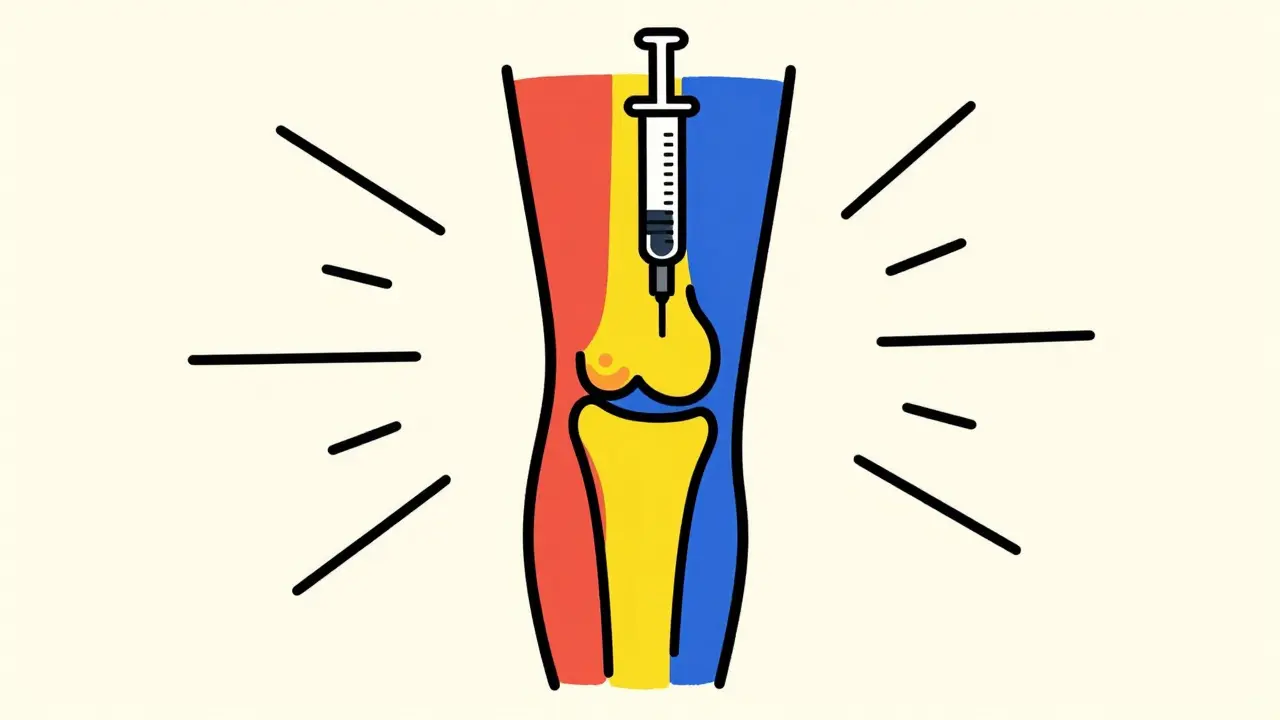
When your knee swells up after a long walk, or your shoulder aches so badly you can’t reach for a coffee mug, corticosteroid injections-often called cortisone shots-might come up in your doctor’s office. They’re one of the most common treatments for joint pain in the U.S., with over 10 million given every year. But here’s the thing: they don’t fix the problem. They just quiet it down. And if you don’t know when to use them-or when to stop-they can do more harm than good.
How Corticosteroid Injections Actually Work
Corticosteroids are lab-made versions of cortisol, a hormone your body naturally makes to control inflammation. When you get a joint injection, the drug doesn’t just sit there. It goes straight into the inflamed tissue and shuts down the inflammatory cascade at the cellular level. It blocks signals from immune cells that cause swelling, heat, and pain. It also reduces the production of proteins like interleukin-6 and tumor necrosis factor-alpha, which are major drivers of joint damage in conditions like rheumatoid arthritis and gout.
Most injections combine a corticosteroid-like triamcinolone, methylprednisolone, or betamethasone-with a fast-acting numbing agent like lidocaine. You’ll feel immediate relief from the numbing part, but the real anti-inflammatory effect kicks in after 24 to 72 hours. That’s why some people think the shot didn’t work if they don’t feel better right away. It’s not broken. It’s just early.
Which Joints Are Commonly Treated?
Not all joints respond the same. The most common injection sites include:
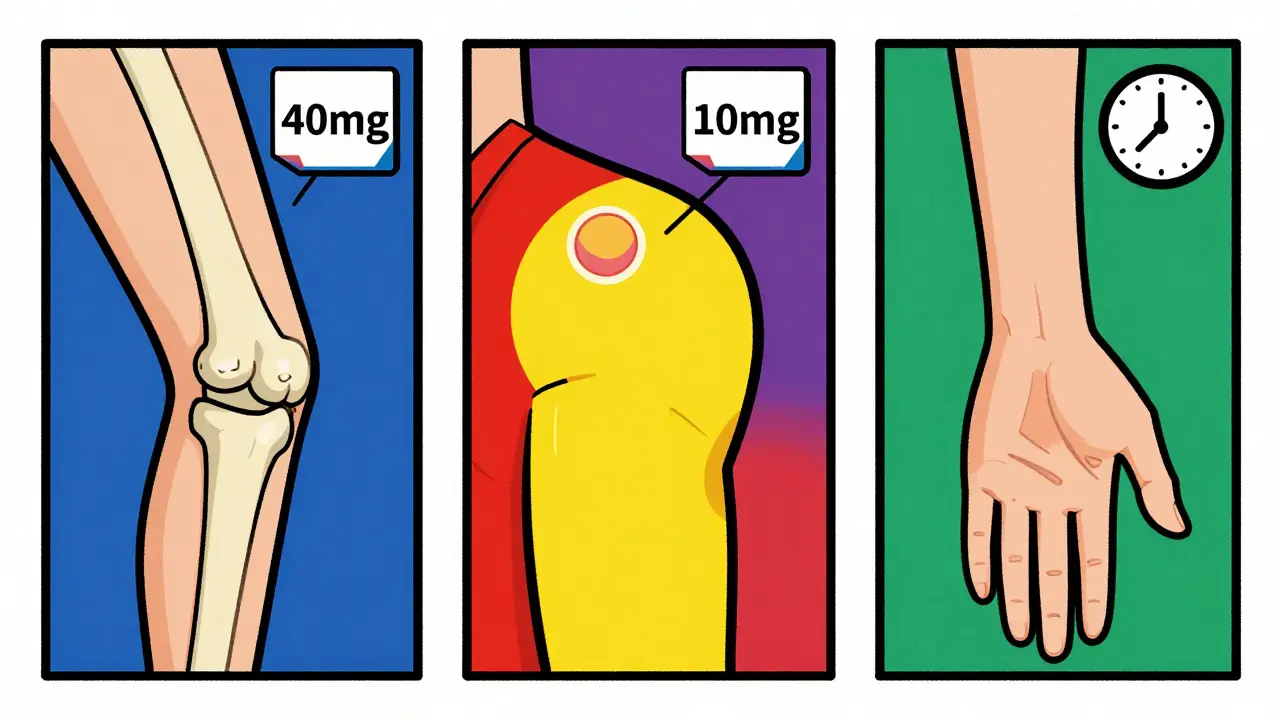
- Knees: Most frequent target, especially for osteoarthritis and bursitis. Doses range from 40 to 80 mg.
- Shoulders: Used for rotator cuff tendinitis, subacromial bursitis, and frozen shoulder.
- Hips: Often injected for trochanteric bursitis or osteoarthritis.
- Wrists and hands: Common for carpal tunnel syndrome or rheumatoid arthritis flares. Smaller doses, usually 10 to 20 mg.
- Elbows: For tennis elbow (lateral epicondylitis), though results fade faster than in larger joints.
Ultrasound guidance is now standard in most clinics because blind injections miss the target nearly 30% of the time. Getting it right means better pain relief and fewer side effects.
How Long Does the Relief Last?
Don’t believe the hype that cortisone shots last for months. Most people get relief for 2 to 4 weeks. Some lucky ones hit 8 to 12 weeks-especially if the pain was from a sudden flare, like gout or bursitis. But if your pain comes from worn-out cartilage (like advanced osteoarthritis), the effect rarely lasts beyond 6 weeks.
A 2023 meta-analysis of 15 studies found no meaningful difference in pain levels between corticosteroid injections and saline placebo after 24 weeks. That means, for degenerative joint disease, the shot isn’t slowing anything down. It’s just buying time.
And here’s something most doctors don’t tell you: the relief often gets weaker with each shot. One patient on Reddit said her first two knee injections gave her 8 weeks of relief. The third? Three weeks-and a three-day flare afterward. That’s not rare. About 41% of users report diminishing returns after two or three injections.
What’s the Cost?
Without insurance, a single corticosteroid injection costs between $100 and $300. That’s a fraction of the price of alternatives:
- PRP (Platelet-Rich Plasma): $500-$1,500 per injection
- Viscosupplementation (hyaluronic acid): $500-$1,000 per injection
- Stem cell therapy: $2,000-$5,000
PRP and stem cell treatments are marketed as regenerative, but the evidence doesn’t support them being better than corticosteroids in the short term. Cortisone wins on speed and cost. But if you’re looking for long-term improvement, none of these are magic bullets.
When Are Corticosteroid Injections a Bad Idea?
They’re not safe for everyone. Here are the red flags:
- Diabetes: Blood sugar can spike for up to 72 hours after the shot. If you’re diabetic, check your levels before and after.
- Recent infection: Injecting into an infected joint can spread bacteria. Even a mild skin infection near the site can be risky.
- Already had a joint replacement: If you’ve had a knee or hip replacement, getting a cortisone shot within 3 months before surgery increases your risk of prosthetic joint infection by over 2 times.
- Advanced osteoarthritis: The American College of Rheumatology says to avoid repeated injections in joints with severe cartilage loss. Studies show they may speed up joint breakdown.
- History of tendon rupture: Corticosteroids weaken collagen. If you’ve had a tendon injury before, repeated shots could make it worse.
Even if you’re healthy, don’t get more than 3 to 4 injections per joint per year. More than that increases your risk of cartilage damage, bone death (osteonecrosis), and tendon tears.
Side Effects You Should Know
Most people have no major side effects. But here’s what can happen:
- Post-injection flare: About 5% of people get a brief spike in pain and swelling 24-48 hours after the shot. It’s caused by crystal formation from the corticosteroid. Ice and ibuprofen usually fix it.
- Skin thinning or lightening: If the injection is near the surface, the skin can lose color or become paper-thin. This is more common in the face, hands, or feet.
- Facial flushing: A temporary redness or warmth in the face, chest, or neck. Lasts a few hours.
- Menstrual changes: Some women report irregular periods after a shot.
- Insomnia or mood changes: Rare, but possible due to systemic absorption.
None of these are common, but they’re real. And they’re often not mentioned until after the fact.
What Should You Do After the Shot?
Don’t rush back to the gym or go hiking the next day. Here’s what experts recommend:
- Avoid heavy activity for 48 hours. This lets the medication settle and prevents it from being pushed out of the joint.
- Use ice on the area. Especially if you feel a flare.
- Take it easy. Let the joint rest. Movement is good later-but not right away.
- Monitor blood sugar if you’re diabetic. Check it 3 times a day for 72 hours.
- Track your pain. Keep a simple log: rate pain 1-10 each day. That helps your doctor decide if another shot makes sense.
Many people skip the tracking. Then they come back saying, “It didn’t work.” But if you didn’t measure it, you can’t prove it.
Alternatives That Actually Work Long-Term
Corticosteroids are a bandage, not a cure. If you want to actually improve your joint health, consider these:
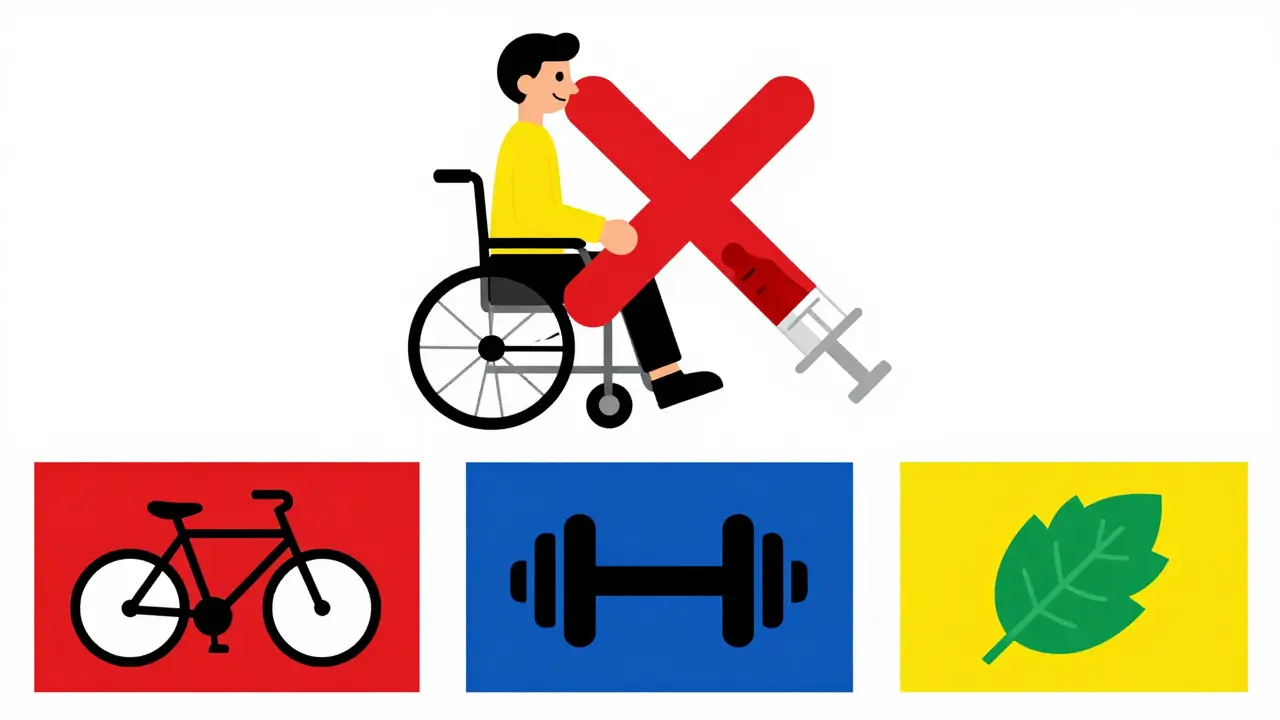
- Physical therapy: The most proven long-term solution. Strengthening muscles around the joint reduces pressure on it. Studies show PT is just as effective as cortisone for knee osteoarthritis-and lasts longer.
- Weight loss: Losing just 10 pounds cuts knee pain by 50% in overweight people.
- Low-impact exercise: Swimming, cycling, and walking help lubricate joints and improve mobility without tearing them down.
- Bracing or orthotics: For knees and feet, proper support can change how force travels through the joint.
- Anti-inflammatory diet: Reducing sugar, processed foods, and omega-6 fats can lower systemic inflammation.
These don’t give you instant relief. But they don’t come with a risk of tendon rupture either.
What’s New in 2025?
There’s one new option: Zilretta, an extended-release form of triamcinolone. It’s designed to slowly release the drug over 12 weeks. In trials, 45% of patients had meaningful pain relief for 3 months-compared to 24% with regular cortisone. It’s FDA-approved for osteoarthritis of the knee and costs about $1,200 per injection. Insurance often covers it if you’ve tried standard shots and still have pain.
But here’s the catch: even Zilretta doesn’t stop joint damage. And researchers are still watching whether long-term use leads to more cartilage loss.
Right now, the biggest innovation isn’t a new drug-it’s better patient selection. Doctors are learning to stop giving cortisone to people with advanced joint degeneration. Instead, they’re using it only for inflammatory flares, not as a crutch for worn-out joints.
Final Takeaway: Use It Wisely
Corticosteroid injections are powerful. They can get you back on your feet when nothing else works. But they’re not a long-term fix. If you’re getting them every few months for the same joint, you’re not treating the cause-you’re masking it.
Ask yourself: Is this shot helping me heal, or just helping me ignore the problem?
Use cortisone when you need quick relief from a flare. Then follow up with physical therapy, movement, and lifestyle changes. That’s the real path to lasting joint health.
Comments (8)
Marilyn Ferrera
December 31, 2025 AT 10:30
It’s not a cure-it’s a pause button. And we treat it like a subscription.
How many of us are just delaying the inevitable, hoping the pain will vanish if we ignore it long enough?
I’ve had three knee shots. Each one worked less. The fourth? I said no.
It’s not the shot that failed me-it’s the habit of reaching for it.
My body’s screaming. I finally stopped pretending the noise isn’t there.
And now? I walk. Slowly. Every day.
It’s not glamorous.
But it’s mine.
And it lasts.
Not because of a needle.
Because I listened.
Not once.
Every day.
That’s the real treatment.
And it’s free.
...if you’re willing to show up.
Robb Rice
January 2, 2026 AT 10:13
While I appreciate the thorough overview of corticosteroid injections, I must respectfully note that the assertion regarding diminishing returns after multiple injections is not universally supported by longitudinal clinical data-though anecdotal evidence, as cited, is compelling.
Moreover, the reference to the 2023 meta-analysis appears accurate, yet the interpretation may benefit from contextualizing the heterogeneity of study populations.
Additionally, the cost comparison between corticosteroids and PRP or stem cell therapies is valid, though the latter modalities are still under investigation for long-term structural modification, which may justify their higher price point in select cases.
Ultimately, the decision must be individualized, and shared decision-making remains paramount.
Harriet Hollingsworth
January 3, 2026 AT 13:48
So let me get this straight-you’re telling me doctors are just handing out poison like candy because it’s cheap?
And people are okay with that?
They don’t care that you’re literally eating your own joints alive for a few weeks of comfort?
It’s not just irresponsible-it’s evil.
And then they tell you to “try physical therapy” like it’s a suggestion and not a lifeline you ignored until your body broke.
Stop treating pain like a glitch to be patched.
It’s your body screaming.
And you’re silencing it with chemicals.
What’s next? Injecting your kids so they stop crying?
Wake up.
Deepika D
January 5, 2026 AT 02:52
Hey everyone, I just wanted to share my journey because I’ve been where you are-knee pain so bad I couldn’t play with my nephew, and I kept getting cortisone shots like they were magic bullets.
First shot: 8 weeks of relief. Second: 5 weeks. Third: 2 weeks and then a flare that had me on the floor for three days.
I thought it was normal.
Turns out, it wasn’t.
My physiotherapist, Rani, sat me down and said, “Deepika, you’re not healing-you’re hiding.”
So I started walking. Just 15 minutes a day.
Then yoga. Then swimming.
I lost 18 pounds.
And guess what? My knee doesn’t hurt anymore.
Not because of a needle.
Because I chose to move.
Not perfectly.
Not fast.
But consistently.
And you can too.
You don’t need expensive treatments.
You need to listen.
And show up.
Even on the days you don’t feel like it.
Especially then.
Love you all. Keep going.
❤️
Bennett Ryynanen
January 5, 2026 AT 15:48
Yeah, sure, ‘use it wisely’-that’s what they all say until they’re back in the office begging for another shot because they didn’t do the damn PT.
Look, I get it. Pain sucks.
But you don’t get to skip the work and still expect your body to hold up.
I’ve seen guys get five shots in a year and then blame the doctor when their knee gives out.
It’s not the shot.
It’s you.
Stop outsourcing your recovery.
Get off your ass.
Move.
And if you can’t, then find someone who’ll make you.
Because no needle fixes laziness.
And you know it.
Chandreson Chandreas
January 7, 2026 AT 06:41
Man, this post hit different.
I got my first cortisone shot last year after a bad hike.
Worked like a charm for 6 weeks.
Then I went back to hiking like nothing happened.
Guess what? Pain came back.
So I started biking instead.
Just 30 mins, 3x a week.
Now I don’t even think about the shot.
It’s not about the needle.
It’s about the rhythm.
Little steps.
Every day.
That’s the real magic.
And yeah, I still get the occasional flare.
But now I know how to ride it.
Not numb it.
Peace out.
🧘♂️
Darren Pearson
January 7, 2026 AT 08:16
The clinical utility of corticosteroid injections remains a cornerstone of musculoskeletal palliative care, particularly in the context of acute inflammatory arthropathies.
However, the pervasive overutilization of these interventions-particularly in degenerative joint disease-represents a systemic failure in the paradigm of pain management, wherein symptomatic relief is erroneously equated with therapeutic efficacy.
One must also consider the socioeconomic underpinnings of this trend: the commodification of medical interventions, coupled with patient demand for rapid resolution, has rendered long-term, non-pharmacological modalities-such as physical therapy and biomechanical re-education-economically and culturally marginalized.
It is not the corticosteroid that is flawed.
It is the system that permits its misuse.
And therein lies the true pathology.
Stewart Smith
January 9, 2026 AT 04:41
Wow. Eight comments already. And not one of them said ‘I got a shot and now I’m a yoga guru.’
Real talk: I got one last year. Felt amazing for three weeks.
Then I went back to sitting all day.
Now I’m back to square one.
Guess what? I’m not mad at the shot.
I’m mad at myself.
And honestly?
That’s the only thing that matters.