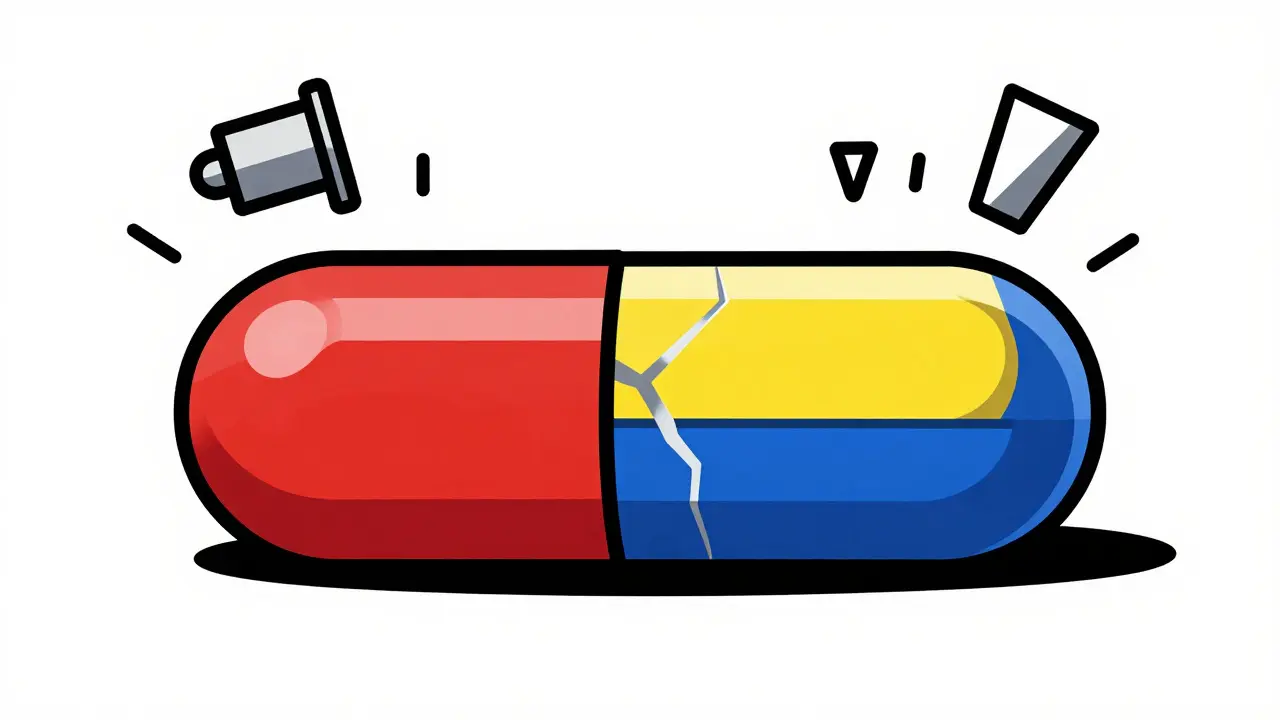
When you pick up a generic pill at the pharmacy, you expect it to work just like the brand-name version. But behind that simple tablet or capsule is a complex manufacturing process where small mistakes can lead to serious safety risks. Between 2019 and 2023, generic drugs had 3.2 times more quality defects than branded ones, according to FDA inspection data. These aren’t just cosmetic flaws-they’re failures that can change how a drug works in your body.
What Counts as a Manufacturing Defect?
A manufacturing defect happens when a drug doesn’t meet its own design specs during production. It’s not about the formula being wrong-it’s about how it was made. Common defects include:- Capping: The top or bottom of a tablet splits off during handling or swallowing. This happens when compression force exceeds 15 kN and moisture in the powder is below 2%, especially in hydrophobic ingredients.
- Lamination: Layers of the tablet separate like a sandwich. This occurs at turret speeds over 40 rotations per minute if pre-compression isn’t strong enough.
- Sticking: The drug material clings to the machine’s punch heads. This is common with active ingredients that melt below 120°C and are exposed to moisture above 4% during long production runs.
- Mottling: Uneven color patterns on the tablet surface. While it may look harmless, it often signals inconsistent mixing of ingredients.
- Weight variation: Tablets that are too heavy or too light. If granule flow rates drop below 0.5 g/s, batch uniformity fails-this affects 12.7% of defective oral solid batches.
- Particulate contamination: Tiny foreign particles in injectables. This is the top cause of recalls in sterile products, often from unclean equipment or poor environmental controls.
The FDA classifies these as critical (dose accuracy off by more than 5%), major (affects patient trust, like severe discoloration), or minor (acceptable with documentation). But even minor defects can signal bigger problems in the facility’s quality culture.
Why Do These Problems Happen So Often in Generics?
The answer isn’t just poor workers or bad equipment-it’s economics. Generic drugs make up 90% of prescriptions in the U.S. but only 23% of total drug spending. That means manufacturers are under intense pressure to cut costs.- Branded companies spend 15-18% of production costs on quality control. Generics average just 8-10%.
- Many generic plants use 20- to 30-year-old machinery that can’t meet modern precision standards. Tablet presses need punch length tolerances within ±0.05 mm. Older machines drift beyond that.
- Shared production lines increase cross-contamination risk. One facility might make antibiotics, then antihypertensives, then insulin-all without full cleaning between runs.
- Price competition pushes companies to use cheaper raw materials or reduce testing frequency.
These pressures show up in inspection data: 57% of generic manufacturing facilities failed FDA inspections in 2023, compared to 28% of branded ones. And 63% of generic recalls trace back to manufacturing defects-far higher than the 41% seen in branded drugs.
Which Generic Drugs Are Most at Risk?
Not all generics are equally vulnerable. Complex formulations are the weakest links:- Inhalers: 18.2% defect rate. Tiny dose inconsistencies can mean life-or-death differences for asthma or COPD patients.
- Modified-release tablets: 14.7% defect rate. If the coating fails or the drug releases too fast, you get side effects-or no effect at all.
- Injectables: 8.7% defect rate. Particulates or endotoxins can cause sepsis.
- Immediate-release tablets: 9.3% defect rate. Simpler, but still prone to weight variation and capping.
For example, a 2024 Reddit thread from pharmacists described batches of metformin ER tablets that crumbled during dispensing. Patients reported inconsistent effects from levothyroxine generics-even from the same manufacturer. These aren’t isolated complaints. The FDA’s MedWatch system logged 1,842 adverse events in 2023 directly tied to visible tablet defects like chipping, cracking, or discoloration.

How Do Manufacturers Try to Fix This?
Some companies are stepping up. The FDA’s 2022 Quality by Design (QbD) guidance requires manufacturers to map out their “design space”-the exact range of process variables that still produce safe, effective drugs. This means knowing how temperature, pressure, humidity, and speed interact.- In-line weight monitoring: Advanced systems reject tablets outside ±5% of target weight at speeds up to 1,200 tablets per minute.
- Automated visual inspection: Cameras detect defects as small as 0.1 mm. This cuts human error from 30% to under 2%.
- Continuous manufacturing: Instead of making drugs in batches, some companies now run production nonstop. The FDA’s Emerging Technology Program found this reduces defects by 65% compared to traditional batch processing.
- AI-powered quality control: Pilot programs at Sandoz and Dr. Reddy’s use machine learning to predict defects before they happen-achieving 92% detection accuracy versus 78% for traditional methods.
Training also matters. Staff need 40+ hours of GMP-specific instruction yearly, with proficiency tests showing 85%+ pass rates. Real-time data logging every 15-30 minutes during production helps catch drift before a whole batch is ruined.
What’s Being Done-and What’s Not
Regulators are pushing for change. The FDA issued 42% of its 2023 Warning Letters to generic manufacturers for manufacturing defects. The European Medicines Agency saw a similar rise. The 2024 Drug Supply Chain Security Act now requires track-and-trace for high-risk generics, cutting counterfeit-related issues by 22% in early trials.But the scale of the problem is staggering. The Generic Pharmaceutical Association estimates it would take $28.7 billion to upgrade all U.S. generic manufacturing facilities to modern standards. Right now, the industry spends just $1.2 billion a year. That gap isn’t closing.
McKinsey & Company predicts that without major investment, 15-20% of generic manufacturers may exit the market within five years-not because they’re bad, but because recalls and shortages are too costly to sustain.
What Patients and Providers Should Do
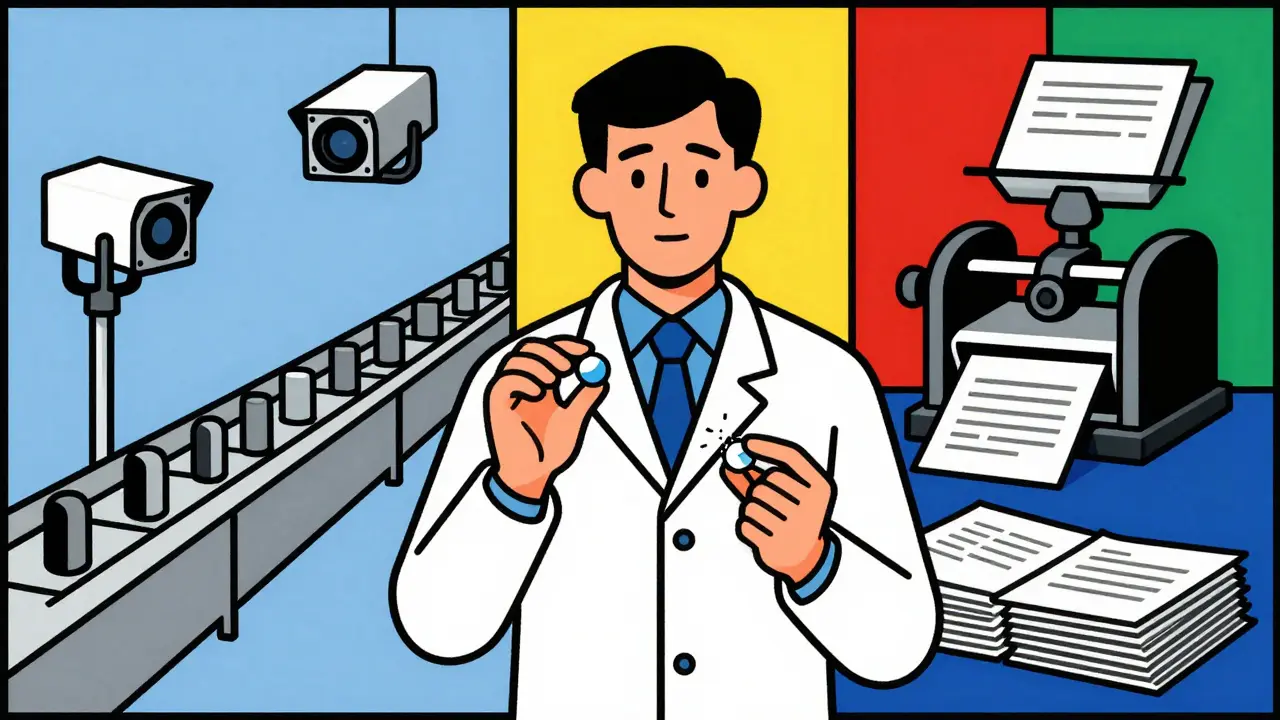
You can’t control the factory, but you can stay alert:- If your generic pill looks different-new color, shape, or texture-ask your pharmacist. It might be a different supplier, not a defect.
- If you notice a change in how a generic drug works (e.g., more side effects, less control of symptoms), report it to your doctor and file a MedWatch report.
- For critical medications like levothyroxine, warfarin, or seizure drugs, stick with the same manufacturer if possible. Switching suppliers increases risk of variability.
- Pharmacists: Document and report quality issues. A 2023 survey found 68% of pharmacists saw generic defects in the past year. Your reports help regulators act.
The system is designed to be safe-but it’s under strain. The goal isn’t to scare people away from generics. They save billions and make care accessible. But safety can’t be an afterthought. When a tablet cracks in your hand, it’s not just a flaw-it’s a warning sign.
Are generic drugs less effective than brand-name drugs?
No-when made correctly, generics are required by law to be bioequivalent to brand-name drugs. But manufacturing defects can interfere with that. A 2021 study found 7.3% of generic applications failed bioequivalence tests-not because the formula was wrong, but because inconsistent production led to variable absorption. The issue isn’t the science-it’s the execution.
Why do some generic pills look different from others?
Different manufacturers use different inactive ingredients (like dyes or binders), which can change the pill’s color, shape, or size. This is normal. But if you notice a sudden change in appearance-like cracking, mottling, or crumbling-after switching to a new batch, that’s not normal. It could signal a manufacturing problem.
Can defective generics cause serious harm?
Yes. Underdosing or overdosing due to weight variation can be dangerous-for example, too little levothyroxine can cause heart problems, while too much can trigger atrial fibrillation. Contaminated injectables have caused bloodstream infections and deaths. The FDA has issued multiple recalls for generic drugs with particulate matter, incorrect dosages, or microbial contamination.
How can I tell if my generic drug is defective?
Look for physical signs: tablets that crumble, split, have uneven color, or feel unusually soft or hard. Injectable solutions should be clear-cloudiness or visible particles are red flags. If you notice these, don’t take the medication. Contact your pharmacist or prescriber. You can also check the FDA’s recall database or report it through MedWatch.
Is it safer to stick with brand-name drugs?
Brand-name drugs have lower defect rates, but they’re far more expensive. For most people, generics are safe and effective. The key is consistency. If you’ve been stable on a specific generic brand, avoid switching unless necessary. If you’re on a critical medication like anticoagulants, epilepsy drugs, or thyroid hormones, talk to your doctor about whether sticking with one manufacturer is right for you.
What’s Next for Generic Drug Safety?
The FDA’s 2024-2027 plan aims to cut quality-related shortages by 30% through incentives for advanced manufacturing. More companies are adopting continuous processing and AI tools. But without a major increase in investment-from both industry and regulators-the gap between what’s possible and what’s practiced will keep growing.The bottom line: Generics are essential. But their safety depends on quality-not just cost. When a tablet fails, it’s not just a business problem. It’s a patient problem.
Comments (15)
gerard najera
January 2, 2026 AT 07:45
Generics aren't broken-they're starved.
Austin Mac-Anabraba
January 3, 2026 AT 01:25
The real scandal isn't the defects-it's that we've normalized pharmaceutical austerity as a public good. When a tablet cracks in your hand, it's not a manufacturing flaw-it's the sound of capitalism chewing through human biology and calling it 'efficiency.' We don't need more inspections; we need to dismantle the incentive structure that rewards corner-cutting over care.
jaspreet sandhu
January 5, 2026 AT 00:41
People act like this is new but it's been happening for decades. India and China make most generics now. You think they care about your thyroid levels? They care about profit margins. You want safe meds? Pay for the brand. Simple. No magic fix. No conspiracy. Just capitalism. Stop pretending this is a technical problem-it's a moral one you refuse to pay for.
Stephen Gikuma
January 6, 2026 AT 14:41
Who really owns the FDA? You think they're inspecting plants? Nah. They're on vacation in Bali while Chinese factories pump out pills with unmarked contaminants. This is all part of the globalist agenda to make Americans dependent on foreign meds. Next thing you know, your blood pressure pill will have a QR code that tracks your biometrics. Wake up. This isn't medicine-it's surveillance.
Bobby Collins
January 8, 2026 AT 08:20
i swear last month my generic adderall looked like it was made out of chalk and tasted like metal?? i thought i was going crazy but now i'm like... ohhh no wonder i felt like a zombie for two weeks 😭
Layla Anna
January 9, 2026 AT 05:25
My grandma takes levothyroxine and she noticed her pills changed color last refill-she didn’t say anything because she didn’t want to be a bother 😔 but now i’m gonna take her to the pharmacy tomorrow and demand answers. we owe it to the people who can’t fight for themselves. 💛
Heather Josey
January 10, 2026 AT 07:58
While the systemic issues are deeply concerning, we must not overlook the proactive steps being taken by forward-thinking manufacturers. The adoption of continuous manufacturing and AI-driven quality control represents not just innovation, but a moral imperative. We should support and incentivize these efforts-not retreat into cynicism. Safety is achievable, but only if we choose to invest in it.
Donna Peplinskie
January 11, 2026 AT 19:10
I just want to say, thank you to every pharmacist who speaks up when they see something off-even if no one else listens. You’re the quiet heroes keeping people safe. And to anyone reading this: if your pill looks weird, don’t take it. It’s not being dramatic. It’s being smart. ❤️
Olukayode Oguntulu
January 13, 2026 AT 17:50
The epistemological collapse of pharmaceutical governance is a microcosm of late-stage neoliberal decay: the commodification of biological integrity, where bioequivalence is reduced to a statistical artifact rather than a phenomenological reality. The tablet is not merely a vehicle for pharmacological intent-it is a semiotic rupture in the social contract between corporeality and capital.
Alex Warden
January 13, 2026 AT 21:28
China makes 80% of our pills and they don't give a damn. We let them take over because we're too lazy to make anything here anymore. Now we're paying with our lives. Time to bring manufacturing back to America. No more imports. No more excuses. This is national security.
LIZETH DE PACHECO
January 14, 2026 AT 13:52
My sister had a bad reaction to a generic seizure med last year. She didn’t know what to do until her pharmacist told her to call MedWatch. She did-and now the whole batch got pulled. You don’t have to be a doctor to make a difference. Just speak up. You might save someone’s life.
Lee M
January 14, 2026 AT 15:44
It's not about cost-it's about control. The system is designed to keep you dependent on cheap, unreliable medicine so you never question why you're always sick. The moment you start demanding consistency, the whole facade cracks. That’s why they silence pharmacists and bury reports. They don't want you to know how fragile this is.
Kristen Russell
January 16, 2026 AT 06:00
My dad’s on warfarin. He’s been on the same generic for 7 years. No changes. No issues. Generics aren’t the enemy. Complacency is. If it works, stick with it. If it doesn’t, speak up. Don’t assume the worst-but don’t ignore the signs.
Bryan Anderson
January 17, 2026 AT 14:15
Thank you for this detailed breakdown. The distinction between formulation and manufacturing defects is critical-and often misunderstood. Many assume generic = inferior, when in reality, the same formula can be safe or dangerous depending entirely on production rigor. This is a systems issue, not a product issue.
Matthew Hekmatniaz
January 18, 2026 AT 21:30
One thing I’ve learned working in community health: patients rarely report defects because they don’t know how-or they fear being dismissed. We need clearer pathways. A simple QR code on the bottle that links to a one-click MedWatch form. No forms. No jargon. Just tap and send. Small change. Big impact.