Most people don’t think about earwax until it starts hurting. That sticky, yellow-brown buildup can block your hearing, make your ear feel full, or even cause dizziness. And if you’ve ever stuck a cotton swab in there to fix it, you know it doesn’t work-and it can make things worse. The good news? You don’t need a doctor to fix most earwax blockages. Cerumenolytics are over-the-counter drops designed to soften earwax safely at home, and they work for the vast majority of people when used correctly.
What Are Cerumenolytics, Really?
Cerumenolytics are not magic. They’re simple chemical solutions that break down earwax (called cerumen) so it can drain out naturally or be flushed away with gentle irrigation. They’ve been around since the 1900s, but the ones you can buy today-like Debrox and Murine-got FDA approval in the 1980s. These aren’t just water or oil. They’re formulated with specific ingredients at precise strengths to be effective without damaging your ear.
There are four main types you’ll find on the shelf:
- Carbamide peroxide (6.5%) - breaks down into hydrogen peroxide and urea. This is what’s in Debrox and Murine. It fizzes, which helps lift wax out.
- Hydrogen peroxide (3%) - often diluted with equal parts sterile water. Works fast on wet, sticky wax.
- Mineral oil, baby oil, or olive oil - lubricates dry, hard wax. Slower but gentler.
- Baking soda solution (15%) - a DIY option. Mix ¼ teaspoon baking soda with 2 teaspoons sterile water.
Each has pros and cons. Carbamide peroxide is the most popular because it’s fast-acting. Oil-based options are safer if you have sensitive skin. Baking soda is cheap and effective, but you have to mix it yourself. And hydrogen peroxide? Only use it diluted. Straight from the bottle? That’s a recipe for burning.
When Should You Use Cerumenolytics?
Not every ear feeling full is earwax. But if you’ve noticed:
- Hearing sounds muffled, like you’re underwater
- A feeling of pressure or fullness in one ear
- Tinnitus (ringing) that started recently
- Itchy or slightly painful ear canal
...and you don’t have a history of ear infections, perforated eardrums, or recent ear surgery-you’re likely a good candidate for home cerumenolytics.
The American Academy of Otolaryngology says these drops should be your first step before irrigation or professional cleaning. Why? Because 65% of ear injuries treated in ERs come from cotton swabs. You’re not cleaning your ear-you’re pushing wax deeper. Cerumenolytics avoid that risk entirely.
Studies show about 6% of adults and up to 30% of seniors deal with earwax impaction. That’s millions of people who could use these drops safely. And with more people wearing in-ear headphones daily, the problem’s getting worse. ENT clinics in Seattle and beyond report a 22% jump in earwax cases since 2019.
How to Use Cerumenolytics Correctly (Step by Step)
Most people fail not because the drops don’t work-but because they use them wrong. Here’s how to do it right:
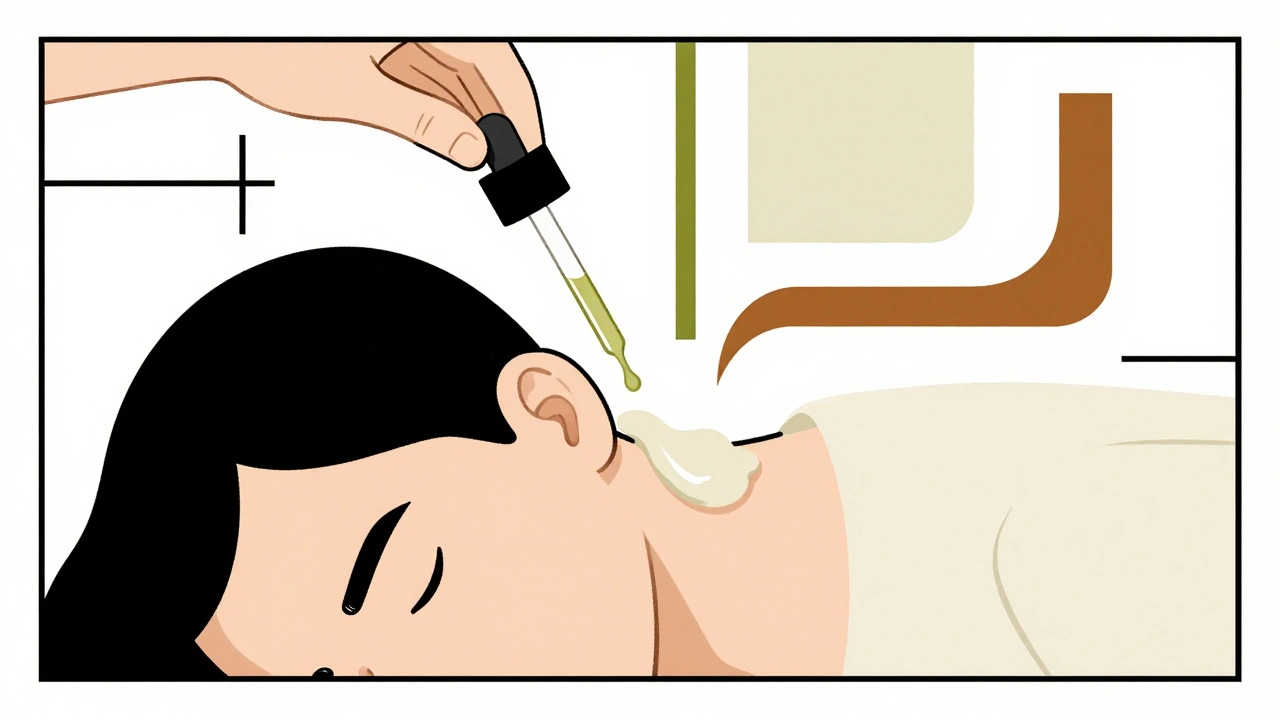
- Warm the drops - Hold the bottle in your hand for 1-2 minutes. Cold drops can cause dizziness.
- Lie on your side - With the affected ear facing up. This keeps the solution in place.
- Use the right amount - 5 to 10 drops, depending on the product label. Don’t guess.
- Stay still - Keep your head tilted for 5 to 10 minutes. This lets the solution soak in. Standing up too soon? You lose 40% of the effectiveness, according to Seattle Children’s Hospital.
- Drain gently - Sit up slowly. Let the liquid and loosened wax drip out. Use a tissue. Don’t poke or wipe inside the ear.
- Repeat daily - For 3 to 7 days. Don’t stop after one use. Wax doesn’t dissolve overnight.
After 3-4 days, try irrigating with warm (not hot) water using a bulb syringe. Only do this if you’ve used drops consistently. If you still feel blocked after a week, see a doctor.
Which Type Works Best?
There’s no single “best” cerumenolytic-but there are best uses.
| Type | Active Ingredient | Time to Work | Best For | Success Rate (Studies) |
|---|---|---|---|---|
| Carbamide peroxide | 6.5% carbamide peroxide | 1-2 days | Wet, sticky wax, first-time users | 65% |
| Hydrogen peroxide (diluted) | 3% H₂O₂ + 3% sterile water | 1 day | Wax with moisture, fast results | 60% |
| Mineral or olive oil | Plant or mineral oil | 3-4 days | Dry, hardened wax, sensitive skin | 58% |
| Baking soda solution | 15% sodium bicarbonate | 3-4 days | Low-cost option, DIY users | 62% |
Debrox and Murine dominate the market because they’re reliable. But if you’ve had irritation before, oil is your friend. A 2023 University of Washington study found that using oil for 3 nights, then one hydrogen peroxide irrigation, cleared 89% of cases-better than either alone.
And here’s a real tip from Reddit’s r/audiology: one user, u/AudiologyTech, used olive oil for five nights, then irrigated. Said he removed 90% of his wax. No doctor visit needed.
What NOT to Do
These mistakes are common-and dangerous:
- Don’t use undiluted hydrogen peroxide. One user on Amazon said it burned for 20 minutes. That’s not normal. Always dilute.
- Don’t use if you have an ear infection. Signs: pain, pus, fever, drainage. If you’re unsure, skip it. You could push infection deeper.
- Don’t insert anything into your ear canal. Not cotton swabs, not bobby pins, not dropper tips. The FDA says don’t go deeper than ¼ inch. Most people go way past that.
- Don’t irrigate if you’ve had ear surgery or a perforated eardrum. This isn’t a guess. If you’ve had tubes, a rupture, or reconstruction, you need a doctor.
- Don’t use tap water for irrigation. Mayo Clinic warns it can cause serious infections. Use sterile water or distilled water.
Also, don’t expect miracles if your wax is completely packed in. About 25% of home treatments fail because the wax is too hard. That’s when you need a professional with a suction tool or curette. It’s not failure-it’s knowing when to stop.
Why This Matters More Than You Think
Cerumen impaction isn’t just annoying. It’s expensive. In the U.S., 12 million doctor visits a year are for earwax. That costs $116 million. Most of those could be avoided with proper home care.
And it’s not just about hearing. Studies link untreated earwax blockage to balance issues in older adults, which increases fall risk. That’s huge for seniors. A simple bottle of drops can prevent a hospital visit.
The market for these products is growing fast-$287 million in 2022, and climbing. New formulas are coming, like Debrox Max, which releases wax-softening agents over longer periods. The FDA even approved a new combo solution in 2022: hydrogen peroxide with glycerin. That’s the first new active ingredient in 15 years.
What’s next? Personalized earwax care. Researchers are looking at whether your wax type (dry vs. wet) can tell you something about your overall health. It’s not sci-fi-it’s science.
Final Tips for Success
- Buy one bottle of carbamide peroxide (Debrox or Murine) and try it first. It’s the most tested.
- Keep a journal: note the day you started, how many drops you used, and how your ear felt each day.
- If you’re over 65, use oil for 4 days before irrigation. Older wax is harder to dissolve.
- Store drops in a cool, dry place. Heat can break down the active ingredients.
- Watch Mayo Clinic’s free video on YouTube: “Earwax Removal: How to Do It Safely.” It’s 10 minutes and shows exactly how to position your head.
Most people who follow these steps see improvement within 2-3 days. Full clearance? Usually by day 5. And if you don’t? That’s your sign to see an ENT. Not because you failed-but because you did everything right and still need help. That’s smart, not weak.
Can I use baby oil to soften earwax?
Yes, baby oil is safe and effective for softening dry, hardened earwax. Use 3-6 drops in the affected ear before bed for 3-4 nights. Lie on your side for 10 minutes after each application. Baby oil is gentler than peroxide and doesn’t cause bubbling, making it ideal for sensitive ears or children. It won’t work as fast as carbamide peroxide, but it’s less likely to irritate.
How long should I leave earwax drops in my ear?
Leave the drops in for 5 to 10 minutes each time. This gives them time to penetrate and soften the wax. Standing up too soon wastes the treatment. Studies show patients who stayed still for 10 minutes had 40% better results than those who didn’t. Set a timer if you need to.
Are earwax drops safe for kids?
Yes, but use only oil-based drops like mineral oil or baby oil for children under 12. Avoid carbamide peroxide and hydrogen peroxide unless directed by a pediatrician. Kids’ ear canals are smaller and more sensitive. Always follow Seattle Children’s Hospital’s guidelines: 3-6 drops, once daily, for 3-4 days. Never irrigate a child’s ear at home without medical advice.
Can I use cerumenolytics if I have ear tubes?
No. If you have ear tubes (tympanostomy tubes), do not use any ear drops unless your ENT doctor specifically says it’s safe. These tubes create a direct path to your middle ear. Introducing liquids or chemicals can cause infection or damage. Always consult your doctor before using any home treatment if you’ve had ear surgery or tubes.
Why do my ears feel worse after using earwax drops?
It’s usually temporary. As the wax softens and moves, it can temporarily block the canal more or irritate the skin. This often happens on day 2 or 3. If you feel pain, dizziness, or discharge, stop using the drops. These could be signs of an infection or perforation. Don’t push through discomfort. See a doctor if symptoms last more than 24 hours after stopping treatment.
What to Do If It Doesn’t Work
If you’ve used cerumenolytics for a full week and still feel blocked, it’s time to see a professional. An ENT or audiologist can:
- Look inside your ear with a magnifying scope
- Use gentle suction or a curette to remove the wax
- Check for other issues like swimmer’s ear or a perforation
Don’t try to force it. No tool at home can match the precision of a doctor’s tools. And if you’ve been using cotton swabs for years, you might have impacted wax that’s been pushed deep. That needs professional removal.
Remember: cerumenolytics aren’t a cure-all. But they’re the safest, cheapest, and most effective first step. For most people, they’re all you’ll ever need.
Comments (15)
Lara Tobin
December 13, 2025 AT 17:53
I used Debrox last week after my ear felt like it was stuffed with cotton. Just 3 days and boom-like someone pulled a plug. I cried. Not from pain, from relief. 😭
Keasha Trawick
December 14, 2025 AT 11:45
Let’s be real-carbamide peroxide is the MVP of cerumenolytics. The fizz? That’s not just theater, that’s physics in action. Hydrogen peroxide’s 3% dilution is the sweet spot-too strong and you’re summoning the ear demons. Olive oil? That’s the grandma method. Slow. Sacred. Effective.
Bruno Janssen
December 14, 2025 AT 22:24
I tried the baking soda thing. Felt like my ear was full of sand. Then I cried in the shower. Why does this happen to me?
Scott Butler
December 16, 2025 AT 09:22
You people are too soft. Back in my day, we used a hairpin and a flashlight. No drops. No fuss. If you can’t handle a little wax, maybe you shouldn’t be listening to music at all.
Deborah Andrich
December 17, 2025 AT 05:35
I’m 71 and I use olive oil every Sunday night. No drama. No fizz. Just peace. My grandkids think I’m weird but I hear the birds again. That’s worth more than any bottle of chemicals. Don’t overthink it. Just be gentle.
Richard Ayres
December 17, 2025 AT 20:36
The data presented here is statistically robust and aligns with current clinical guidelines from the AAO-HNS. It is noteworthy that the success rate of carbamide peroxide exceeds that of irrigation alone, which supports its role as a first-line intervention. Further, the temporal correlation between increased headphone usage and wax impaction is a compelling epidemiological trend.
Rawlson King
December 18, 2025 AT 14:25
This is why America is falling apart. You’re all too scared to just clean your ears like normal people. Canada uses saltwater rinses. Simple. No chemicals. No marketing. Just common sense.
Tyrone Marshall
December 19, 2025 AT 09:51
I used to think earwax was just dirt. Then I learned it’s actually a natural lubricant and antimicrobial shield. The body makes it for a reason. You’re not ‘cleaning’ your ear-you’re helping it out of a jam. That’s why oil is the quiet hero here. It doesn’t fight the body. It teams up with it.
Emily Haworth
December 19, 2025 AT 10:42
I heard the government put tracking chips in earwax drops. That’s why they’re so cheap. They’re watching you through your ear canal. 😳👁️👂
Tom Zerkoff
December 20, 2025 AT 18:43
The protocol outlined in this post adheres to evidence-based otolaryngological standards. It is imperative to emphasize that the use of sterile, non-pyrogenic solutions for irrigation is non-negotiable. Tap water introduces gram-negative pathogens such as Pseudomonas aeruginosa, which can lead to malignant otitis externa-a potentially fatal condition in immunocompromised individuals.
Yatendra S
December 21, 2025 AT 10:54
Earwax is not waste. It is the soul’s residue. In Vedic texts, it is said that the ear is the gateway to the mind, and the wax is the ink of your thoughts. To remove it violently is to erase your inner voice. Oil is meditation. Let it sit. Let it speak.
Himmat Singh
December 22, 2025 AT 09:33
Your entire premise is flawed. The FDA approval of cerumenolytics in the 1980s was a corporate maneuver to replace physician visits. Studies funded by pharmaceutical companies show inflated success rates. Real medicine is manual removal. Everything else is placebo with a label.
kevin moranga
December 22, 2025 AT 16:05
I was skeptical but I tried the oil thing-just 3 nights of baby oil before bed. Lying there like a sleepy turtle. And guess what? My ear felt like a balloon popped. No drama. No burning. Just quiet. I told my mom and now she’s doing it too. We’re like earwax whisperers now. 🙌
Alvin Montanez
December 24, 2025 AT 00:51
People who use ear drops are just too lazy to get a real doctor. You think this is safe? You’re letting some chemist in a lab decide what goes in your body. And then you brag about it on Reddit like you’re some kind of health guru. You’re not healing yourself-you’re surrendering to corporate medicine. And you call that wisdom?
Webster Bull
December 25, 2025 AT 15:47
just use oil. no cap. 3 nights. done. 🤘