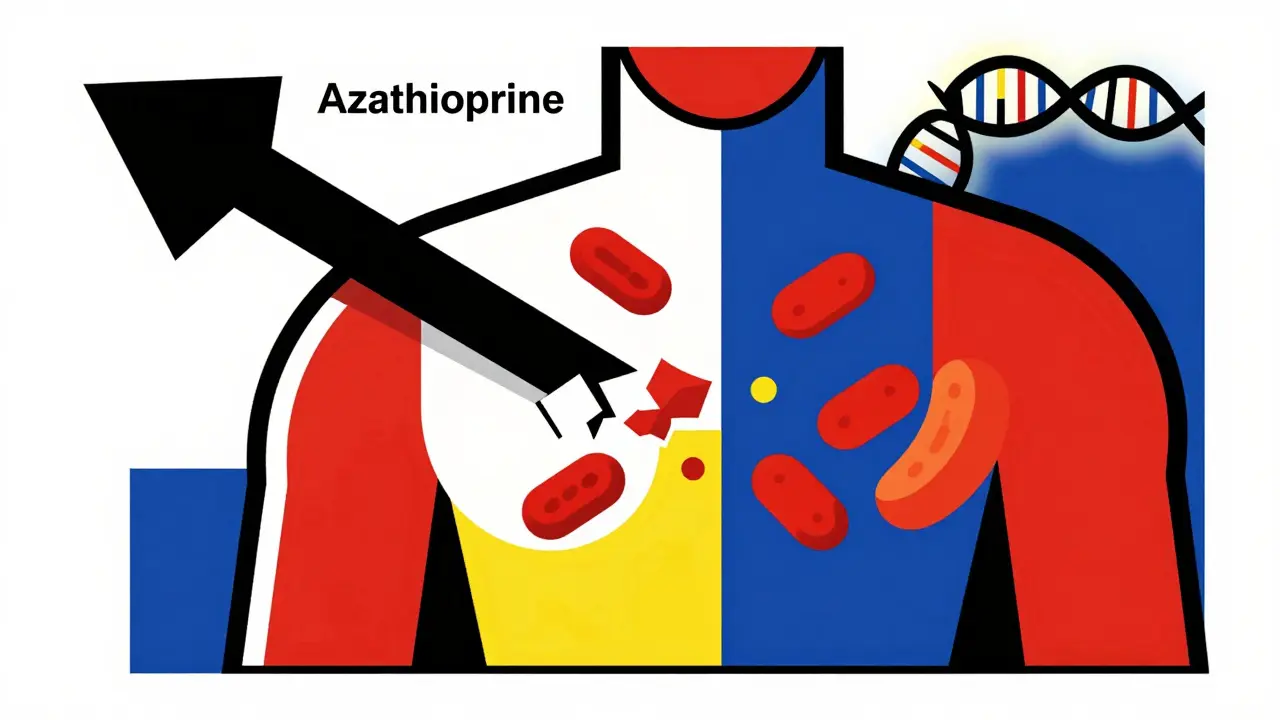
Azathioprine Safety Calculator
How This Tool Works
Enter your TPMT enzyme activity results and genetic test results below to understand your risk of severe side effects when taking azathioprine. This calculator helps you and your doctor determine the safest starting dose for your unique biology.
Measured in red blood cells (normal range: 15-60)
When you’re prescribed azathioprine for Crohn’s disease, lupus, or after a transplant, your doctor isn’t just picking a drug-they’re making a bet on your body’s ability to handle it. Most people tolerate it fine. But for a small number, this common immunosuppressant can trigger a silent, deadly crash in blood cell production. That’s where TPMT testing comes in-not as a luxury, but as a necessary safety check.
Why Azathioprine Can Be Dangerous
Azathioprine has been used for over 60 years. It’s cheap, effective, and often the only affordable long-term option for autoimmune diseases. But here’s the catch: your body doesn’t process it the same way as your neighbor’s. The drug breaks down into active compounds that suppress your immune system. Too much, and it starts killing your bone marrow. That means your white blood cells, red blood cells, and platelets plummet. The result? Severe infections, extreme fatigue, uncontrolled bleeding-even death. About 15% to 28% of people on azathioprine experience side effects. Nausea is common. But the scary part? The most dangerous reactions aren’t predictable by symptoms. They come out of nowhere. And they’re tied to your genes.What Is TPMT, and Why Does It Matter?
TPMT stands for thiopurine methyltransferase. It’s an enzyme that breaks down azathioprine into harmless pieces. If your TPMT enzyme is working normally, you’re fine. But if you inherit two broken copies of the gene (homozygous deficiency), your body can’t process the drug at all. About 1 in 300 people fall into this category. For them, even a standard dose can cause life-threatening bone marrow failure within weeks. Then there’s the middle group-about 10% of Americans. They have one working copy and one broken copy (heterozygous). Their TPMT activity is reduced. They’re not in immediate danger, but they’re at higher risk of low blood counts if given a full dose. Most doctors miss this. They see a normal lab result and assume the patient is fine. But without adjusting the dose, many of these people end up in the hospital.The Real Power of TPMT Testing
TPMT testing isn’t about avoiding azathioprine. It’s about using it safely. The test looks at your DNA to find common gene variants like *2, *3A, *3B, and *3C. Or it measures enzyme activity directly in your red blood cells. Either way, the goal is simple: match the dose to your biology. If you’re homozygous deficient (two bad copies)? Don’t take azathioprine. Use methotrexate or another drug instead. The risk of pancytopenia is too high. If you’re heterozygous (one bad copy)? Start at 30% to 70% of the normal dose. Monitor your blood counts every week for the first month. Most patients do fine with this adjusted approach. One IBD patient in a 2022 study said, “I was on 100 mg. My doctor lowered it to 50 mg after my TPMT test. My white blood cells stayed stable. My friend, who skipped testing, had to quit after her counts crashed.”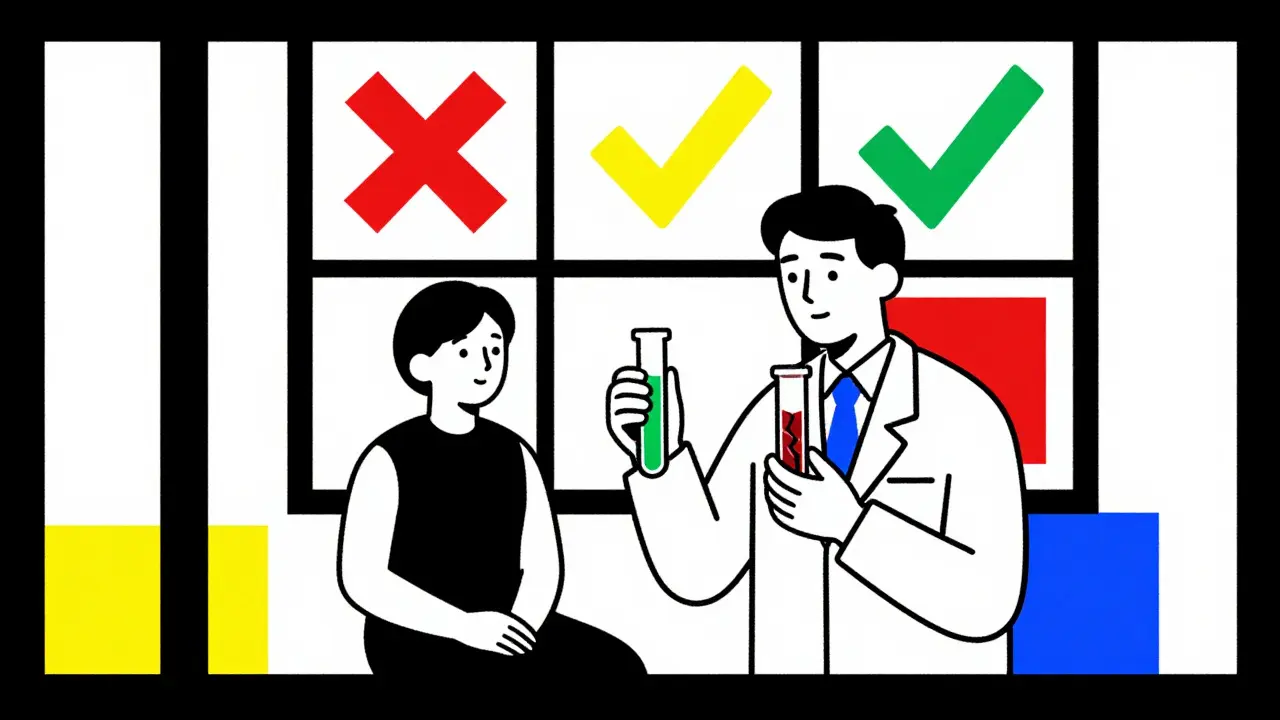
But Testing Isn’t Perfect
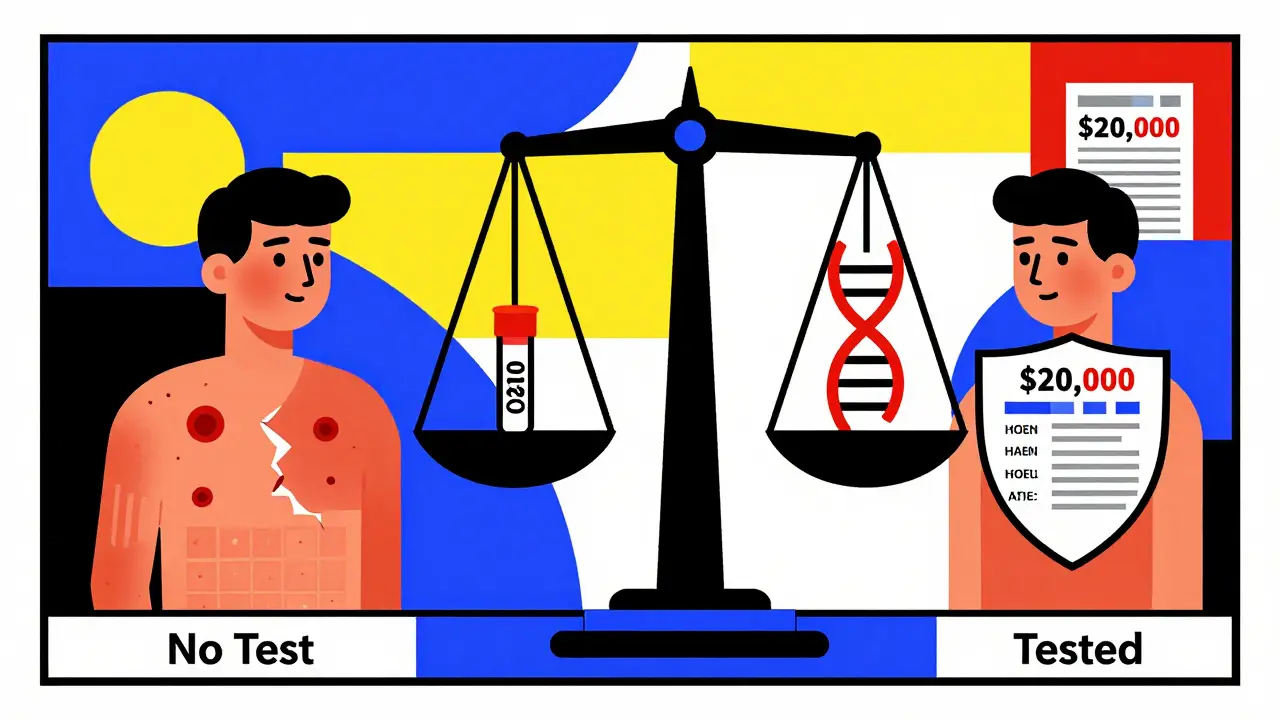
Here’s the uncomfortable truth: TPMT testing doesn’t catch everything. A 2011 JAMA study tracked 333 patients. Half got tested. Half didn’t. After four months, the rate of side effects was nearly identical: 29% vs. 28%. Why? Because TPMT explains only part of the story. Other genes matter too. NUDT15 is a big one-especially for people of Asian descent. Up to 20% of this population has variants that make them extra sensitive to azathioprine. If you’re not tested for NUDT15, you could still have a bad reaction-even with normal TPMT. And then there are drug interactions. Allopurinol (used for gout) blocks the same pathway as TPMT. Even if your genes are fine, taking both drugs can cause severe toxicity. ACE inhibitors, certain antibiotics, and even high-dose aspirin can interfere. Your liver and kidneys also play a role. If they’re not working well, the drug builds up. One Reddit user wrote: “My TPMT was normal. I still got liver damage. Turns out, I was on an antibiotic that messed with the metabolism. Testing didn’t help me.”What You Need to Do Before Starting Azathioprine
You can’t rely on guesswork. Here’s what actually works:- Get tested for both TPMT and NUDT15 before your first dose. Many labs now offer combined panels.
- Ask for a baseline complete blood count (CBC) and liver enzyme test. You need this before and after starting.
- If you’re on allopurinol, tell your doctor. You may need a different drug entirely.
- For heterozygous patients: start low, go slow. Weekly CBC checks for the first month are non-negotiable.
- Watch for signs: unexplained bruising, fever, sore throat, fatigue, or yellowing skin. These aren’t “just side effects”-they’re warnings.
Comments (15)
Jazminn Jones
March 9, 2026 AT 23:13
The fundamental flaw in contemporary pharmacogenomic implementation is the romanticization of genetic determinism as a panacea. TPMT testing, while statistically significant, represents a reductionist framework that ignores the epistemic complexity of drug metabolism. The 2011 JAMA study you cite is not an indictment of TPMT-it is a revelation of the inadequacy of single-gene models in polygenic systems. To presume that NUDT15 is the next logical variable is to commit the same epistemological error on a larger scale.
Pharmacogenomics must evolve beyond SNP-centric dogma and integrate dynamic biomarkers: transcriptomic profiles, gut microbiome modulation of drug activation, and real-time metabolomic feedback loops. Relying on static DNA snapshots is akin to navigating the Atlantic with a 17th-century sextant.
The FDA's 2019 label update is performative, not prophylactic. It satisfies regulatory optics without mandating clinical infrastructure. What use is a test if 80% of community clinics lack the infrastructure to interpret it? The real crisis is not genetic variability-it is institutional neglect masquerading as scientific progress.
rafeq khlo
March 10, 2026 AT 11:52
People think genetics solves everything but you still need to monitor blood counts no matter what your genes say
My cousin took azathioprine with normal TPMT and still got liver failure because he was also on trimethoprim
Doctors dont care they just want to prescribe and move on
Its all about money not science
Stephen Rudd
March 10, 2026 AT 11:56
You call this medicine? A 60-year-old drug still being used because it's cheap while we have biologics that don't require genetic roulette? This isn't personalized medicine-it's genetic gambling with a side of bureaucratic inertia.
The fact that we're still debating whether to test for TPMT in 2024 is a national disgrace. We have CRISPR labs and quantum computers but can't get a $200 genetic test into rural clinics? The system isn't broken-it was designed this way.
And don't get me started on NUDT15. You think this is the end? There are at least seven other genes in the thiopurine pathway that are completely unregulated, unmonitored, and unacknowledged by guidelines. We're treating patients like lab rats with half the data.
Stop calling this progress. This is triage with a PhD.
Erica Santos
March 10, 2026 AT 21:50
Oh wow, a drug that can kill you if you don't get a $400 test before taking it? How very 2024. Tell me again why we're not just using prednisone and calling it a day?
Let me guess-next they'll require a personality assessment before prescribing ibuprofen. "Sorry, Mr. Johnson, your neuroticism score indicates you're likely to misinterpret mild nausea as "bone marrow failure.""
It's not medicine anymore. It's a subscription service for paranoia.
George Vou
March 11, 2026 AT 22:45
so like if u have the bad gene u just cant take the drug? what do u do then? pay 20k for a hospital trip? lol
my bro took this for crohns and his doc never tested him and he got real sick
now he's on some fancy biologic that costs 100k a year
so the system just makes u pay more later
they dont care if u live or die as long as u pay
Scott Easterling
March 13, 2026 AT 19:44
Why are we still using azathioprine? It's 2024. We have monoclonal antibodies that are 100x safer, 10x more effective, and don't require a genetics degree to prescribe.
And yet... here we are, still testing for TPMT like it's 1998. Why? Because the pharmaceutical industry doesn't profit from a $20 generic drug. They profit from $12,000/month biologics. The test isn't to save lives-it's to justify the upgrade.
Don't believe me? Look at the patent expiration dates. The timeline matches perfectly.
This isn't science. It's capitalism in a lab coat.
Mantooth Lehto
March 15, 2026 AT 15:28
I had to fight my insurance for 6 months just to get the TPMT test done
They said "it's not medically necessary"
My doctor was like "eh, you'll be fine"
Turns out I'm heterozygous
My WBC dropped to 1.8
I was in the ER for 3 days
Now they want me to pay $1500 for the hospital bill
Thanks for nothing, healthcare system
😭
Melba Miller
March 16, 2026 AT 08:09
Why are we letting the U.S. healthcare system dictate who lives and who dies based on their zip code?
Europe tests 80% of patients. We test 20% in rural areas.
That’s not a gap in care. That’s a death sentence for poor people.
And don’t tell me about "insurance coverage"-I’ve seen people denied because their plan "doesn’t include pharmacogenomics."
It’s not about genetics.
It’s about class.
And if you think this is just about Crohn’s disease-you’re wrong.
This is the blueprint for how America kills its sick.
Katy Shamitz
March 17, 2026 AT 23:17
I just want to say thank you to the doctors who push for these tests. I know it takes extra time, extra paperwork, extra fights with insurance.
I’m a nurse, and I’ve seen patients come in with zero symptoms-then crash within days.
One patient, 24 years old, had normal TPMT but low NUDT15. We caught it early. She’s now on a modified dose and back at work.
It’s not perfect. But doing something? Even if it’s messy? That’s what saves lives.
Keep pushing. You’re not alone.
Ray Foret Jr.
March 19, 2026 AT 21:18
So if I got tested and my TPMT is fine, I'm good to go right? 😊
Wait no-now I need NUDT15 too?
And also check my liver?
And avoid allopurinol?
And do weekly blood tests?
And wear sunscreen?
And pray?
Okay I'll just take the biologic that costs $10k/month. At least I know what I'm getting into.
Thanks for the info! 🙏
Samantha Fierro
March 20, 2026 AT 09:30
There is a profound ethical imperative here that transcends clinical guidelines. The fact that a life-saving genetic test is treated as optional-when its cost is less than a single hospitalization-is not an oversight. It is a moral failure of the medical-industrial complex.
Every time a clinician says, "We don’t have time," or "It’s not standard," they are choosing convenience over consent.
Patients deserve autonomy grounded in evidence-not luck.
Advocating for testing is not being difficult. It is being human.
And if your doctor resists? Ask for a genetics consult. Demand a pharmacist review. Bring a printed copy of the FDA label. You are not asking for a favor. You are claiming your right to safe care.
Robert Bliss
March 22, 2026 AT 08:08
Man I didn't know this stuff was so complicated
I thought if your doctor says take it, you take it
Now I'm scared to even take aspirin
But I'm gonna ask for the test next time
Thanks for laying it out
Hope everyone gets to stay healthy
Peter Kovac
March 23, 2026 AT 14:10
The notion that TPMT testing is a "necessary safety check" is empirically misleading. The statistical risk reduction is marginal when viewed in the context of overall azathioprine usage. The absolute risk of severe toxicity in untested populations remains below 1% in most cohorts.
Furthermore, the cost-benefit analysis fails to account for the downstream effects of false positives: unnecessary discontinuation of effective therapy, increased use of more expensive alternatives, and iatrogenic anxiety.
Universal testing is not evidence-based-it is risk-averse dogma dressed in genomic garb.
Monitoring CBCs remains the gold standard. All else is noise.
APRIL HARRINGTON
March 23, 2026 AT 16:29
MY BEST FRIEND DIED FROM AZATHIOPRINE
SHE WAS 29
SHE HAD CROHNS
SHE DIDN'T GET TESTED
THEY SAID "IT'S RARE"
IT WASN'T RARE FOR HER
HER KID IS 4 NOW
NO ONE TOLD HER
NO ONE TOLD US
WE NEED TO CHANGE THIS
Leon Hallal
March 24, 2026 AT 05:20
So if I have normal TPMT but my liver is junk from drinking… am I still safe?
What if I’m on antibiotics?
What if I’m just unlucky?
Why is this so complicated?
Why can’t they just make a better drug?
I’m tired of being a lab rat